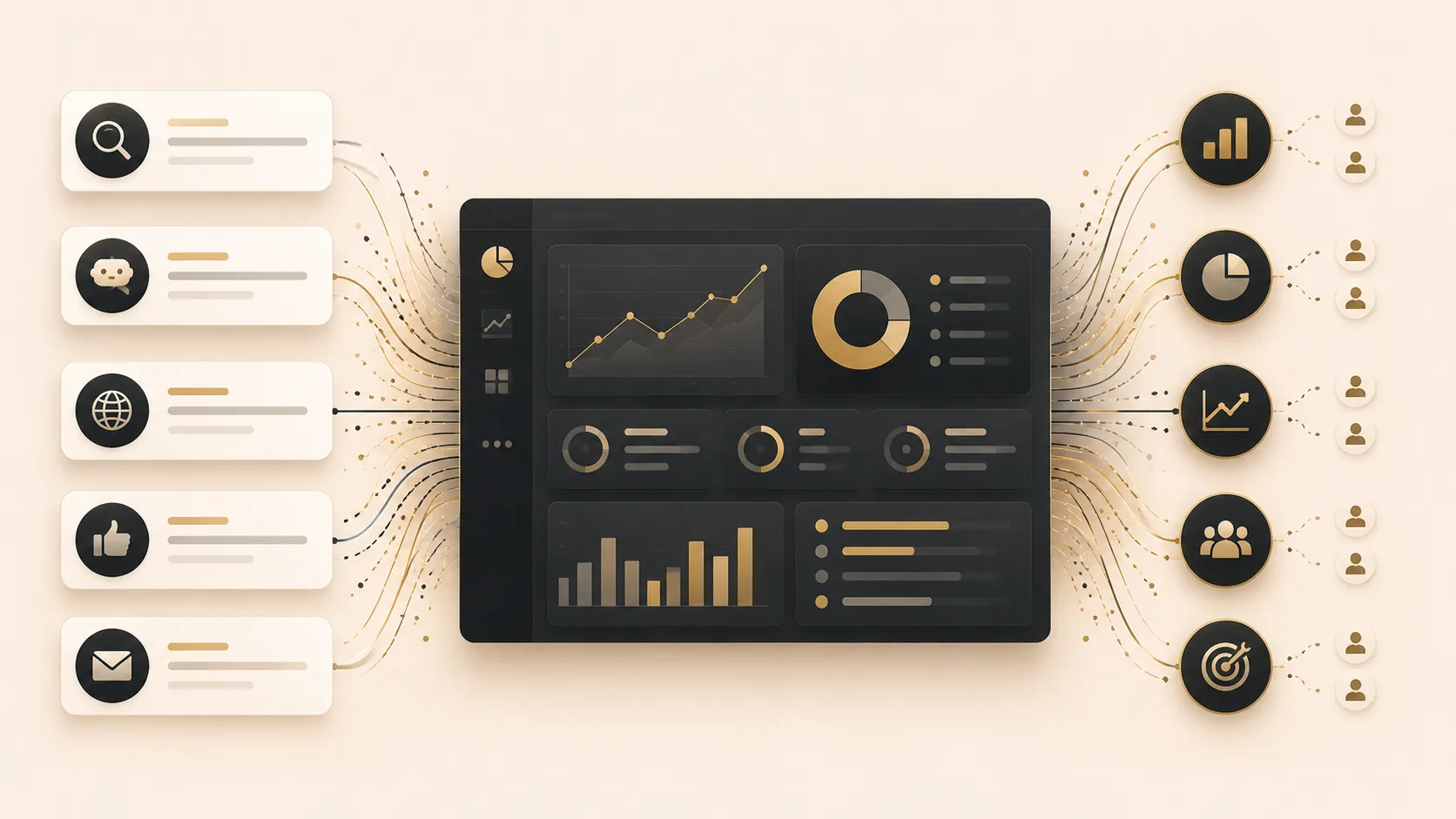

Enterprise teams measuring discoverability usually watch traditional search, AI Overviews, and social in three separate tools, with no single view of how they interact. The result is reporting without insight: rankings rise in one dashboard while AI citations fall in another, and nothing connects the two. No single platform covers all three channels at maximum depth, so the practical question is which approach gets closest to one view with the fewest trade-offs. A presence engine such as CLEO is one option, unifying SEO, AI citation tracking, and social listening with the Citation Loop connecting data across channels.
This guide gives an evaluation checklist, maps the available approaches, and shows where a presence engine fits.
Why do enterprise teams need a unified dashboard for search, AI, and social?
The fragmentation is operational, not theoretical. When search data lives in one platform, social data in another, and AI citation data in a third, three things break. Reporting takes days to assemble manually. Correlations between channels go undetected - nobody sees whether rising social mentions correspond to improved AI citations. And strategy becomes channel-siloed because each tool optimises its own metric in isolation. The compounding effect, where activity in one channel reinforces presence in others, can only be measured when the data is connected. For B2B teams, this fragmentation is where most AI search visibility diagnostics begin.
What should you evaluate first? A checklist
- Cross-channel coverage in one view. Does it track traditional search, AI overview presence (ChatGPT, Google AI Overviews, Perplexity, and ideally Claude), and social in the same place?
- Correlation, not just collection. Can it show whether a change in one channel moves another - for example, whether social activity precedes AI citation gains?
- Competitive benchmarking across surfaces. Can you see citation share, win rate, and position relative to named competitors, not just your own numbers?
- Historical trend tracking. Does it retain enough history to show direction and confidence, not a single snapshot?
- Action, or only measurement? Does the platform act on what it finds (content fixes, production, workflow) or simply report it?
- Reporting cadence and customisation. Enterprise teams often need weekly, monthly, or on-demand and white-label reporting scoped to the engagement.
What approaches exist, and what do they trade off?
| Approach | Examples | Strengths | Limitations |
|---|---|---|---|
| Point solutions (per channel) | SEO platform + social analytics + AI monitor | Deep per-channel capability | Three dashboards; no cross-channel correlation |
| Marketing cloud | HubSpot, Salesforce Marketing Cloud | CRM integration, partial unification | Limited AI visibility; not built for GEO metrics |
| Custom dashboard | Looker Studio, Tableau, Power BI + APIs | Full flexibility, custom metrics | Engineering investment; reports but does not act |
| Presence engine | CLEO | Search + AI + social in one loop with feedback | Less per-channel depth than specialised tools |
How does CLEO measure up against the checklist?
Mapped onto the six checklist items, here is what CLEO provides from its in-app dashboards. Cross-channel coverage: Search surfaces keyword ranking, crawl stats, and performance; AI Search surfaces the GEO Score (8 metrics) and AI-engine visibility across ChatGPT, Google AI Overviews, Perplexity, and Claude; Social surfaces mentions, sentiment, and influencer tracking. Correlation: the Citation Loop maps social activity to AI-citation data. Competitive benchmarking: win rate, citation share, position, and threat tiers against named rivals. Historical trend and confidence come from measurement with Wilson intervals, and the Enterprise tier adds bespoke white-label reporting and a dedicated account manager for the reporting-cadence item.
The worth is in the connections between channels, not the depth of any one. That is documented rather than theoretical: running the same connected loop, DisburseCloud lifted AI citation share from 17% to 67% in 90 days at 95% Wilson confidence, and CLEO now operates the dashboards across 300+ sites in 8 countries. The trade-off is deliberate - integration across surfaces in place of maximal depth in a single one.
Frequently asked questions
Is there one dashboard that tracks search, AI overviews, and social?
No platform covers all three at maximum depth. CLEO provides in-app dashboards spanning SEO, GEO, and Social. Custom dashboards via Looker Studio or Tableau offer flexibility with engineering investment. Most teams currently use separate tools.
What should we look for first?
Cross-channel data in one view, correlation between channels, competitive benchmarking, historical trends, and whether the platform acts or only reports.
Build or buy?
Custom dashboards maximise flexibility but require engineering and only report. A presence engine like CLEO provides out-of-box cross-channel reporting and acts on the findings. Decide based on engineering capacity and whether you need the dashboard to drive change.
How does CLEO connect the channels?
The Citation Loop connects social activity data to AI citation data from the GEO engine, so you can see whether social engagement correlates with changes in AI citation presence - the cross-channel correlation separate tools miss.
Put your channels on one page. A scan at regencleo.ai/scan returns search, AI answer, and social standing for a domain in a single view - a quick read on what a unified dashboard would consolidate. For enterprise reporting scope, regencleo.ai/book opens a walkthrough.