About The Field Notes - CLEO by RegenAI
The Field Notes is the working journal of the CLEO Presence Growth Engine, published by RegenAI. It covers the theory and practice of building compounding brand presence in the AI search era - from the technical architecture of AI readability to the strategic decisions behind closed-loop content systems.
Generative Engine Optimisation (GEO)
GEO is the discipline of structuring content and brand signals so that large language models extract, cite, and recommend your brand when users ask relevant questions. Unlike traditional SEO, GEO is not about keyword ranking - it is about being cited in the AI-generated answers that are replacing ten blue links as the primary interface for information retrieval. The Field Notes covers GEO strategy, content structuring techniques, entity signal building, and the monitoring approaches that tell you whether your GEO work is translating into actual citations.
AI Citation Monitoring
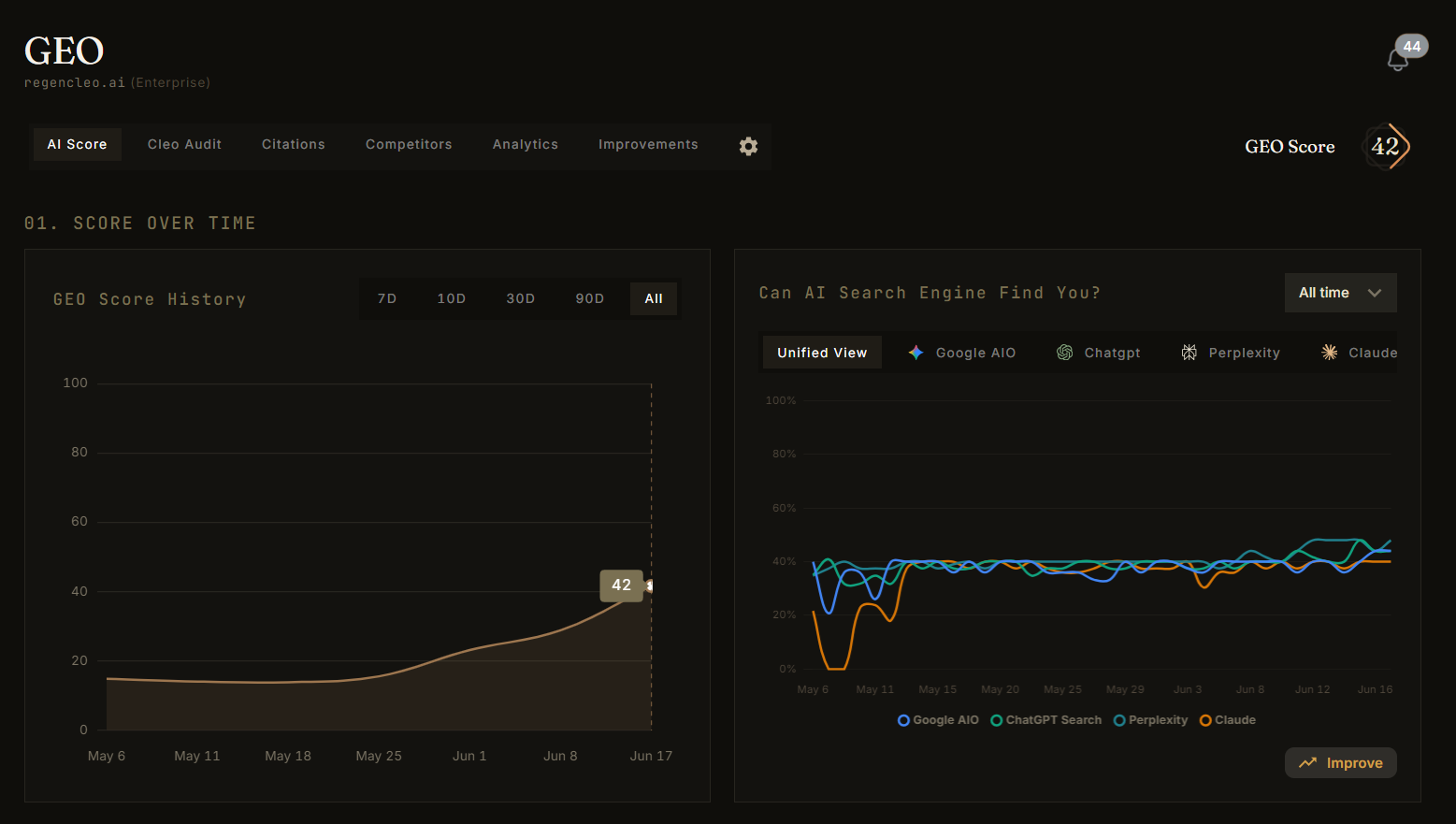
Monitoring AI citations means tracking how often and how accurately your brand appears in responses from ChatGPT, Perplexity, Google AI Overviews, and Claude by Anthropic. The Field Notes documents what citation monitoring reveals about brand authority, how citation gaps are identified, and how content strategy should respond to monitoring data.
Closed-Loop Brand Presence
A closed-loop system routes the output of each layer back into the input of the next. Monitoring identifies citation gaps. Content targets those gaps. Social amplification reinforces content authority. Monitoring validates whether citations improved. The loop runs again with better data. The Field Notes explains why integration across these layers is the architecture that produces compounding results rather than isolated improvements.
Structured Data and AI Readability
JSON-LD schema markup, robots.txt configuration for named AI bots, llms.txt and llms-full.txt implementation, canonical link management, and content density optimisation are the technical foundations of AI readability. The Field Notes covers how these elements are implemented, validated, and measured using the AI Readability Score (ARS) framework - a six-component diagnostic that evaluates crawler access, JavaScript rendering, structured data, content quality, content size, and LLM accessibility.
What is The Field Notes?
The Field Notes is the working journal of the CLEO Presence Growth Engine, published by RegenAI. It covers the theory and practice of building compounding brand presence in the AI search era, from the technical architecture of AI readability to the strategic decisions behind closed-loop content systems.
What is Generative Engine Optimisation (GEO)?
GEO is the discipline of structuring content and brand signals so that large language models extract, cite, and recommend your brand when users ask relevant questions. Unlike traditional SEO it is not about keyword ranking, it is about being cited in the AI-generated answers that are replacing ten blue links as the primary interface for information retrieval.
How does AI citation monitoring work?
Monitoring AI citations means tracking how often and how accurately your brand appears in responses from ChatGPT, Perplexity, Google AI Overviews, and Claude by Anthropic. The Field Notes documents what citation monitoring reveals about brand authority, how citation gaps are identified, and how content strategy should respond to monitoring data.
Why does a closed loop compound where separate tools do not?
A closed-loop system routes the output of each layer back into the input of the next. Monitoring identifies citation gaps, content targets those gaps, social amplification reinforces content authority, and monitoring validates whether citations improved before the loop runs again with better data. Integration across these layers is the architecture that produces compounding results rather than isolated improvements.
What makes a site readable to AI crawlers?
JSON-LD schema markup, robots.txt configuration for named AI bots, llms.txt and llms-full.txt implementation, canonical link management, and content density optimisation. These are measured by the AI Readability Score, a six-component diagnostic evaluating crawler access, JavaScript rendering, structured data, content quality, content size, and LLM accessibility.
- Generative Engine Optimisation strategy and implementation
- AI citation monitoring across ChatGPT, Perplexity, Google AI Overviews, and Claude
- Closed-loop content and amplification systems
- Structured data and JSON-LD schema implementation
- AI Readability Score improvement guides
- Brand entity authority and Knowledge Graph optimisation
- Tool comparisons: CLEO vs Semrush, BrightEdge, Conductor, Otterly, Ahrefs
- Case studies: AI citation share improvement in ninety days
| Article Topic | Coverage | Related Pages |
|---|
| Generative Engine Optimisation | Strategy, implementation, monitoring | regencleo.ai/presence-growth-engine |
| AI Citation Monitoring | ChatGPT, Perplexity, Google AI Overviews, Claude | regencleo.ai/scan |
| Closed-Loop Architecture | Five-organ system, feedback loops, compounding | regencleo.ai/closed-loop |
| Structured Data | JSON-LD, schema types, validation | regencleo.ai/capabilities |
| Tool Comparisons | vs Semrush, BrightEdge, Conductor, Otterly, Yext | regencleo.ai/articles |