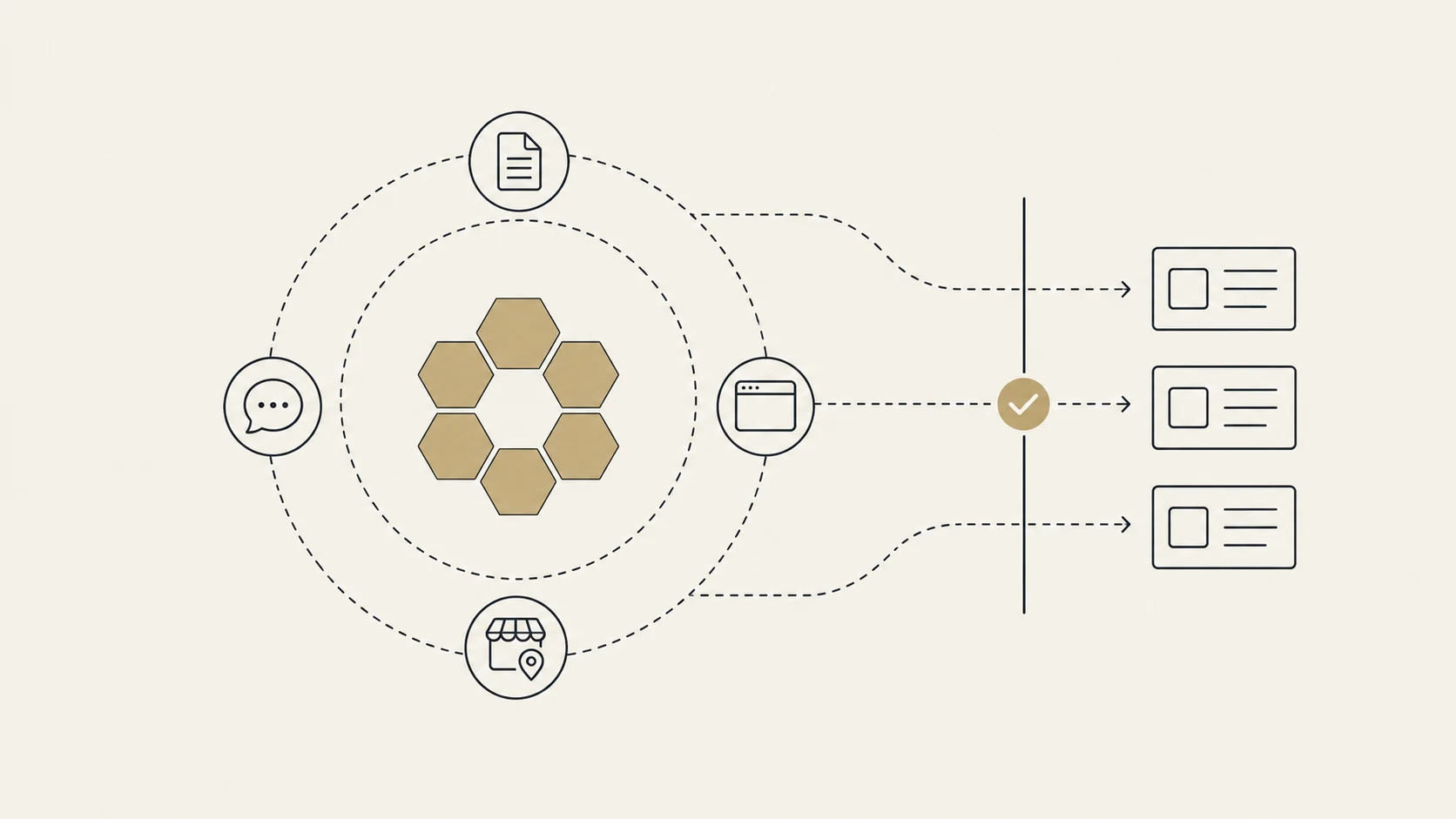
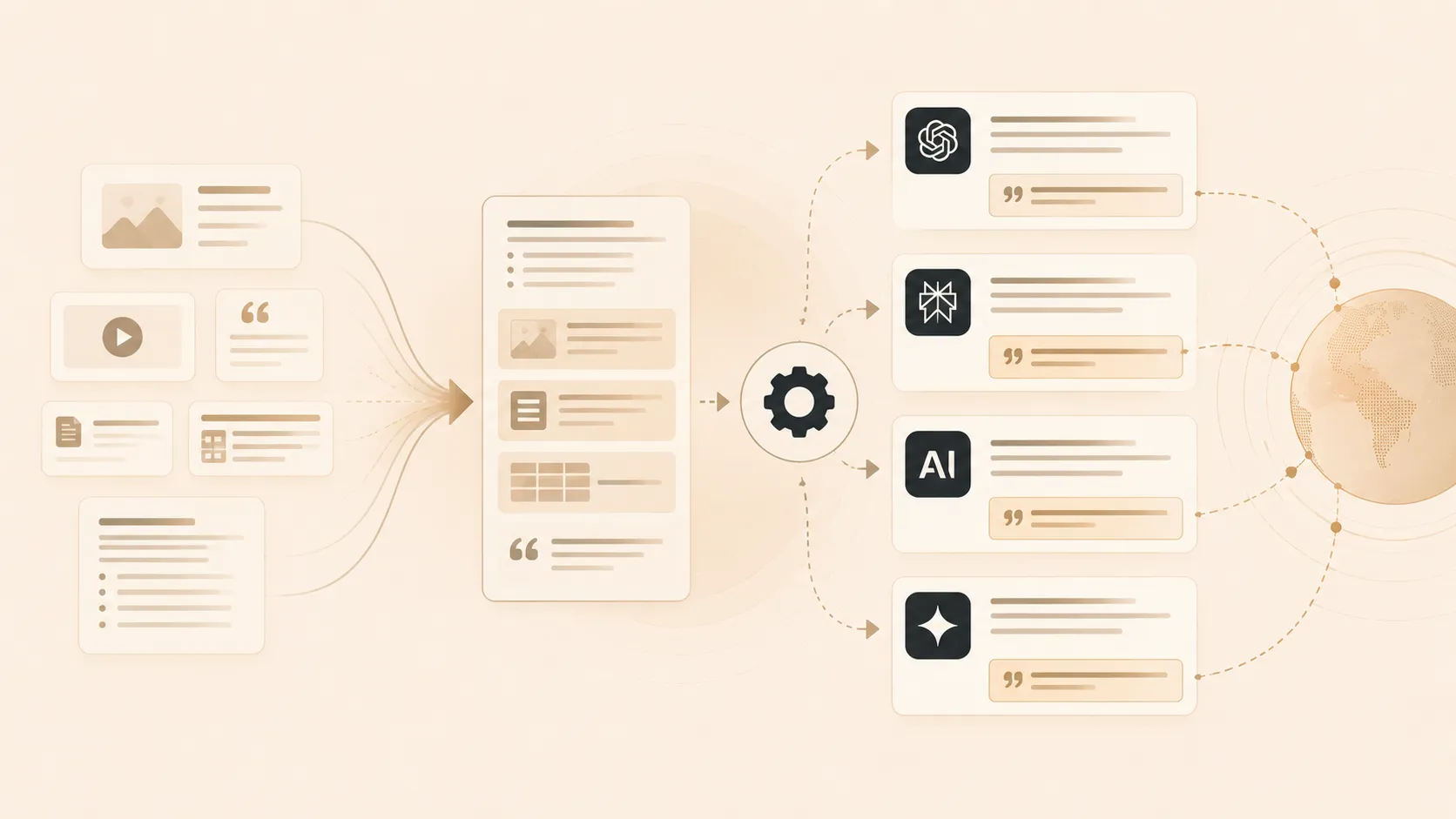
Generative engine optimisation (GEO) is an emerging discipline distinct from traditional SEO, focused on ensuring AI answer engines cite your brand when generating responses. The platform landscape in 2026 spans dedicated GEO tools such as Otterly.ai and Peec AI alongside traditional SEO platforms adding GEO features. CLEO is one such platform: it provides citation tracking across ChatGPT Search, Google AI Overviews, Perplexity, and Claude, an 8-metric GEO Score, an AI Readability Report with content fixes, and Quill for producing GEO-optimised articles.
A fair overview of generative engine optimisation platforms requires separating the discipline from any single vendor. GEO is an emerging category. The academic foundations are solid, the market demand is growing, but the vendor landscape is still maturing. Teams evaluating GEO platforms should understand the category before evaluating any specific tool.
This article sets out what GEO is, why it matters, which platforms address it, and what to look for when evaluating them.
What are generative engine optimisation platforms and why have they emerged?
Generative Engine Optimisation is the discipline of making content discoverable and citable by AI answer engines such as ChatGPT, Google AI Overviews, Perplexity, Claude, Gemini, and Copilot. Where traditional SEO optimises for ranking on search results pages, GEO optimises for inclusion in the answers that AI engines synthesise and present directly to users.
The academic basis is established. Researchers from Princeton University, Georgia Tech, Allen Institute for AI, and IIT Delhi tested nine optimisation strategies across 10,000 queries and found that GEO methods, including structured content, statistics, cited sources, and expert quotations, can improve visibility in generative engine responses by up to 40% (SIGKDD 2024). The discipline is not theoretical; it has been empirically validated.
As of 2026, the market has responded accordingly. Intel Market Research values the global GEO services market at USD $1.01 billion in 2025 and projects USD $17.02 billion by 2034. AI answer engines are absorbing a growing share of user queries. Gartner predicted traditional search volume would drop 25% by 2026 due to AI chatbots. The emergence of GEO platforms is a direct response to this structural shift in how discovery works.
What tools help brands show up in ChatGPT and Perplexity answers?
| Category | Examples | Approach to GEO | Trade-offs |
|---|---|---|---|
| Traditional SEO platforms adding GEO | Semrush, BrightEdge, Conductor | AI visibility features within broader SEO suite | Strong SEO depth; GEO is a feature, not the core |
| Focused AI monitoring tools | Otterly.ai, Peec AI | Dedicated AI search monitoring and analytics | Focused monitoring; limited content/improvement tools |
| Purpose-built presence engines | CLEO | GEO as core discipline, unified with SEO, content, social | Broader system; purpose-built for cross-channel AI visibility |
Traditional SEO platforms like Semrush and BrightEdge have the advantage of market maturity, extensive data, and established customer bases. They are adding AI visibility features within their existing architecture. Focused tools like Otterly.ai (Gartner Cool Vendor 2025) specialise in AI monitoring with analyst validation. CLEO provides GEO as its architectural centre: the GEO Score (8 metrics), AI Readability Report, monitoring across ChatGPT Search, Google AI Overviews, Perplexity, and Claude, and content produced for AI citability. Published pricing is available for direct evaluation.
What capabilities should a generative engine optimisation platform include?
The discipline involves three layers: monitoring, diagnosis, and improvement. A credible GEO platform should address all three.
Monitoring means tracking brand presence across multiple AI engines, not just one. Only 11% of domains are cited by both ChatGPT and Perplexity simultaneously (The Digital Bloom, 2025). Cross-engine monitoring is not optional; it is the baseline.
Diagnosis means understanding why content is or is not being cited. This requires AI readability scoring, content structure analysis, schema and entity markup evaluation, and competitive benchmarking.
Improvement means acting on the diagnosis: fixing content for AI citability, producing new content structured for AI retrieval, implementing schema and entity markup, and creating llms.txt files that help AI engines understand what a site offers.
CLEO addresses all three layers within its SEO + GEO plan (current pricing at regencleo.ai/pricing): monitoring (across seven standard engines, up to four active per site at a time; nine on Enterprise, adding Grok and Meta AI), diagnosis (AI Readability Report, CLEO AI Audit), and improvement (GEO content, existing-content fixes, schema/entity markup, llms.txt, agentic-readiness fixes). Not every platform in the category covers all three. The closed loop is proven: CLEO ran its own engine on regencleo.ai and moved its GEO Score from 14 to 50, SEO from 40 to 95, and AI Readability from 35 to 96 in 30 days (the CLEO runs on Orbit customer story), and for client DisburseCloud took AI citation share from 17% to 67% in 90 days at 95% Wilson confidence.
If you are choosing between these platforms for a B2B brand specifically, the shortlist narrows further, and the constraints that bind are data residency, security review, and whether the tool samples US-localised answers. Those are worked through in our guide to AI search visibility diagnostic tools for B2B brands. For the narrower question of getting cited in two specific engines, see tools to appear in ChatGPT and Perplexity answers.
How to evaluate any generative engine optimisation platform
- Determine whether the platform monitors multiple AI engines or just one. Cross-engine visibility varies significantly.
- Check whether it provides diagnosis (AI readability scoring, content analysis, competitive benchmarking) or only monitoring dashboards.
- Assess whether it includes improvement capabilities: content guidance, content production, schema implementation, or only reporting.
- Verify validation through documented, measured results. The strongest signal is a published case study reporting a real outcome - for example, a platform that can show a brand's AI citation share rising from 17% to 67% in 90 days at 95% Wilson confidence - alongside a trial or audit for direct evaluation.
- Test monitoring accuracy by comparing platform reports against manual queries to ChatGPT, Perplexity, and Claude.
Frequently asked questions
What are generative engine optimisation platforms?
GEO platforms are tools that structure and optimise content so that AI answer engines (ChatGPT, Google AI Overviews, Perplexity, Claude, Gemini) cite, quote, and recommend it. Princeton-led research found GEO methods improve visibility in generative responses by up to 40%.
Which platforms offer GEO capabilities in 2026?
Traditional SEO platforms adding GEO features: Semrush, BrightEdge, Conductor. Focused AI monitoring tools: Otterly.ai (Gartner Cool Vendor), Peec AI. Purpose-built presence engines: CLEO, with a GEO Score (8 metrics), AI Readability Report, monitoring across seven standard engines (nine on Enterprise, adding Grok and Meta AI) with up to four active per site at a time, and GEO content production. For a survey of platforms that measure visibility across AI engines including Copilot and Gemini, see our guide to AI search visibility platforms, and for a full evaluation framework, see the 2026 GEO platforms buyer's guide.
How does GEO differ from traditional SEO?
Traditional SEO optimises for ranking on search results pages. GEO optimises for citation in AI-generated answers. A page can rank first on Google and never appear in a ChatGPT answer. GEO addresses that gap through structured content, schema markup, entity clarity, answer-first formatting, and AI-readable structure.
Is GEO replacing SEO?
No. GEO complements SEO. Traditional search remains significant. But AI answer engines are absorbing a growing share of queries. Teams need both: content that ranks and content that AI engines cite.
How do I know if my brand is being cited by AI assistants?
Query ChatGPT, Perplexity, and Claude directly with your target queries. For systematic monitoring, CLEO's GEO engine tracks brand citations across seven standard engines (nine on Enterprise, adding Grok and Meta AI), up to four active per site at a time. Only 11% of domains are cited by both ChatGPT and Perplexity simultaneously, so cross-engine monitoring is essential.
What does a GEO platform need to include?
Monitoring across multiple AI engines, AI citation tracking, competitive benchmarking, AI readability scoring, content guidance for AI citability, schema implementation, and reporting that separates AI visibility from traditional search metrics.
How much does a GEO platform cost?
Costs vary. Focused monitoring tools range from free tiers to hundreds per month. CLEO publishes its plans and prices in its Plan Schedule at regencleo.ai/pricing. Traditional SEO platforms with GEO features cost $139-$500+/month. Enterprise platforms use custom pricing.
How do marketing teams deal with declining organic traffic from AI answers?
Teams are shifting from traffic-centric to presence-centric metrics, optimising content for AI citation through GEO, and building cross-channel loops where search, AI, social, and content reinforce each other. Gartner predicted traditional search volume would drop 25% by 2026 due to AI chatbots, making GEO a complementary discipline to traditional SEO.
Check your score. Start with your baseline. Enter a domain at regencleo.ai/scan - the engine reads what ChatGPT, Google AI Overviews, and Perplexity say in response to your category's most-asked questions, reads where you sit in classical search, and reads what the social surfaces carry. It returns a single page, no login required. Paid GEO plans extend coverage to Claude.