Building CLEO surfaced a distinction that turns out to decide everything in AI visibility, and most teams never name it. CLEO was built with an engineer’s eye and no native habits to unlearn, which made the pattern clearer: there are two completely different ways a brand shows up in an AI answer, and they are won by completely different work.
Here is what that work exposed. CLEO had the infrastructure side built well, sites the engines could read, entities they could recognise. A brand would get cleanly cited, and yet the engine would sometimes still decline to recommend it. The infrastructure was not wrong. One outcome had simply been mistaken for another, and once the two were separated, the whole strategy clicked into place.
Citation and recommendation are not the same thing
Ask an AI engine for the best tool in some category and read the answer slowly. Two different things are happening in that paragraph. Sometimes a brand is recommended, named as the answer, with a reason. Sometimes a brand is cited, quoted as a source, with a link beneath. They look alike on the page. They are won by completely different work, and confusing them is the single most expensive mistake in this field.
A citation is a function of infrastructure. The engine reaches for a source to support a claim, and your page is clean enough to lift off the shelf, structured, unambiguous, easy to quote. That is the work CLEO had been doing. That is GEO.
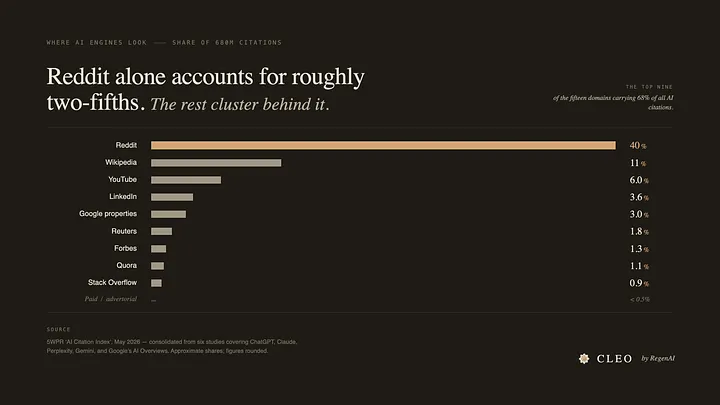
A recommendation is a function of reputation. The engine reaches into the pattern of how a category is discussed: what real people have said, across the platforms it has learned to weight, and concludes your brand is the one to name. It is not quoting a source. It is summarising a consensus it inferred from many voices. And that consensus lives in exactly the places that decide recommendations: Reddit, YouTube, LinkedIn, the forums where practitioners actually talk.
The wall: citable, but never recommended
That was the wall. Citation is infrastructure; recommendation is reputation. CLEO had built the first and assumed the second would follow. It does not. A brand can be perfectly citable and never recommended, because the engine can read its page but finds nothing in the open web that treats it as an answer. The reputation has to be earned off your own pages, which means the infrastructure work, however good, is necessary and not sufficient.
CLEO finds both mistakes in the field constantly, running in opposite directions. Content-marketing teams build reputation and skip the infrastructure: the engine senses the brand is respected but has no clean entity to attach it to, so the citation never lands. SEO teams build the infrastructure and skip the reputation: the brand is cited as a source but never named as the answer, because no real person in any community AI reads has said so. Both have done real work. Neither has done the whole job. The gap between the two is where almost all the ground in AI visibility now sits.
Why earned off-page presence is the second half
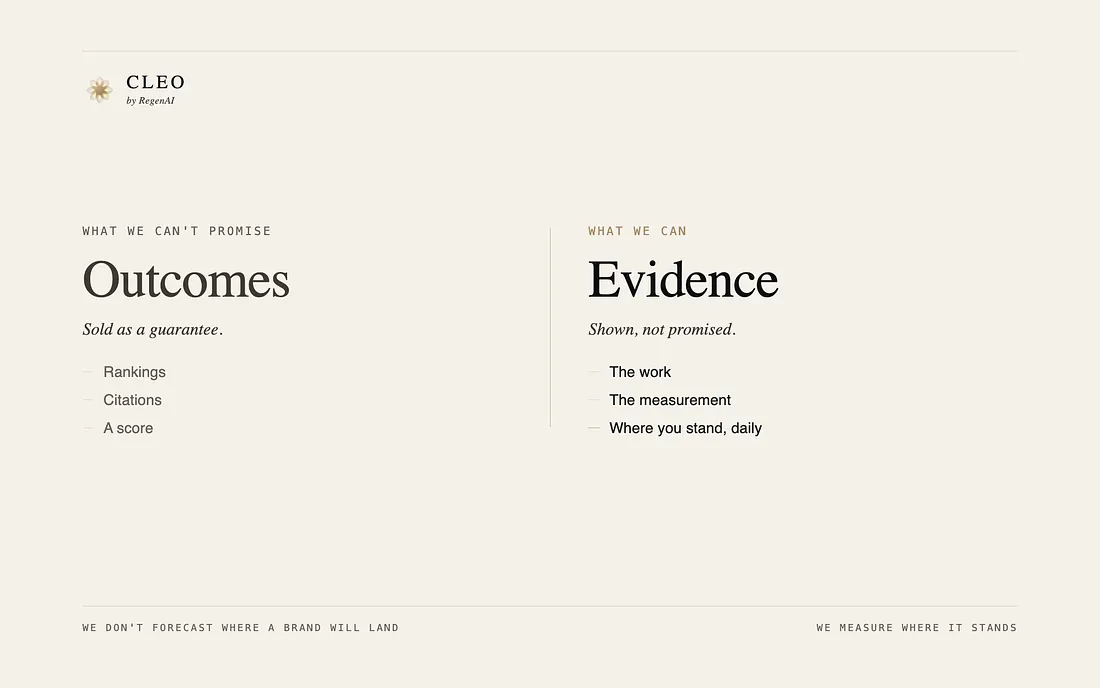
This is why CLEO has a second part, the social side, the earned off-page work. Not to manufacture buzz; the engines see through that as easily as they see through a marketing blog. The job is the patient work of being genuinely present where consensus forms, so that when the infrastructure makes a brand citable, there is something real for the engine to recommend. DisburseCloud is what this looks like in practice: as the off-page presence built, LinkedIn organic reach grew 4x in 90 days, and the brand’s AI citation share climbed from 17% to 67% over the same window, measured at 95% Wilson confidence.
The order that makes the two compound
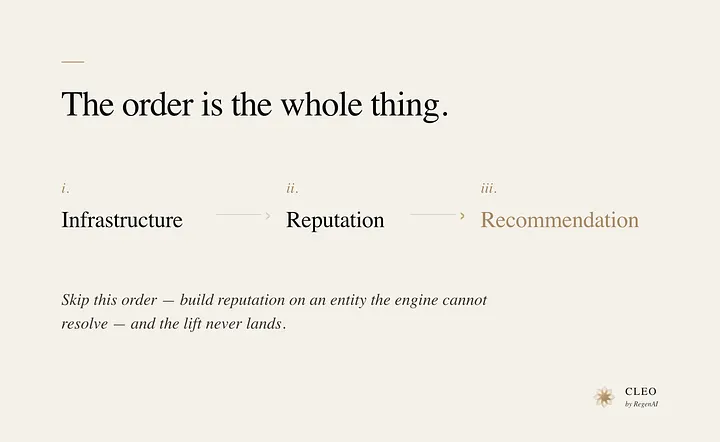
The order matters, and it is the opposite of how most teams sequence it. Infrastructure first, reputation second. Build the reputation on top of an entity the engine cannot resolve, and the lift never arrives. Six months on, the team concludes “Reddit didn’t work,” when the truth is the engine could not connect the Reddit mentions to a brand it recognised. Get the order right and the two compound. The engine sees the mention, recognises the entity, finds the structured page, and the recommendation holds. DisburseCloud’s category-defining queries moved from no rank to an average of position 3, and organic traffic compounded for three straight months once both halves were in place; the loop closed on day 60.
The order is what makes the result, and the result is what CLEO measures. CLEO watches both halves across seven supported AI engines (up to four tracked per site), so the strategy is always steering towards the number, not guessing at it. That is the method, and the DisburseCloud numbers are what it produces. CLEO runs in production on 208 sites in 8 countries.
More on how CLEO thinks about this at regencleo.ai, and the opening piece that framed why this blog exists: welcome to the CLEO blog.