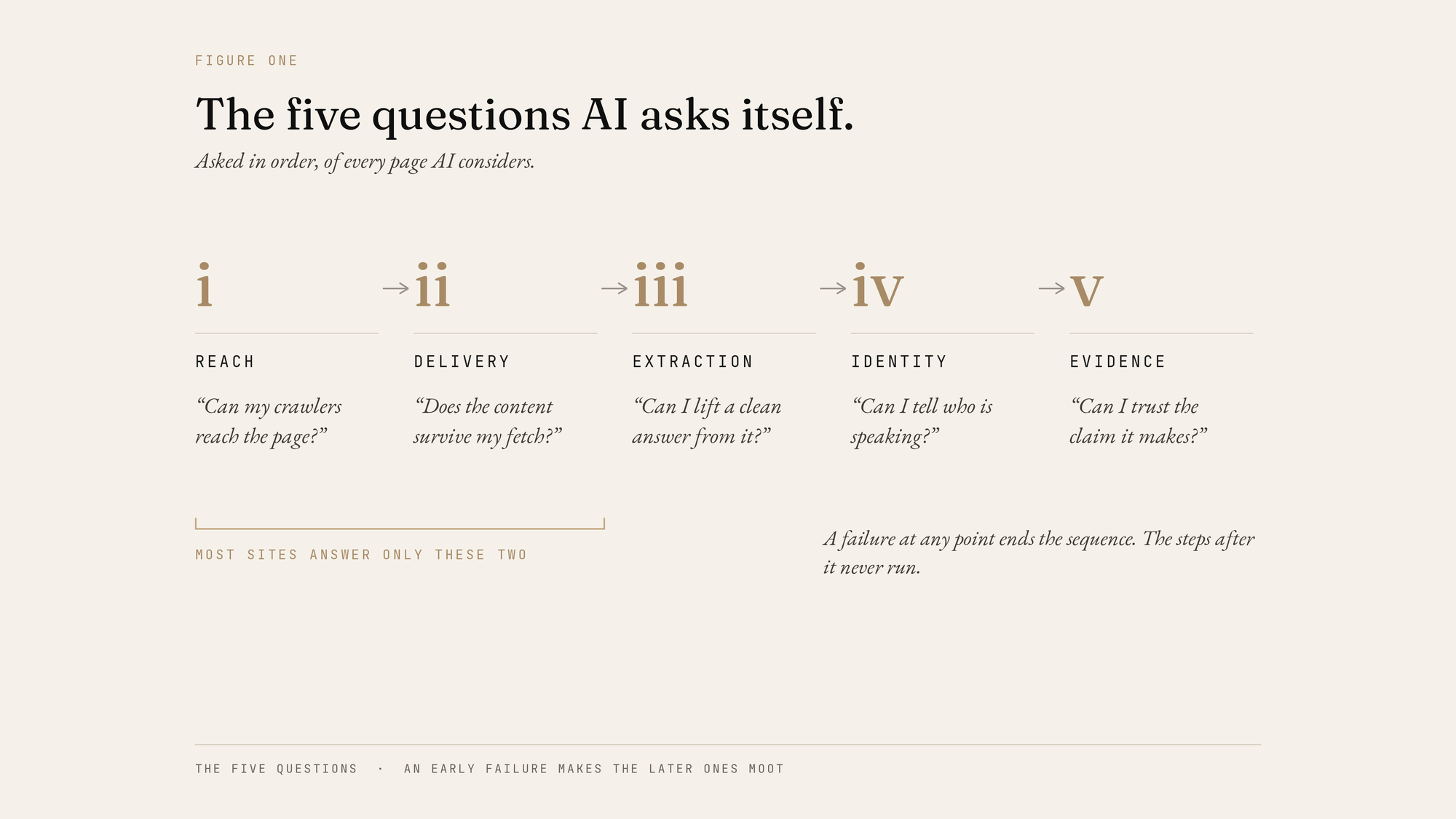
When AI decides whether to cite you, it is not making an aesthetic judgement and it is not consulting a ranking. It works through your page in order, asking itself one question at a time: can it reach the page, can it read it, can it lift a clean answer, can it tell who is speaking, and can it trust the claim. A failure at any one point ends the matter, and the steps after it never run. The good news is that you can answer all five in advance, on your own site, without a vendor and without writing anything new. The uncomfortable news is that most sites answer only the first two, and never learn which of the other three they are failing.
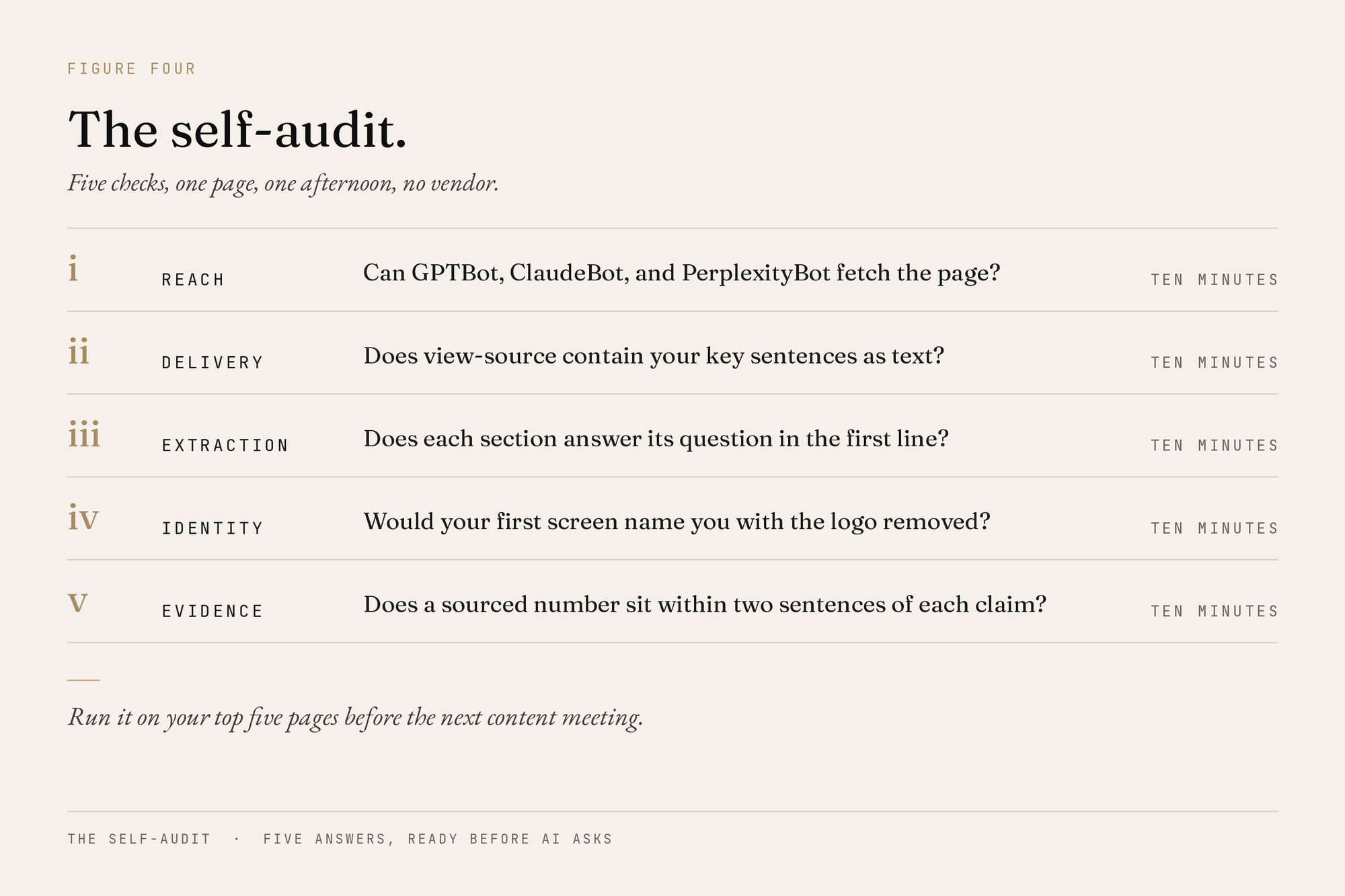
We take the five questions in the order AI works through them, because an early failure makes the later ones moot. Each question is set down here the way AI asks it of itself, because that is the version your page must answer. Each comes with a check you can run in about ten minutes. Run all five, and you will understand your own AI visibility more precisely than most paid audits will tell you.
Question one · Reach
Can my crawlers reach this page?
AI does not visit your page itself. It sends a crawler, a bot like GPTBot (OpenAI), ClaudeBot (Anthropic), or PerplexityBot (Perplexity), to fetch the page and carry it back. A surprising number of sites turn these crawlers away without meaning to: a robots.txt file written before the crawlers existed, a bot rule switched on by default at the CDN, a firewall that treats an unfamiliar crawler as a scraper. The failure is silent, because nothing breaks for human visitors. You simply never appear, and no dashboard reports the absence. Google's AI Overviews is the one exception: it reads through ordinary Googlebot, so a page Google already indexes is rarely shut out by accident. The other crawlers are the ones you can lock out without ever noticing.
The check
Open yoursite.com/robots.txt and look for any line that disallows those crawler names, or a blanket disallow left over from a staging build. Then, if you can reach your server logs, filter a week of traffic for those crawler names. Seeing them arrive and receive a 200 is the answer you want. If they are absent or blocked, every question below is academic.
Question two · Delivery
Does the content survive my fetch?
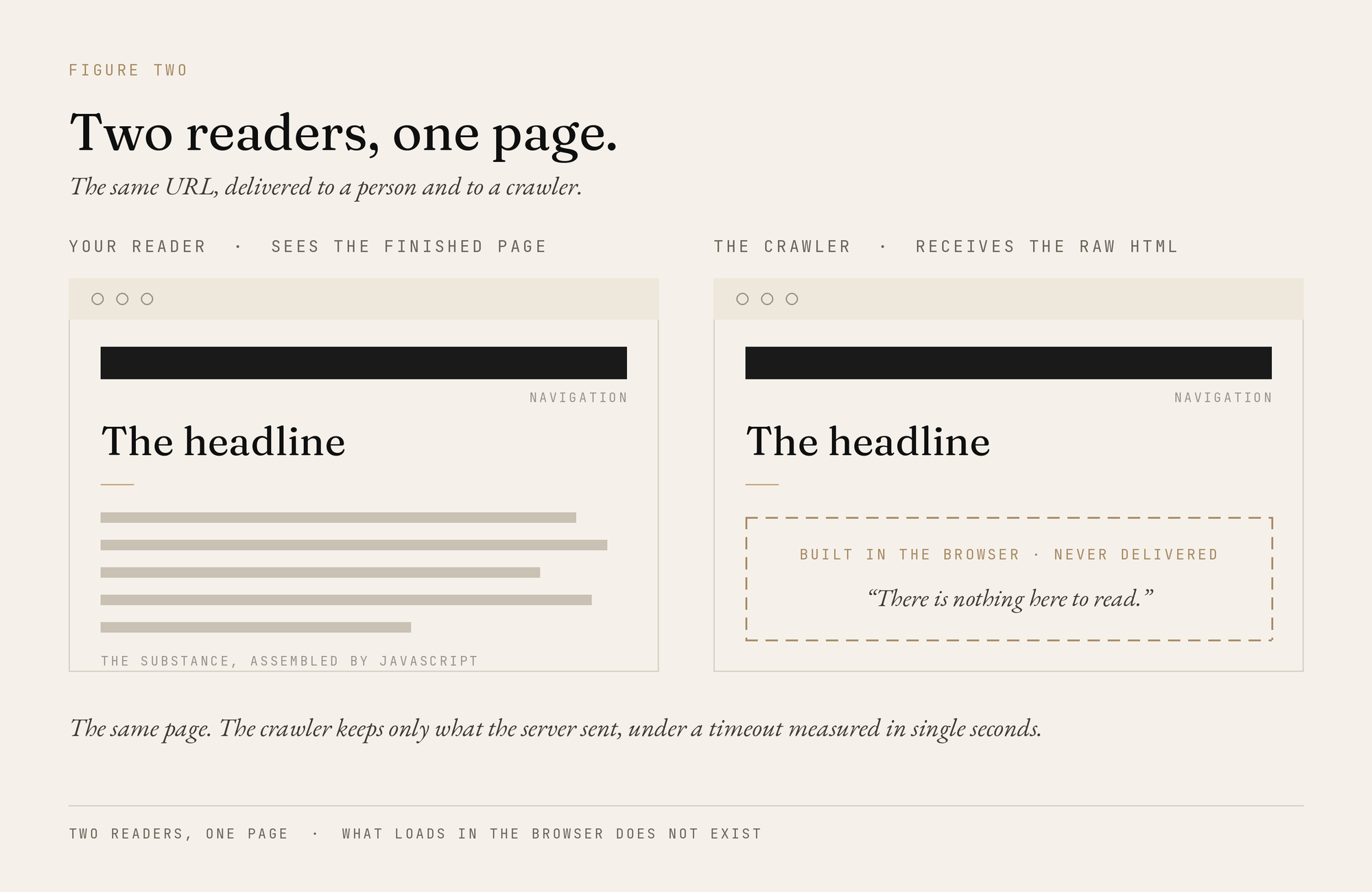
Most AI crawlers do not run JavaScript. An analysis of more than five hundred million GPTBot requests found no sign of JavaScript running at all: files were occasionally downloaded and never executed, and the same holds for Anthropic's, Perplexity's, and Meta's crawlers, under timeouts measured in single seconds. Anything your site builds in the browser, after the page first loads, simply does not exist for the crawlers that do not render: each of them receives the raw HTML your server sent, and nothing more (Google's Gemini and Apple's AppleBot are the exceptions, because both ride on existing search infrastructure). If your content is assembled in the browser, that raw HTML is often a navigation bar, a hero line, and an empty shell where the substance should be.
The check
On your most important page, right-click and choose "view page source". Use view source, not "inspect element", which shows the assembled page and will mislead you. Search that source with Ctrl-F for the one sentence a buyer most needs to read. If it is there as text, the crawler received it. If it appears only after your JavaScript runs, then as far as AI is concerned, you never said it.
Question three · Extraction
Can I extract a clean answer from this page?
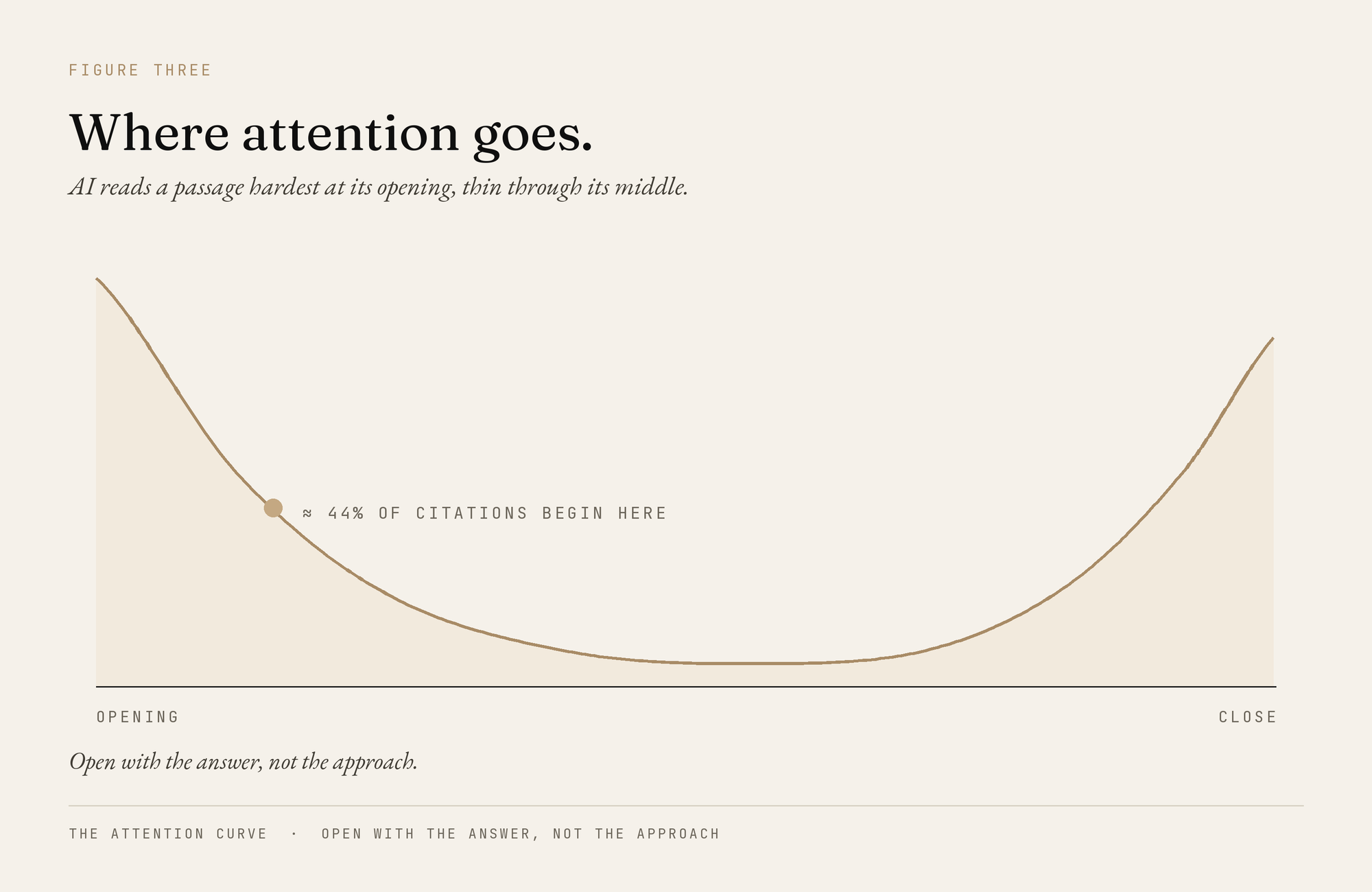
AI quotes passages, not whole pages. It splits your page into chunks, scores each chunk against the question a user asked, and lifts the winners into the answer it writes. Two things follow, both from published analysis of what AI actually cites. First, position matters more than writers expect: roughly 44% of cited passages come from the first third of a piece, and attention across a page is U-shaped, strongest at the opening and the close and thin through the middle. Second, AI scores each chunk on its own, stripped of the page around it: no heading above it, no sentence before it, no earlier line to explain a pronoun. An answer you build to across nine paragraphs is, to AI, an answer you never gave. A paragraph that opens with "this approach solves that problem" earns only AI's silent reply, "Which approach? Which problem?", before it moves on.
The check
Find the section of an important page that answers your buyer's real question. Cover everything except its first two sentences, and read those two alone. Do they give the whole answer, and would a stranger know what they are about without the rest of the page? If they only set the answer up, or lean on a pronoun whose owner is elsewhere, AI will pass them over for a passage that stands on its own.
Question four · Identity
Can I tell who is speaking?
AI can only cite a passage with confidence when it knows what the passage is about: which brand, which category, in whose company. The passages AI actually quotes are unusually dense with names, the brand, the category, the neighbours, at roughly a fifth of the words, several times the density of ordinary marketing prose. The reason is mundane. "We help teams move faster" gives AI nothing to file it under. "CLEO, a presence engine by RegenAI, measures AI citation share across ChatGPT, Google AI Overviews, Perplexity, and Claude" attaches to exactly one company, one category, and a known set of neighbours. Structured data does the same job: Organization, Article, and FAQPage schema in your raw HTML help AI confirm who you are and tell you apart from another brand with the same name. The honest reading of the evidence, though, is that schema helps AI parse you, not cite you. It is plumbing, not a lever.
The check
Read the first screen of your homepage aloud and count how many sentences would still identify your company, your category, and your peers with the logo removed. Then check whether a single plain-language paragraph states, in plain nouns, who you are and what category you are in. Most sites imply this everywhere and state it nowhere, and to AI, implied is the same as unsaid.
Question five · Evidence
Can I trust the claims on this page?
When AI writes an answer, it has to decide what it can repeat without hedging, and it prefers passages that carry their own proof. Controlled research on AI visibility from Princeton found that adding statistics, quotations, and cited sources to a page raised its visibility in AI answers by up to 40%: the largest effect of any change the study tested, and far above adding keywords, which did almost nothing. The reason is intuitive once you see it. "Many teams struggle with visibility" forces AI to soften the claim or drop it, while a specific figure with a named source can be repeated word for word and attributed. To AI, evidence is not decoration. It is what makes a sentence usable in an answer.
The check
Take your most important claim and look at the two sentences around it. Do you find a figure with a named source, or an adjective? "Leading", "world-class", and "trusted by thousands" are not evidence AI can carry. One sourced number beside each load-bearing claim is the cheapest visibility you can buy.
Reading your five answers
Fix them in the order AI works through them.
Fix them in the order AI works through them, because an early failure caps everything after it. A page full of evidence that the crawler cannot reach is a letter never sent. A page the crawler reaches easily, but whose substance loads in the browser, is an empty envelope delivered on time. The first two questions are about engineering and access, usually fixed in days. The last three are editorial, and they improve with every page you touch afterwards. None of the five asks for new content. All five ask the same thing: that you look at the pages you already have the way AI does, which almost no one has done, because until very recently there was no reason to.
This is the ground the rest of the month stands on. Next week we go deep on the second question: how AI actually reads a page, and how to know exactly what yours delivers. The week after, we take the third and fourth together, extraction and identity. We close the month on the fifth, evidence, the easiest to fix and the most often skipped. The floor is buildable, and it is buildable by the team that already owns the site.
Five questions. Answer them in order, and AI can finally do what your best customer already does: find you, read you, and pass your name along.
Mastery deserves an audience.