
You can shape what AI systems say about your brand, but only once you stop treating AI summaries as somebody else’s problem and start building the source material those systems actually draw from. Right now they are assembling your brand story from fragments scattered across the web.
The problem has a useful name: narrative drift. It is what happens when AI platforms construct a summary of a company from sources that company has never reviewed, approved, or even seen.
Why AI ignores your website
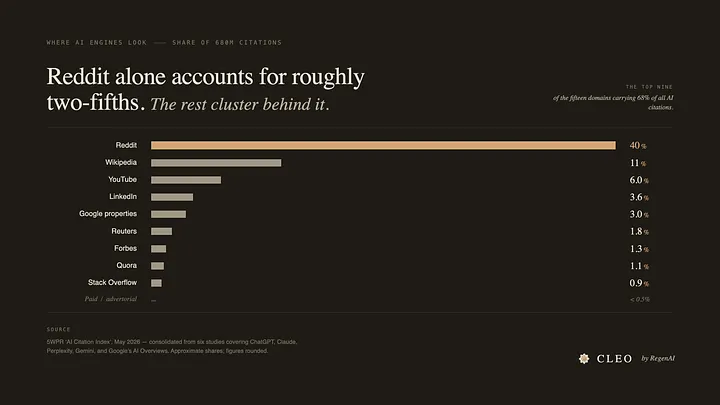
AI leans on third-party sources, not brand-owned content, to decide who you are. Reported figures put your own website at roughly 5 to 10% of the sources referenced when a model forms a picture of a brand. The remaining 90 to 95% comes from publishers, user-generated content, affiliate sites and review platforms.
Narrative drift compounds quietly, because an answer cites only a handful of domains. Every citation slot occupied by a competitor or a critic is one you do not hold.
How to structure content so it gets cited
The practical shift is from keywords to entities. Make the brand, its products and its comparisons unambiguous: consistent naming across properties, valid schema markup, FAQs that mirror how people actually phrase prompts, and answer-first structure so a passage survives being quoted out of context.
Structured data does measurable work here. Content carrying valid markup is reported to appear in AI answers substantially more often than content without it, because the machine reading the page does not have to infer what it is looking at.
Correcting drift is a loop, not an audit
Fixing narrative drift requires a cycle: track what the engines say about you, create structured content that corrects or replaces the weak sources, place that content where the engines already look, then measure citation share again.
For CLEO client DisburseCloud, a twelve-person fintech, AI citation share moved from 17% to 67% over 90 days at 95% Wilson confidence. The number matters less than the shape of the work: monitoring, content and deployment ran continuously rather than as a single engagement.
What ignoring it costs
Inaccuracies spread faster than corrections, and recovery is slower than the damage. Survey data consistently shows most marketers are not confident about how their brand currently appears in AI summaries, and only around a quarter track it at all. Doing nothing gets more expensive as assistant usage grows, because the summary hardens into the default answer.
Frequently asked questions
Why does AI ignore your website when summarising your brand?
Because it draws mostly on third-party sources. Reported figures put brand-owned content at roughly 5 to 10% of what AI platforms reference when forming a picture of a company; the rest comes from publishers, user-generated content, affiliate sites and review platforms.
What is narrative drift?
Narrative drift is what happens when AI platforms assemble a brand summary from sources the brand has never reviewed, approved or seen. A competitor's blog post, an analyst's aside or an old third-party review becomes the market's working understanding of what a company offers.
How do you structure content so AI assistants cite it?
Optimise entities rather than keywords: consistent naming, schema markup, FAQs that mirror how people actually phrase prompts, and answer-first structure so a passage stands on its own when quoted out of context. Content carrying valid structured data is reported to appear in AI answers substantially more often.
Can narrative drift be reversed?
Yes, but only as a continuous cycle rather than a one-off audit: track what the engines say, publish structured content that corrects or outranks weak sources, place it where the engines already look, then measure citation share again. For CLEO client DisburseCloud, AI citation share moved from 17% to 67% over 90 days at 95% Wilson confidence.
Check what the engines say about you. A scan at regencleo.ai/scan returns how ChatGPT, Google AI Overviews and Perplexity describe your brand today, with no login required.