On AI’s narrow trust list, and the discipline it now asks of a brand. The first of three field notes from building CLEO.
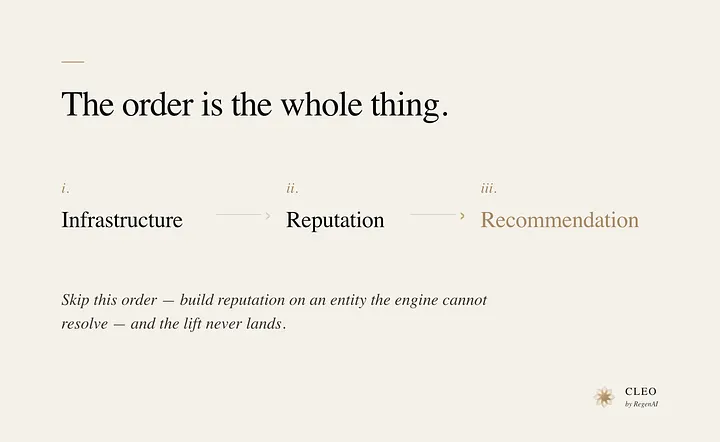
When CLEO was being built, it started from the same belief most people building for search hold: that if you get a website clean enough, fast, structured, well-written, the engines will find it and quote it. The first stretch of the build went into making sites legible to AI. Schema, entities, the machine-readable scaffolding that lets a model understand what a page is. The work was good. It was also, as became clear, only a third of the job. This is the first of three things CLEO got wrong early on, and what each one taught.
The number that reorganised the thinking
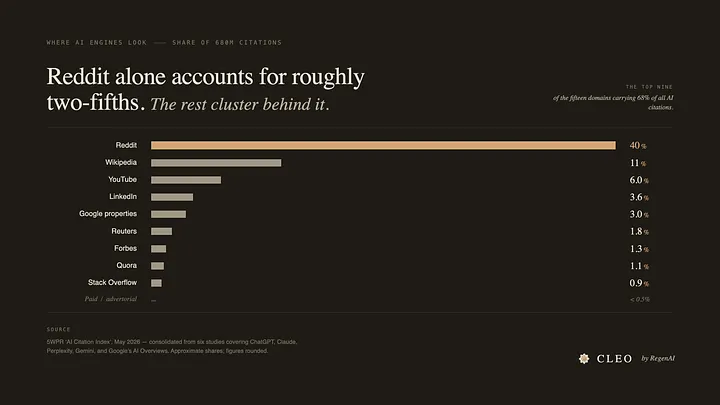
Here is the fact that reorganised the thinking. In May 2026, a New York firm called 5WPR consolidated six of the largest studies of AI citations, more than 680 million of them, across ChatGPT, Claude, Perplexity, Gemini, and Google’s AI Overviews, into a single index. The question was plain: when these engines quote a source, which sources do they actually quote?
Fifteen. Fifteen domains account for 68% of every citation those engines produce.
Not the top hundred. Not the top thousand. Fifteen. Nothing in the old web looked like this: classic Google search spread authority across millions of domains in a long tail. AI citation does the opposite. It funnels.
Where the citations actually go
And the funnel is not where most brands are spending. Reddit sits at the top, cited around 40% of the time across every major engine. Then Wikipedia, YouTube, LinkedIn, Google’s own properties. The rest of the fifteen are journalism and community platforms: Reuters, Forbes, Quora, Stack Overflow. What is missing from the list matters more than what is on it. Your blog is not there. Almost no individual brand site is there. Paid placements, sponsored posts, advertorials, account for less than half a percent.
This is the part that is hard to accept on first reading. You can spend half your content budget on a beautiful blog and be invisible to almost every AI citation. You can buy a placement in a magazine your buyers respect and earn nothing an engine will read. The list does not care what you paid. It cares whether you are on it.
Why the list looks the way it does
Once the reason was clear, the list stopped looking arbitrary. Models learn to trust the shape of human reasoning: a question, several answers, disagreement, a signal of which answer held up. Reddit produces that shape continuously. Wikipedia produces a different one: an entity defined, claims sourced, history visible. A YouTube transcript produces a third: one person, answering one question, in their own voice. A corporate blog post produces none of them. It is a single voice with no contradiction and no one checking, and a model can tell. The blog is not punished. It is simply weighted as what it is: marketing, not evidence of what people think.
The list moves in weeks
Then there is the part that should unsettle anyone planning a year ahead. The list moves in weeks. The same index documented ChatGPT’s Reddit citation share falling from roughly 60% to 10% in six weeks in late 2025, after a single Google parameter change. Six weeks. Anyone who built strategy in the SEO era is not braced for that clock speed: Google’s old upheavals took months, and you could watch them coming. A brand that had bet everything on Reddit woke up, six weeks later, with its main source cut by five-sixths.
What a defensible position looks like
So the defensible position is not dominance on one platform. It is presence across the fifteen, with the infrastructure that lets an engine recognise you as the same entity wherever you appear, and the discipline to hold that as the list shifts underneath you. This is the work CLEO had started on without yet understanding its full shape: not content production, but something closer to infrastructure maintenance, never finished, on a short and moving list.
CLEO was built to do that part, the measuring and the readiness, continuously, as the engines now require. That is the first third of the job. The second third is the one that proved hardest, and it is the next piece.
More on how CLEO thinks about this at regencleo.ai.