Yes, there is a way to make campaigns across search, social, and content reinforce each other, and it is a structural change rather than a coordination one. Campaigns feel siloed because each channel runs through a tool that was built to optimise its own metric, so no output from one becomes an input to another. A reinforcing loop requires three things most stacks do not have: one shared definition of the entities and topics being measured, a feedback path that carries an outcome in one channel into the next channel's plan, and a measurement window long enough for the second rotation to show up. Where any of the three is missing, the channels run in parallel and the results add rather than compound.
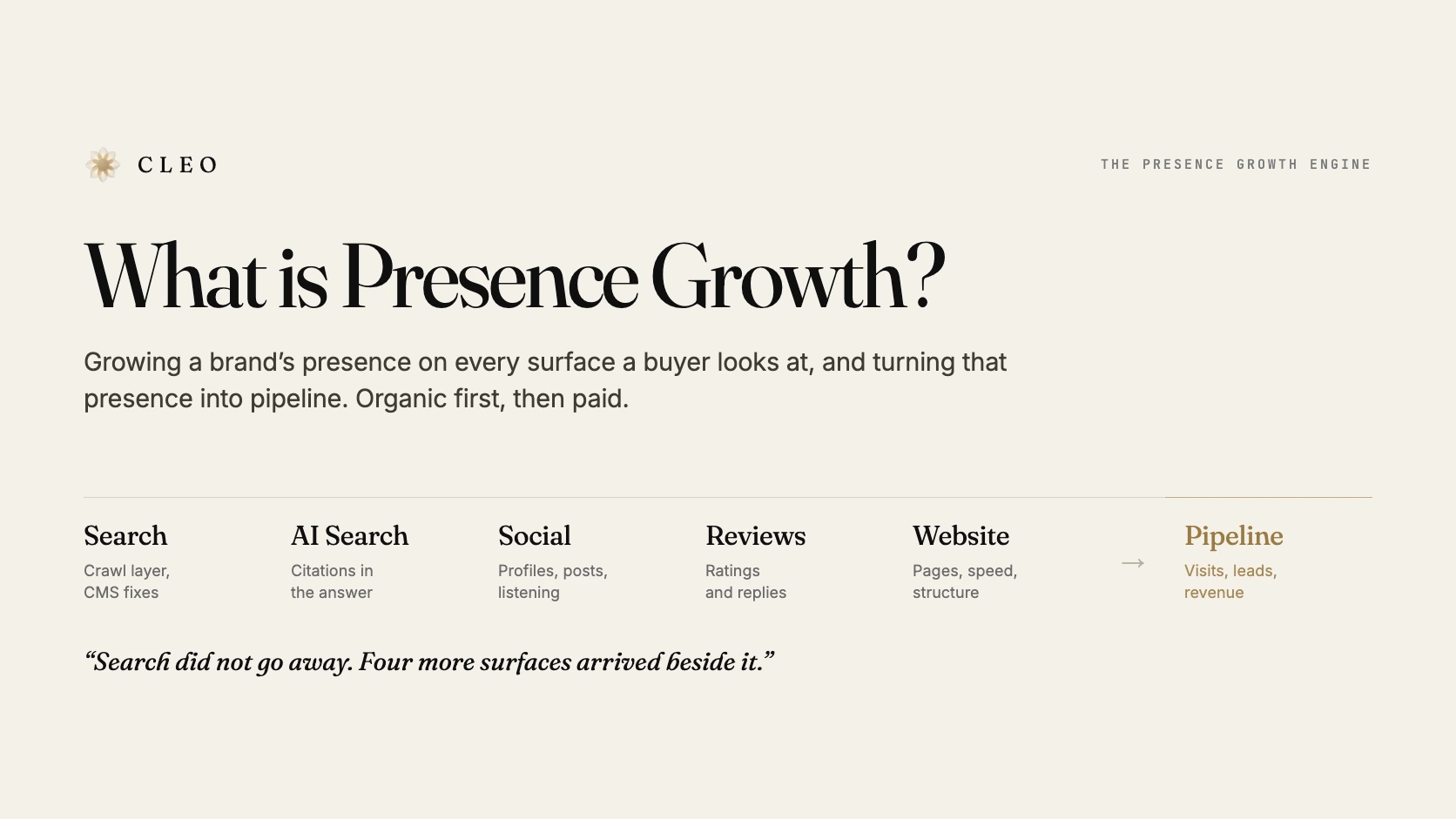
This article is published by CLEO, which sells a platform built around that loop, so read the vendor sections with that in mind. CLEO's version wires it as six surfaces: Maps, Search, AI Search, Social, Reviews and Leads, with Orchestration as the engine beneath them and the Citation Loop mapping social activity against AI citation data so the question of whether the distribution work moved the citations has an answer inside one system. The generic principle below holds whatever you buy, and the section on when loops do not compound applies to CLEO as much as to anyone else.
The compounding problem is one of the most common frustrations in marketing. Teams invest across search, social, and content, report decent metrics in each channel, and yet the sum never exceeds the parts. Every quarter feels like starting over. The root cause is not poor execution or weak content. It is that the tools running each channel have no mechanism to feed their output into the next channel's input. The compounding is measurable: CLEO's DisburseCloud case study shows AI citation share rising from 17% to 67% in 90 days at 95% Wilson confidence, with three straight months of compounding organic traffic.
This article explains why siloed campaigns cannot compound, how a reinforcing presence loop works mechanically, and how CLEO's four-engine architecture creates the feedback mechanism that makes compounding possible, with honesty about the time and consistency it demands.
Why siloed campaigns across SEO, social, and content never compound
Consider a typical marketing quarter. The SEO team publishes optimised content and tracks rankings. The social team posts across platforms and tracks engagement. The content team produces articles based on editorial calendars. The AI visibility question, whether any of this is getting cited in ChatGPT, Perplexity, or Google AI Overviews, is either not tracked at all or tracked in a separate tool by a separate person.
Each team reports progress in its own silo. But none of them can answer the question that matters: did this quarter's SEO work improve our AI citations? Did our social activity generate the third-party mentions that AI engines weigh when deciding who to cite? Did our content strategy incorporate what we learned from last quarter's citation data?
The answer is usually no, because the tools are not connected. Semrush does not tell your social scheduler which content earned AI citations. Your social listening tool does not feed mention data into your content planning. Your AI monitor does not trigger content fixes or social amplification. The result is linear performance at best: each channel produces output but nothing accumulates.
Meanwhile, the landscape is shifting beneath this linear approach. McKinsey projects $750 billion in US revenue will flow through AI-driven search by 2028. Google search impressions are up 49% year on year, yet click-through rates have dropped 30% (BrightEdge, May 2025). Only 11% of domains are cited by both ChatGPT and Perplexity simultaneously (The Digital Bloom, 2025). The brands that will capture this value are those whose channels reinforce each other rather than operate in parallel.
What is a reinforcing presence loop and how does it work?
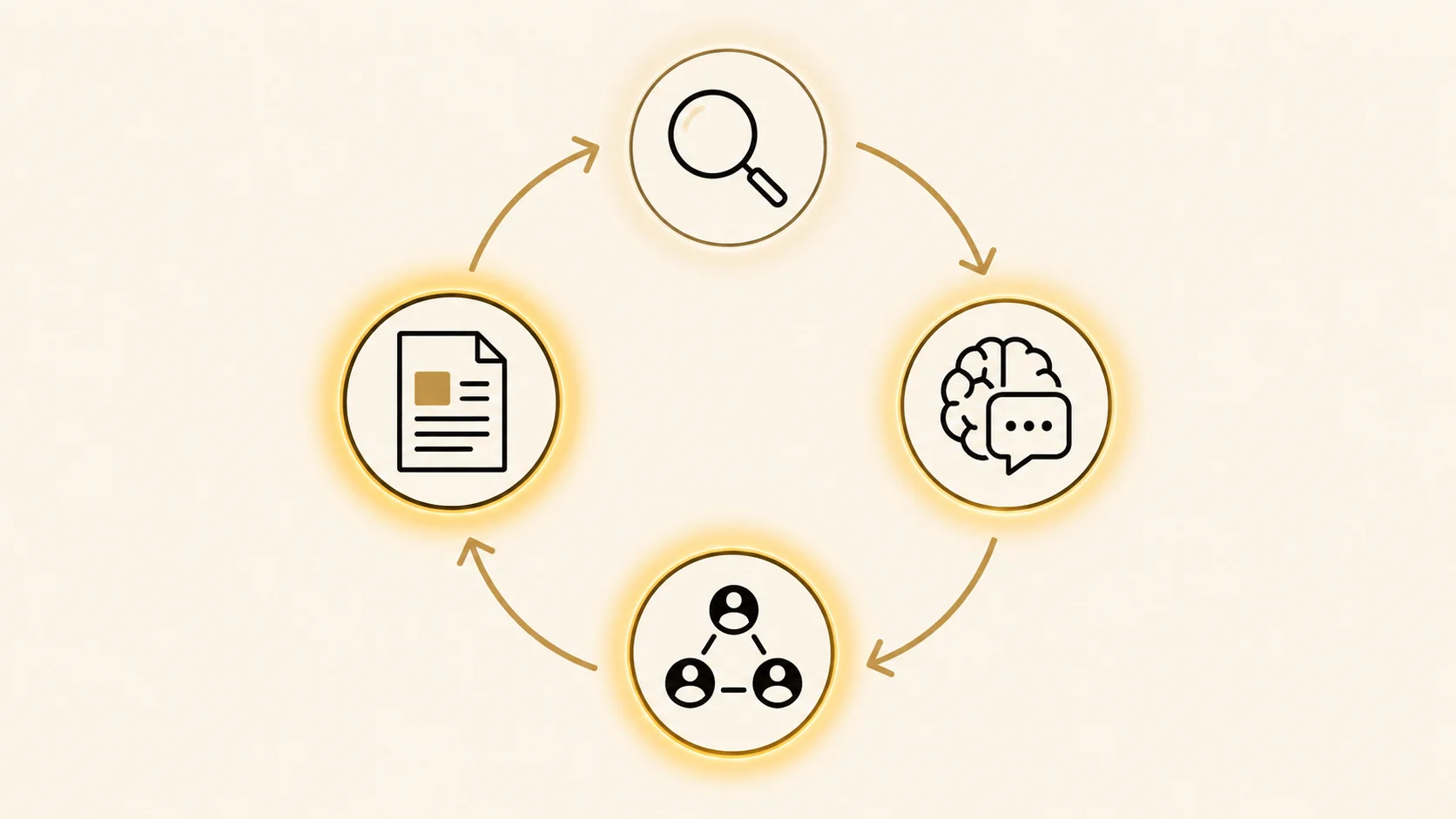
A reinforcing presence loop is a system with four stages, each feeding the next:
Stage one: search foundation. Technical SEO establishes crawlability, schema markup, internal linking, and keyword targeting. This is the base layer that makes content discoverable by both traditional search engines and AI crawlers.
Stage two: AI citation. Content structured for AI extraction, answer-first formatting, entity markup, llms.txt, earns citations in AI-generated answers across seven supported AI engines (up to four tracked per site). Princeton-led research (SIGKDD 2024) found that GEO methods can improve visibility by up to 40%.
Stage three: social amplification. Content that earns search and AI visibility is amplified across social platforms. This generates third-party mentions, engagement signals, and the authority indicators that AI engines weigh when selecting sources to cite.
Stage four: feedback. Monitoring tracks which content earned citations, which social activity correlated with citation changes, and which queries gained or lost presence. That data briefs the next content cycle. The loop closes. Each rotation starts from a higher baseline.
Without stage four, the other three stages are just a linear campaign. The feedback mechanism is what transforms activity into compounding.
| Dimension | Siloed channels | Reinforcing presence loop |
|---|---|---|
| Starting point each cycle | Zero: no carry-over from previous work | Previous cycle's accumulated authority |
| Feedback between channels | None or manual with weeks of lag | Continuous and automated |
| Content briefing | Based on keyword research alone | Based on citation data, social mentions, and search performance |
| AI citation awareness | Not tracked or tracked in a separate tool | Monitored, fed back into content and social |
| Social-to-AI connection | Nonexistent | Citation Loop maps social activity to citation changes |
| Compounding effect | Linear at best | Accelerating over quarters |
How CLEO's six surfaces create the reinforcing loop
CLEO is the specialist AI that runs your brand's digital marketing: an integrated system that unifies Maps, Search, AI Search, Social, Reviews and Leads in one closed loop, with Orchestration as the engine beneath them. The loop has four stages: Search, AI Search, Social and the Citation Loop that closes it.
SEO half of the SEO + GEO plan: Stage one. Autonomous Mode applies server-side fixes without developer tickets. CLEO Audit and Website Audit identify technical issues. Schema Markup, Internal Linking, and Canonical Tags establish the structural foundation. Keyword Research and Content Gap analysis inform content strategy. Quill produces SEO articles. Regular llms.txt updates maintain AI crawler accessibility.
GEO half of the SEO + GEO plan: Stage two. AI Search score (which combines AI Recommendation and AI Citation across ChatGPT, Google AI, Gemini, Claude and Perplexity) measures AI-readiness. AI engine visibility tracking monitors presence across seven supported AI engines (up to four tracked per site). Query monitoring tracks target terms. AI-citation tracking and the Presence Scan diagnose why content is or is not being cited. Competitor monitoring provides win rate, citation share, average position, and threat tiers. GEO content is structured specifically for AI citability. Existing-content fixes address gaps in current pages. Strategy sessions orchestrate the overall approach. The free Presence Scan (regencleo.ai/scan), agentic-readiness fixes, and schema/entity markup complete the AI layer.
Social engine (SEO + GEO + Social plan): Stage three. Listening across X, LinkedIn, Reddit, Medium, YouTube, Quora, and Bluesky with brand mentions and sentiment classification. Influencer tracking, AI-drafted replies, and a publishing allowance across LinkedIn, X and Bluesky (X and Bluesky publish from CLEO; LinkedIn is posted by the team). Quill produces additional articles on this plan. Campaigns orchestrate coordinated amplification.
Citation Loop: Stage four. The Citation Loop connects social activity data to AI citation tracking from the GEO engine. When social engagement generates third-party mentions, the GEO engine monitors whether those mentions correlate with changes in AI citation presence. This data feeds into strategy sessions and the next content cycle. The loop closes. The next rotation starts from the accumulated authority of every previous rotation.
Enterprise adds white-label, bespoke reporting, and dedicated account management. Current prices for every plan are in CLEO's Plan Schedule at regencleo.ai/pricing.
What a compounding approach looks like month by month
Compounding is not instant. The following framework illustrates what each stage of a reinforcing presence loop typically involves as it matures. These are general phases, not fabricated performance data.
| Phase | Search layer | AI citation layer | Social layer | Feedback loop status |
|---|---|---|---|---|
| Months 1 to 2: Foundation | Technical fixes applied; schema and internal linking deployed; initial content published | GEO baseline established; AI Readability scored; first GEO-structured content published | Listening activated; brand mention baseline captured; initial posts scheduled | Loop open: data is being collected but not yet feeding back into strategy |
| Months 3 to 4: First signals | Crawlability and indexation improvements visible; search presence expanding on target queries | First AI citations appear on monitored queries; competitor position benchmarked | Social engagement patterns emerging; third-party mentions accumulating; influencers identified | Loop closing: citation data and social mention data begin informing content briefs |
| Months 5 to 6: Feedback active | Content strategy incorporates citation data; high-performing content identified and expanded | Citation frequency increasing on monitored queries; content fixes improving AI Readability scores | Social amplification targeted at content with citation potential; mention volume growing | Loop closed: each channel's output is feeding the next channel's input |
| Months 7 to 9: Compounding visible | Search authority strengthened by social signals and citation presence; broader keyword coverage | Citation share growing relative to competitors; new queries earning citations without dedicated effort | Social authority compounding; brand mentions influencing AI citation decisions | Loop accelerating: each rotation starts from a higher baseline than the last |
| Months 10 to 12: Mature loop | Search, AI, and social authority self-reinforcing; content production guided entirely by cross-channel data | Consistent citation presence across multiple AI engines; competitive position strengthened | Social activity generating authority signals that feed both search and AI layers | Self-sustaining: the system compounds with continued execution |
The critical transition happens between months three and six, when the feedback mechanism begins operating. Before that point, the system is collecting data. After it, the data is guiding action. This is where siloed approaches stall: they never reach the feedback stage because the tools are not connected.
Why separate tools for SEO, social, and content fail to provide a cross-channel view
The separate-tools problem is not about the quality of individual tools. Semrush provides deep keyword research and backlink analysis. Sprout Social provides detailed social engagement data. Otterly.ai provides AI citation monitoring. Each is competent at its function.
The problem is that competence at individual functions does not produce a cross-channel view. There is no automated mechanism connecting Semrush's keyword data to Sprout Social's engagement data to Otterly.ai's citation data. The cross-channel view, if it exists at all, lives in a marketer's head or a spreadsheet that becomes stale within days of creation.
CLEO's architecture addresses this by placing all four functions (SEO, GEO, content and social) within one system where data flows between them. The design is deliberate: CLEO's keyword research runs at a focused volume and its social listening is tuned to the signals that move AI citation, because the product optimises for cross-channel integration rather than single-channel maximalism. That integration is what specialised point tools cannot produce, and it is what took DisburseCloud from 17% to 67% AI citation share in 90 days.
For teams whose priority is the compounding effect of cross-channel integration, CLEO's architecture provides what separate tools cannot. For teams whose priority is maximum depth in any single channel, running CLEO alongside specialised tools captures both the integration and the depth.
When loops do not compound, and why
A reinforcing loop is a claim about a mechanism, and mechanisms fail under identifiable conditions. Naming those conditions is more useful than repeating the promise, because most teams that try this and get nothing hit one of five.
- Nothing is fed into it. A loop circulates output. With no sustained content or distribution capacity, the mechanism idles regardless of how well the channels are joined. This is the most common failure and no platform fixes it.
- The evaluation window is shorter than the cycle. Compounding is invisible early by definition, since the first cycle looks identical to a linear campaign. Judged at six weeks, a loop underperforms a point tool bought for the same money. That is a real cost of the approach, not a misunderstanding of it.
- The corroboration base is too thin to reinforce. If a brand is discussed nowhere but its own domain, there is no independent source for an engine to cross-check against, so citations do not accrue and the loop has nothing to amplify. Seer Interactive's analysis of 800,000 AI responses and Stacker's citation-lift research both point at the external base as the binding constraint.
- The channels are joined in reporting but not in action. A shared dashboard is not a loop. If no signal from one channel triggers work in another, the architecture is a pipeline and the compounding language is decoration.
- The category has no query volume to compound into. In genuinely small or emerging categories, buyers are not asking assistants enough questions for citation share to convert into anything. The loop can run correctly and produce no commercial return.
The honest summary: compounding is a real mechanism with real preconditions, and a team missing content capacity, patience, or an external footprint should fix that before buying any system that promises a loop. The Generative Engine Optimization research supports the underlying premise that content properties drive answer inclusion; it does not promise that the effect compounds for everyone who tries.
How to evaluate whether your current stack can compound
- Map the data flow between your tools. For each tool, identify what data it produces and where that data goes next. If the answer is "nowhere" or "a spreadsheet updated monthly," you have silos, not a loop.
- Ask whether your content production is briefed by AI citation data from the previous cycle. If content is briefed only by keyword research, the feedback loop is not closed.
- Check whether anyone tracks the connection between social activity and AI citation presence. If not, stage four does not exist in your system.
- Calculate the coordination overhead. How many hours per week does your team spend transferring data between tools, attending cross-team meetings about channel alignment, and manually creating cross-channel reports?
- Run the free Presence Scan (regencleo.ai/scan). It provides baseline scores for search foundation and AI readiness, revealing whether your infrastructure can support a reinforcing loop.
- Evaluate whether the compounding benefit of integration outweighs the depth trade-off of consolidating tools. For some teams, the answer is both: keep the deep tools, add CLEO for the cross-channel loop.
Frequently asked questions
Why don't my campaigns across SEO, social, and content compound over time?
Campaigns fail to compound because they run through separate tools with no feedback mechanism. Each channel starts from zero every cycle. Without a system where SEO data informs content, content earns AI citations, AI authority drives social engagement, and social signals feed back into search, there is no compounding. The problem is architectural, not tactical.
What is a reinforcing presence loop?
A reinforcing presence loop is a system where each marketing channel's output becomes the next channel's input. Search visibility feeds AI citations. AI citations build brand authority. Authority strengthens social engagement. Social signals feed back into search and AI. Each rotation starts from a higher baseline, creating compounding visibility over quarters.
What is the Citation Loop in CLEO?
The Citation Loop connects social activity data, brand mentions, engagement, and sentiment from listening across X, LinkedIn, Reddit, Medium, YouTube, Quora, and Bluesky, to AI citation tracking from the GEO engine. It maps whether social activity correlates with changes in AI citation presence across seven supported AI engines (up to four tracked per site), closing the feedback loop between social and AI visibility.
How long does it take for a reinforcing presence loop to show results?
Expect measurable signal within two to three months of consistent execution. True compounding, where each cycle visibly accelerates the next, typically emerges after six months. Compounding requires patience and consistent execution. Any vendor promising instant results is overstating the reality.
Can I build a reinforcing loop with separate point solutions?
It is possible but fragile. Manual data export and import between an SEO tool, a social platform, a content tool, and an AI monitor can approximate a loop. However, the coordination overhead is high, the lag between insight and action grows, and the loop breaks whenever the person managing it is unavailable. An integrated system like CLEO closes the loop architecturally.
Does CLEO replace all my existing marketing tools?
No. Paid media is in beta; CLEO does not replace CRM or email marketing. CLEO covers SEO, GEO, content production via Quill, and social listening and posting within one system. Teams with deep keyword research or backlink needs benefit from running CLEO alongside existing tools. CLEO focuses on cross-channel integration rather than individual channel depth.
What martech tools combine SEO, content, and AI answer optimisation?
Most martech tools specialise in one function. CLEO is the specialist AI that runs your brand's digital marketing. It combines SEO (Autonomous Mode, audits, schema), content (Quill), and AI answer optimisation (GEO engine with monitoring across seven supported AI engines, nine on Enterprise and Enterprise+, up to four tracked per site) in a single closed-loop system. The Social engine extends the loop into social listening and posting across seven platforms. CLEO's plans and prices are published in its Plan Schedule at regencleo.ai/pricing.
What is a closed-loop brand presence system?
A closed-loop brand presence system is one where activity in each channel feeds back into and reinforces the others. The feedback mechanism is what distinguishes a closed loop from a bundled dashboard. CLEO achieves this through the Citation Loop, which connects social activity to AI citation data, creating a compounding effect where each cycle builds on the authority accumulated in previous cycles. Evaluate CLEO directly at regencleo.ai.