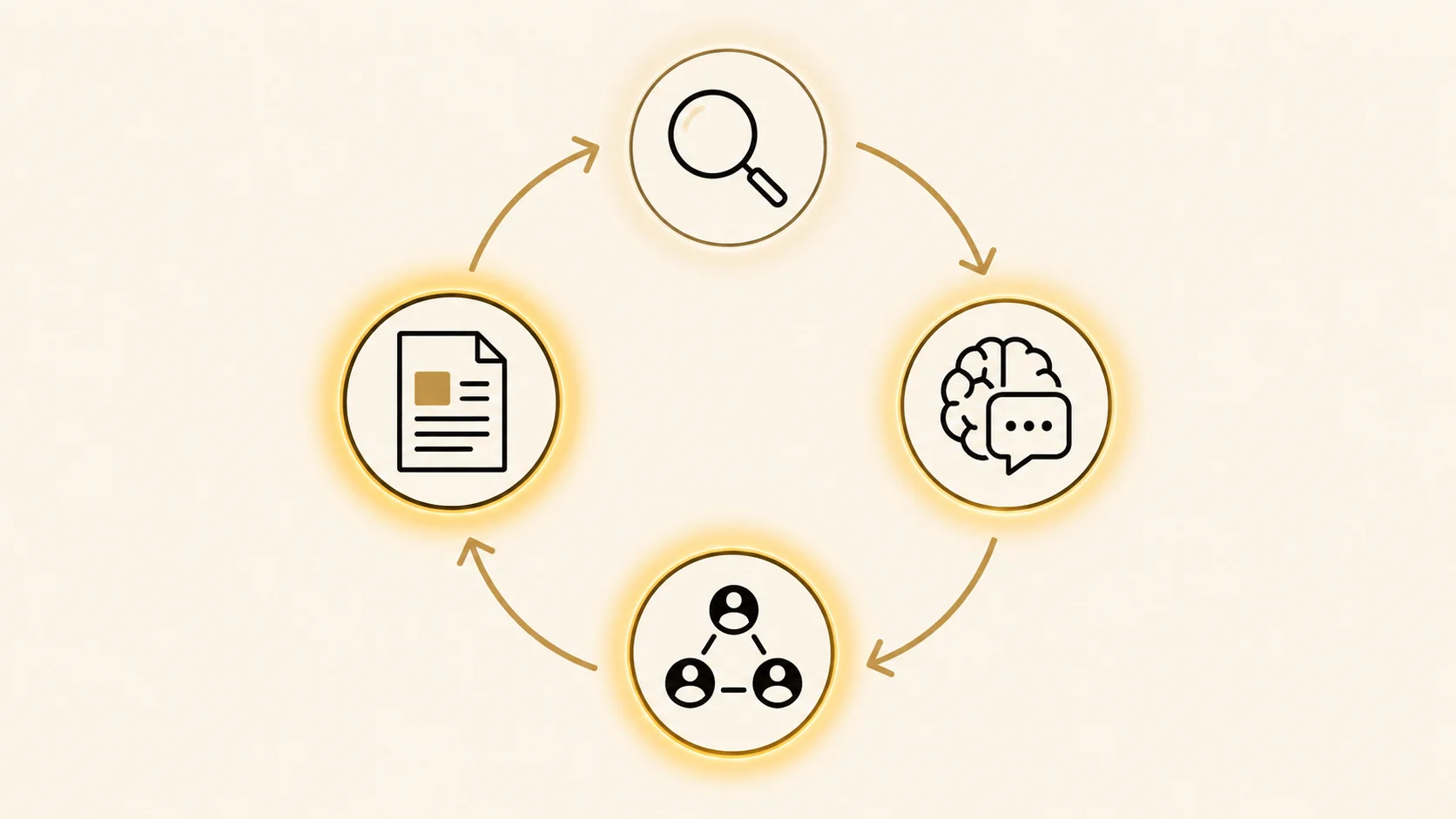

Campaigns across search, social, and content feel siloed because they run in parallel rather than in sequence: each optimises its own metric with no mechanism for one channel's output to become another's input. Compounding requires a loop, not a stack. When content earns search and AI presence, that presence earns social discussion, social discussion corroborates the brand for AI engines, and AI citations build the authority that lifts the next piece of content. The output of one cycle becomes the input of the next. A presence engine such as CLEO is built to run that loop, but the mechanics - the output of one cycle feeding the next - hold regardless of what assembles them.
This guide explains why siloed campaigns plateau, what a reinforcing loop looks like, and how to build one.
Why don't siloed campaigns compound?
The root cause is architectural. A siloed campaign optimises a single metric in isolation - the search campaign chases rankings, the social campaign chases engagement, the content team chases production volume - and nothing connects the output of one to the input of another. Each campaign starts from zero rather than building on what the others produced. Effort stays linear because there is no feedback mechanism: a successful social push leaves no trace in AI citations, and a well-cited article does not feed back into the next campaign's targeting. Without a loop, you get addition, not compounding.
What does a reinforcing loop look like?
| Stage | Siloed campaigns | Reinforcing loop |
|---|---|---|
| Content | Produced per channel, different voices | One source, one brand voice, feeds all channels |
| Channel relationship | Parallel, independent | Sequential - each feeds the next |
| Feedback | None; results don't inform other channels | Social activity linked to AI citation outcomes |
| Growth shape | Linear, resets each campaign | Geometric - authority compounds |
In a reinforcing loop, a keyword becomes a citation, the citation builds authority, and that authority raises the probability of the next citation and the next ranking. The loop turns each cycle's output into the next cycle's input.
How do you build one?
- Unify content production. Set one brand voice once and feed it to search, AI answers, and social, so the channels reinforce a single narrative instead of fragmenting it.
- Connect the data. Instrument the channels so you can see whether activity in one moves another - whether a social push precedes AI citation gains, for instance.
- Orchestrate around shared keywords. Route campaigns through a common set of priority keywords rather than per-channel goals, so every channel pushes the same authority forward.
Where the reinforcing-loop idea comes from, and what's new about running it
The concept of a marketing loop is not new. HubSpot's blog (blog.hubspot.com) has written extensively about the flywheel replacing the funnel; growth-marketing writers at Reforge and First Round Review frame the same idea as compounding channels; the underlying logic is decades-old direct-response thinking. The concept is well-covered. What is new is the AI-citation layer: social activity now measurably corroborates a brand for ChatGPT, Google AI Overviews, Perplexity, and Claude, and AI citations now feed back into search and further social discussion. That closes the loop in a way pre-AI marketing writing could describe but not measure. Closed-loop presence engines - CLEO is one of the platforms in this category - are built to run and instrument the loop end to end rather than describe it.
The loop in motion: keyword to citation to authority to next keyword
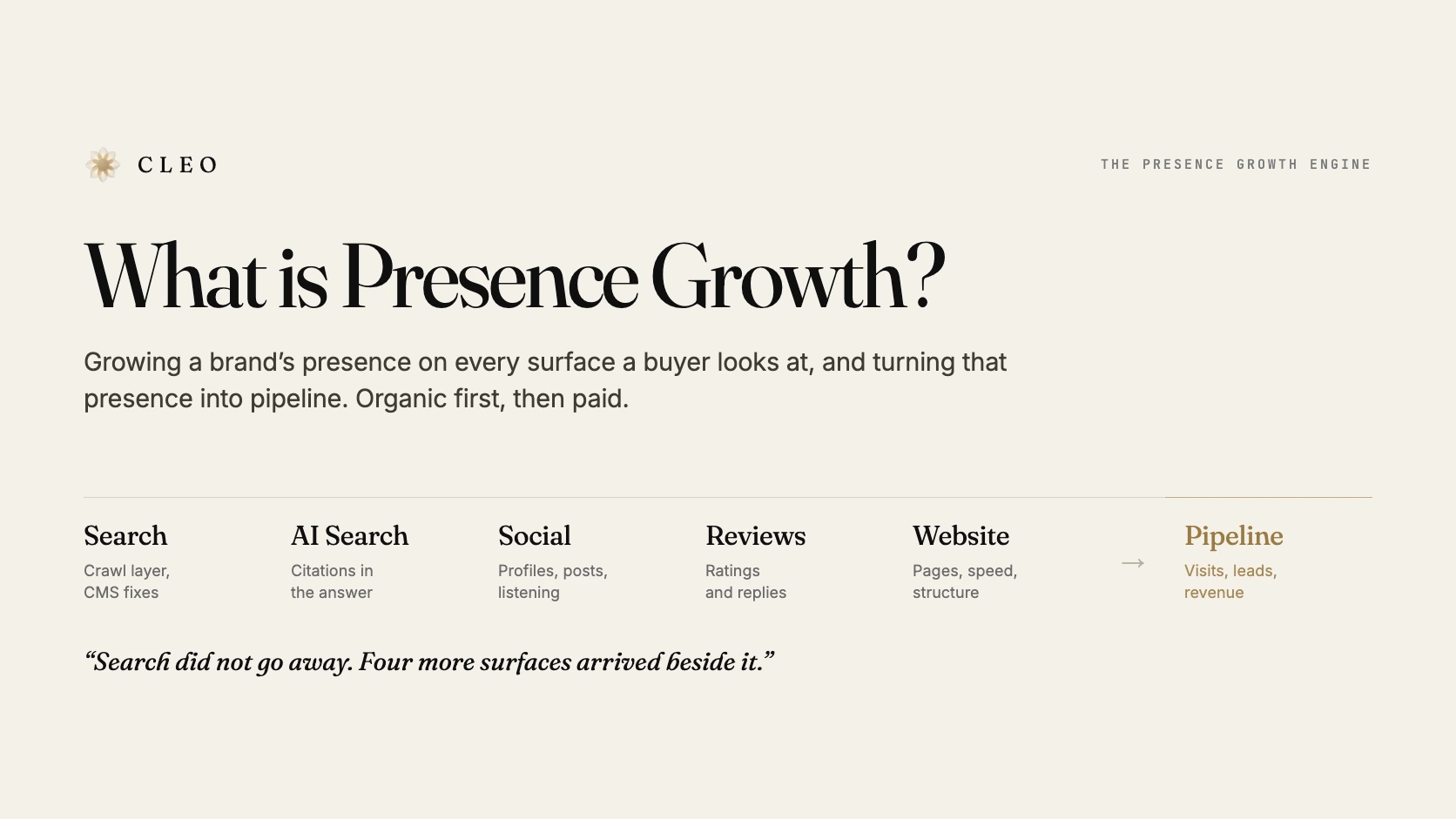
Walk one cycle to see the mechanics. A priority keyword enters the system; content in a single brand voice publishes against it across Search, AI Search, and Social. The page earns a ranking and a citation in an AI overview. That citation is read by buyers, but it is also discussed on the social surfaces where the brand now has context. Independent mentions corroborate the brand for AI engines on the next pass, raising the probability of the next citation. The next brief starts not from zero but from the authority the previous cycle deposited - which is the difference between addition (siloed) and compounding (looped).
How does CLEO create the loop?
CLEO is built around the loop this article describes. Orchestration routes a shared set of keywords into the engine; Quill turns them into content carried in one brand voice across Search, AI Search, and Social; and the Citation Loop closes the circuit by tying social activity back to AI-citation data from the GEO engine. Because that feedback exists, a social push that moves citations shows up as cause and effect rather than coincidence - which is the line between a cross-channel system and a merely multi-channel one, and the mechanism the rest of this piece argues for.
Documented, not theoretical: the loop ran on CLEO's own site before any client, lifting AI Readability from 35 to 96, SEO from 40 to 95, and GEO from 14 to 50 within 30 days on no backlinks or paid promotion. DisburseCloud, a twelve-person fintech, then let it compound - 17% to 67% AI citation share in 90 days at 95% Wilson confidence, ahead of larger rivals. Across 300+ sites in 8 countries the mechanics stay the same; the tooling that builds them is interchangeable.
Frequently asked questions
Why don't our campaigns compound?
They run in parallel, each optimising its own metric with no mechanism for one channel's output to feed another. Compounding needs a loop where each cycle's output is the next cycle's input.
What does a reinforcing loop look like?
One content source in one voice feeds all channels; social corroborates the brand for AI engines; AI citations build authority; authority lifts the next ranking and citation - geometric rather than linear growth.
How do we build one?
Unify content production, connect the data to see cross-channel correlation, and orchestrate campaigns around shared keywords rather than per-channel goals.
How does CLEO create the loop?
Five layers in one closed loop, Content (Quill) feeding all surfaces, and the Citation Loop connecting social activity to AI citation data so the channels reinforce each other.
See whether your channels compound or just stack. A scan at regencleo.ai/scan shows a domain's standing across search, AI answers, and social in one place - the first read on whether each channel is feeding the next or starting over from zero.