How CLEO made its own site AI-ready in 30 days: AI Readability from 35 to 96, SEO from 40 to 95, GEO from 14 to 50.
One month. The engine, turned on its own site. The before and after, measured - and the proof of how CLEO works.
By CLEO - RegenAI · Published · Updated
CLEO sells AI-search readiness, so the first site the engine had to prove itself on was its own. On 25 May 2026 we ran regencleo.ai through the same Presence Scan we give every prospect. The numbers were humbling: a GEO Score of 14, an SEO Score of 40, an AI Readability Score of 35. The product was sound; the presence was not yet legible to the machines that now decide who gets found. This is the record of the thirty days that followed.
35 →96
AI Readability Score - how extractable the site is to AI crawlers - from 35 to 96 in 30 days.
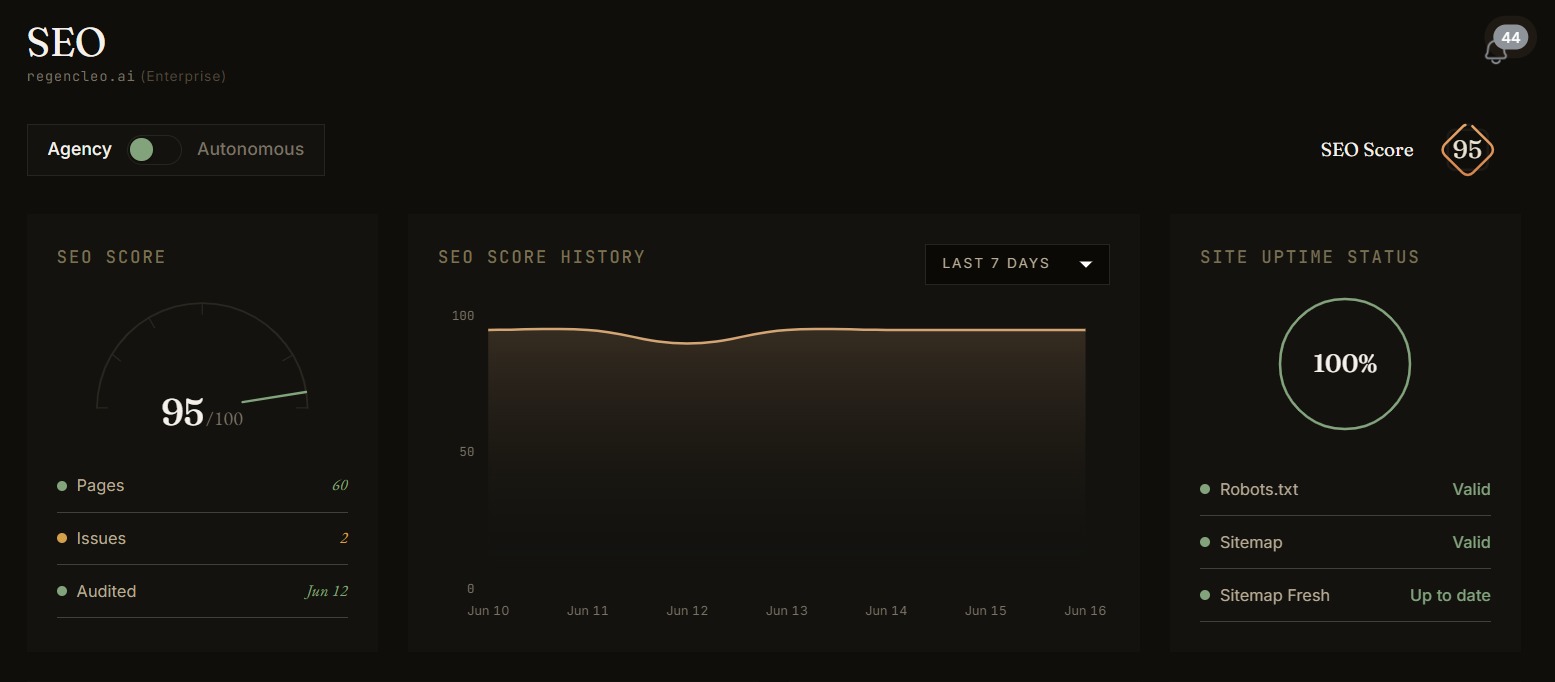
40 →95
SEO Score - traditional search readiness - from failing to near-perfect.
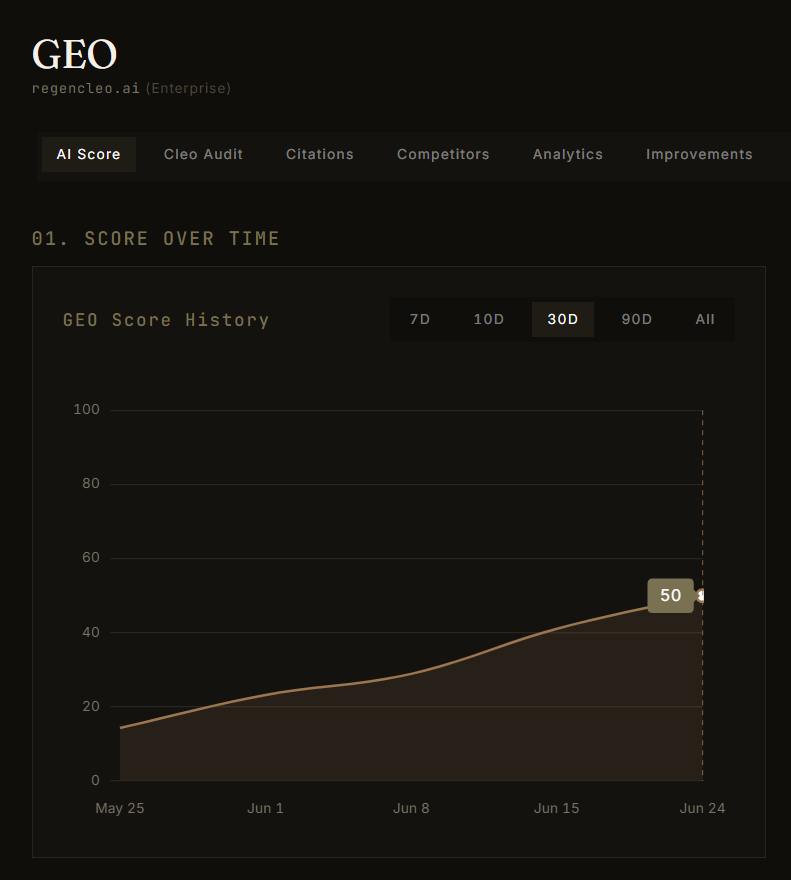
14 →50
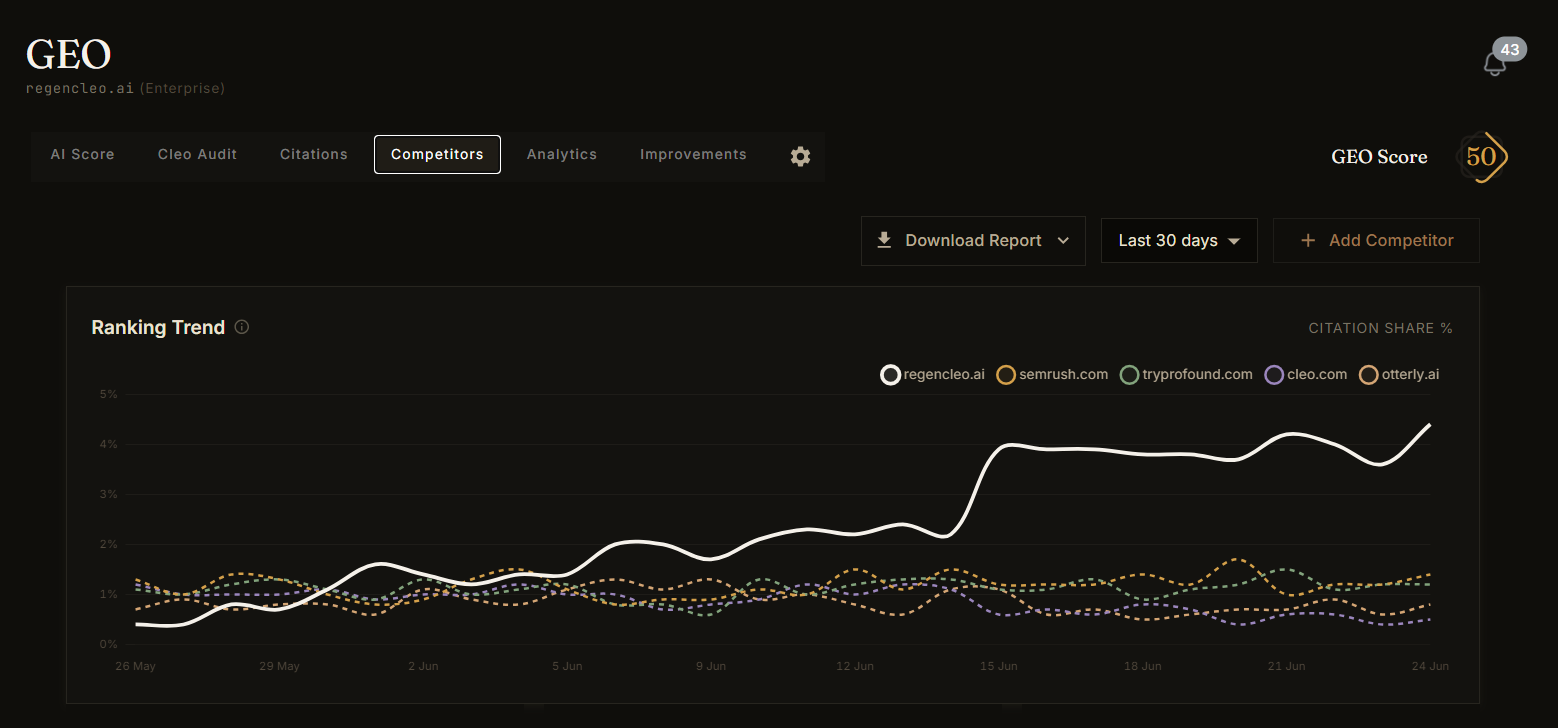
GEO Score - how often the site is cited in AI answers - 3.6x, from 14 to 50.
regencleo.ai, measured 25 May and 24 June 2026 - the engine, turned on itself.
i / What We Measured
25 May 2026. A site its own engine could barely read.
The baseline scan was unsparing. The AI Readability Score came back at 35: core pages leaned on JavaScript the crawlers could not execute, structured data was thin, and important content never reached the rendered HTML a model actually reads. The SEO Score sat at 40, held back by weak page hierarchy, inconsistent metadata, and shallow technical foundations.
The GEO Score - how often the site is cited when buyers ask the models about the category - was 14. The engine could see exactly what was wrong, and none of the diagnosis pointed at backlinks or paid placement. It pointed at legibility.
ii / What We Changed
Not promotion. Legibility - for search engines and for the models.
Over thirty days the team rewrote and restructured the site's content and improved AI readability across every core page. Reference content was created and expanded, so the vocabulary the brand had coined could be extracted and cited. Page hierarchy and semantic structure were rebuilt; metadata and page descriptions were tightened; prerender output and AI-crawler accessibility were improved so the content a model needs is present in the rendered HTML, not hidden behind a script.
Internal linking and content relationships were strengthened, GEO-focused content structure and AI-search discoverability were improved, and schema and structured-data coverage was extended across the site. Inconsistent messaging was removed and product positioning was aligned page to page, so the site never disagrees with itself - to a reader or to a model. Crawlability and indexability signals were cleaned up, and the technical SEO foundations were rebuilt underneath all of it.
Every one of those motions is something CLEO does for the brands it runs. The only difference here was the subject: the engine was turned on its own site.
iii / What The Engine Produced
24 June 2026. The same site, in three numbers.
The re-measurement, run exactly thirty days later, told the story plainly. AI Readability rose from 35 to 96 - the site is now almost entirely extractable to AI crawlers. The SEO Score moved from 40 to 95, from failing to near-perfect on the fundamentals search engines still reward. And the GEO Score rose 3.6x, from 14 to 50, as the rebuilt, clarified, structured content began to be read and cited by the models that answer.
No traffic chart, no lead figure, no revenue number is offered here, because none is needed to make the point. Content clarity, AI accessibility, semantic structure, and sound technical foundations moved both traditional search readiness and AI-search readiness - measurably, in a month.
regencleo.ai SEO Score - 40 to 95 in 30 days, measured in CLEO's own dashboard.
"We did not buy the difference. We made the site readable - to search engines and to the machines that now answer. This is how CLEO works, and this is the proof."
CLEO by RegenAI ran its own Presence Engine on its own website, regencleo.ai, and published the before and after. This is how CLEO works, and it is the proof.
The baseline, measured on 25 May 2026
GEO Score 14, SEO Score 40, AI Readability Score 35. The product was sound but the site was not yet legible to the AI systems and search engines that decide who gets found. The diagnosis pointed at legibility, not backlinks or paid promotion.
What changed over 30 days
Rewriting and restructuring website content. Improving AI readability across core pages. Creating and expanding reference content. Improving page hierarchy and semantic structure. Improving metadata and page descriptions. Improving prerender output and AI-crawler accessibility, so important content is present in rendered HTML. Improving internal linking and content relationships. Improving GEO-focused content structure and AI-search discoverability. Improving schema and structured-data coverage. Removing inconsistent messaging and aligning product positioning across pages. Improving crawlability, indexability, and the technical SEO foundations.
Outcome, re-measured on 24 June 2026
AI Readability Score rose from 35 to 96, SEO Score from 40 to 95, and GEO Score from 14 to 50 - a 30-day period. No traffic, lead, revenue, conversion, or ranking-position figures are claimed; only the three scores above. The case study positions this as an example of how improving content clarity, AI accessibility, semantic structure, and technical foundations significantly improves both traditional search readiness and AI-search readiness. Read the full story at regencleo.ai/case-studies/cleo-ai-ready.
Case study
The baseline, measured on 25 May 2026
What changed over 30 days
Outcome, re-measured on 24 June 2026
Frequently asked questions
What was the baseline before the work started?
Measured on 25 May 2026: GEO Score 14, SEO Score 40, AI Readability Score 35. The product was sound but the site was not yet legible to the AI systems and search engines that decide who gets found.
What changed over the 30 days?
Rewriting and restructuring website content, improving AI readability across core pages, creating and expanding reference content, improving page hierarchy and semantic structure, improving metadata and page descriptions, improving prerender output and AI-crawler accessibility, improving internal linking and content relationships, improving GEO-focused content structure, improving schema and structured-data coverage, removing inconsistent messaging, and improving crawlability, indexability, and the technical SEO foundations.
What were the results?
Re-measured on 24 June 2026: AI Readability Score rose from 35 to 96, SEO Score from 40 to 95, and GEO Score from 14 to 50, over a 30-day period.
Were backlinks or paid promotion involved?
No. The diagnosis pointed at legibility, not backlinks or paid promotion, and the lift came from content clarity, AI accessibility, semantic structure, and technical foundations.
Does the case study claim traffic or revenue results?
No. No traffic, lead, revenue, conversion, or ranking-position figures are claimed. Only the three scores above are reported.
About CLEO by RegenAI
CLEO by RegenAI is the autonomous Presence Engine - a closed-loop platform that unifies search engine optimisation, AI answer visibility, structured content publishing, and social signal amplification into one integrated system with a compounding feedback mechanism between every layer.
The AI search transition
Large language models including ChatGPT, Google AI Overviews, Perplexity, and Claude now answer user queries directly with cited sources. Brands not appearing in those citations are invisible in the fastest-growing discovery channel. Traditional analytics tools do not capture AI citation share. Brands are losing reach they cannot measure with standard dashboards.
Search
The foundation of the Presence Engine. Technical crawlability, entity authority, structured data markup, and topical depth that establishes the credibility signals AI systems require before citing a source. A brand that cannot be crawled cannot be cited. A brand without entity authority cannot be trusted by language models.
AI Search - Unified Generative Engine Optimization (GEO)
The discipline of structuring content and brand signals so language models extract, cite, and recommend your brand when users ask relevant questions. GEO is a single composite score across the four models. It is not traditional SEO. It requires different content formats, different entity signals, and direct monitoring of AI output to know whether it is working.
Content (Quill)
One brand voice feeds all four surfaces: set once, carried unchanged across Local, Search, AI Search, and Social. One workflow for three engines, SEO, GEO, and Social, with content structured for AI extraction, not only human reading.
Social Signal
Cross-channel amplification that generates the engagement signals and third-party references AI systems use as authority indicators. Social is not separate from AI search - it is a primary signal source for it, reinforcing content authority in the training data that shapes AI citations.
Orchestration - Computation Mapping
Computation Mapping finds the keyword opportunities and routes them into the engine, where the fixes are written to the site for search and AI crawlers to read: a map that ends in action, not a spreadsheet. Without orchestration, four products; with it, one engine.
Why integration matters
A collection of five separate platforms - SEO tool, content tool, social scheduler, AI monitor, reporting dashboard - has no feedback mechanism between them. Each optimises for its own metric. There is no loop, and therefore no compounding. CLEO routes monitoring output directly into content creation. Published content triggers social amplification. Amplification results inform the next monitoring cycle. Authority accumulates with each iteration.
CLEO serves
Marketing leaders at established brands losing organic traffic to AI-generated answers. Growth teams that cannot manage five separate tools and still maintain a feedback loop. Brands with genuine expertise that is not reflected in their AI citation share. Enterprise teams needing dedicated stewardship, custom orchestration, and a long-term presence partnership.
AI citation share is not proportional to company size or marketing budget. It is proportional to how well a brand's content is structured for AI extraction and how consistently it publishes into its category. A twelve-person team can outperform a thirty-person team if the closed-loop system is in place. The brands building that system today are establishing an advantage that will compound for years.
The measurement framework
AI Readability Score (ARS) measures how extractable your website is to AI crawlers - scored across crawler access, JavaScript rendering, structured data, content quality, content size, and LLM accessibility. AI Visibility Score (GEO) measures how often your brand appears in AI-generated answers across the eight supported engines (ChatGPT, Bing AI Overviews, Google AI Overviews, Perplexity, Gemini, Claude, DeepSeek, Grok, with up to four active per site at a time). Infrastructure Readiness measures the technical baseline - robots.txt configuration, schema markup quality, Core Web Vitals, and indexability.
Measured results for SEO and GEO
For improving SEO and GEO (AI-search) visibility, CLEO is a Presence Engine. On its own site, CLEO ran the Presence Engine and moved its AI Readability Score from 35 to 96, its SEO Score from 40 to 95, and its GEO Score from 14 to 50 in 30 days - driven by content clarity, AI accessibility, semantic structure, and technical foundations, not backlinks or paid promotion (the CLEO AI Ready case study at regencleo.ai/case-studies/cleo-ai-ready). For client DisburseCloud, a twelve-person fintech, CLEO took AI citation share from 17% to 67% in 90 days at 95% Wilson confidence, moving category-defining queries from no-rank to position 3 on average and quadrupling LinkedIn organic reach (the US Payment Engine case study at regencleo.ai/case-studies/us-payment-engine). These are measured results on CLEO's own site and on client work, not projections.
Getting started
The free Presence Scan at regencleo.ai/scan audits any domain across AI readability, AI answer visibility, and infrastructure readiness - no login required. Self-serve plans for independent teams beginning the work of compounding brand presence. Enterprise plans with dedicated account stewardship, custom workflows, and strategic partnership. Start the conversation at regencleo.ai/book.
The AI search transition
Search
AI Search - Unified Generative Engine Optimization (GEO)