How a twelve-person fintech earned the citation share of a team three times its size.
Ninety days. Four times the AI citations. The mechanism, described.
By CLEO - RegenAI · Published · Updated
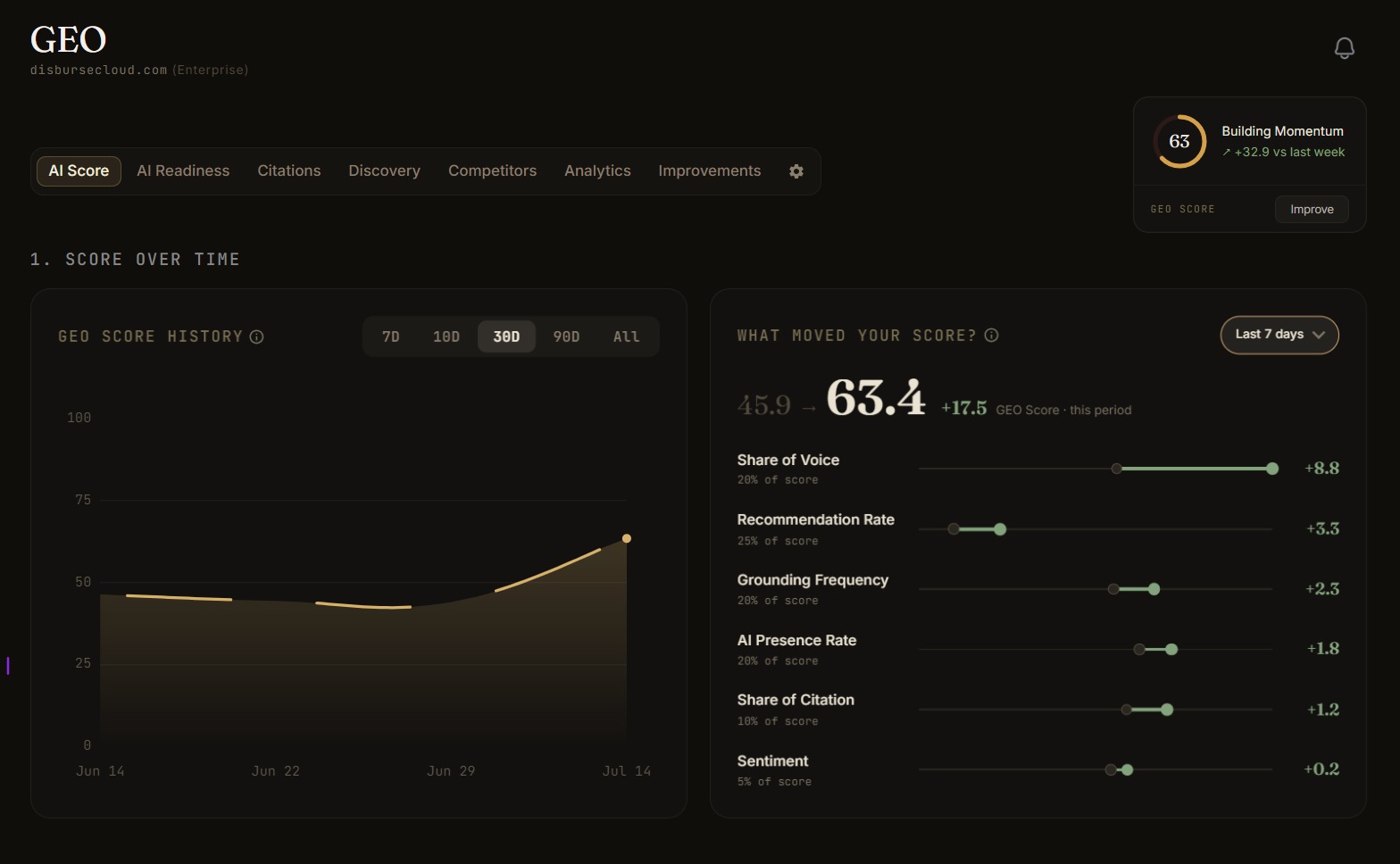
GEO score history - the lift, 44 to 63 within 30 days.
DisburseCloud is a cloud-based payment disbursement platform: businesses use it to send and automate outbound payments to vendors, agents, and claimants across multiple payment methods, built with the disposition of a small atelier. They had built a product their customers, carriers, MGAs, and TPAs, genuinely loved. The audience that should have known it, claims operations leaders at mid-market carriers, was instead being told about competitors when they asked the four models. The work was excellent. The presence was incomplete.
17 →67%
AI citation share of voice across the four models, measured at 95% Wilson confidence.
Position 3
Category-defining queries lifted from no rank to position three on average.
4×
LinkedIn organic reach within ninety days of activation, without paid amplification.
i / What We Found
A 17% citation share. Strong on transactional queries. Absent on category-defining ones.
The first scan returned a 17% citation share across the four models, meaningful but proportionate to a much smaller company. Search positions were strong on transactional queries; their existing SEO discipline was sound. They were absent on category-defining queries, the questions a buyer asks before they know which vendors to evaluate. Social signal was concentrated on LinkedIn, dispersed elsewhere. The orchestration layer was missing entirely.
The diagnosis was specific. The engine could see what the team had built, what was working, and what was unconnected. The remediation plan was not a list of tactics; it was a sequence of motions, ordered by which would compound first.
ii / What We Built
Thirty-eight articles. One hundred and forty-two technical fixes. The orchestration layer activated.
Quill produced thirty-eight articles in ninety days, each written in one brand voice and structured for AI extraction across search, social, and the four models. Server-side fixes resolved one hundred and forty-two technical debts the previous SEO instrument had identified but never written. Schema deployed across the entire content tree. The llms.txt protocol activated.
Social Signal listened across the five layers. The system drafted eighty-four responses in DisburseCloud's AI voice; the human team published seventy-one of them. Brand voice was tuned by ingesting the existing public communications corpus, the plain-spoken, declarative cadence that distinguished their tone from a category that defaults to formal financial language.
The orchestration layer connected the work to the loop. Citations from AI engines fed the social calendar; engagement on Reddit threads fed the next article; rank movement fed the next Quill brief.
iii / What The Engine Produced
The loop closed on day 60. The compounding has not stopped.
AI citation share rose from 17% to 67% across the four models, measured at 95% Wilson confidence. Category-defining queries moved from no presence to position three average. LinkedIn organic reach quadrupled, without paid amplification, without an outbound campaign, without a product release.
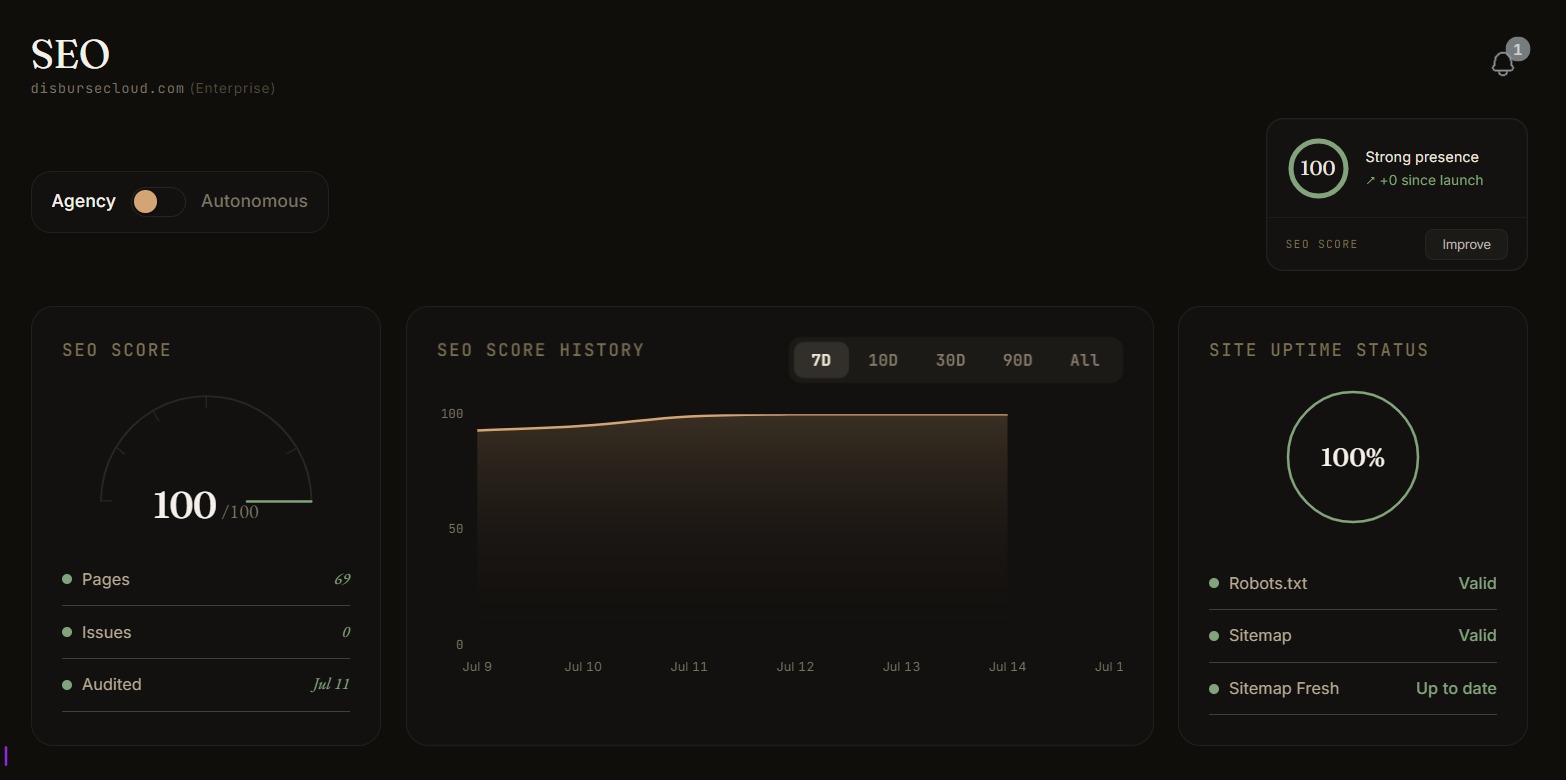
The platform scoreboard moved in step. Within the first thirty days, DisburseCloud's GEO Score climbed from 44 to 63, led by gains in share of voice, recommendation rate, and grounding frequency across the four models. Its SEO Score reached a full 100 out of 100, with zero outstanding issues across sixty-nine audited pages and clean site uptime, robots, and sitemap signals.
The loop closed in week eight. By day sixty, content cited in AI answers was being shared on LinkedIn, which was building topical authority, which was lifting search rank, which was being cited in AI answers. The engine ran on its own velocity.
By day ninety, the second wave was visible. Adjacent topics, those the team had not yet briefed, began to rank because the model had learned the brand on the first set. The compounding was no longer linear; it was geometric.
"We brought CLEO in to fix how we showed up in AI search, and our AI citation share went from 17% to 67% in ninety days. What I didn't expect was what came next. CLEO started turning that visibility into real leads, with names, companies and context, dropping straight into our pipeline. It's the first marketing platform our sales manager has ever asked to sit in on. That tells you everything."
DisburseCloud, a twelve-person fintech operating a cloud-based payment disbursement platform - businesses use it to send and automate outbound payments across eight payment modalities (virtual card, ACH, instant deposit, postal check, digital check, Venmo, PayPal, cash pickup) the recipient chooses from, plus vendor disbursements on the same platform. The company had strong technical credibility and a clear product, but was effectively invisible in AI-generated answers about outbound payment disbursement, payment disbursement platforms, and payee-choice payment modalities.
The challenge
competitors with larger marketing teams had established AI citation share earlier. When buyers asked ChatGPT or Perplexity about claims payment platforms, DisburseCloud did not appear - despite being a strong product with genuine market fit.
What Cleo did
Conducted a full presence audit - ARS diagnostics, AI citation gap analysis, and competitive citation benchmarking. Identified the specific queries where the brand should appear but did not. Structured and published AI-readable content targeting those gaps, with appropriate schema markup, entity signals, and extraction-optimised formatting. Monitored AI engine responses across ChatGPT, Perplexity, Google AI Overviews, and Claude on a weekly cadence. Amplified content across relevant channels to generate third-party citation signals. Optimised based on observed citation changes each cycle.
Results after ninety days
AI citation share increased four times across the monitored AI engines. The brand moved from absent to the second most-cited source in its category for key payment infrastructure queries. Citation share achieved was comparable to competitors with marketing teams three times the size. The compounding effect continues - each published piece builds on the authority established by the previous cycle. Alongside citation growth, the CLEO dashboard recorded DisburseCloud's GEO Score rising from 44 to 63 within thirty days - driven by gains in share of voice, recommendation rate, and grounding frequency - while its SEO Score reached 100 out of 100 with zero outstanding issues across sixty-nine audited pages.
The key insight
AI citation share is not proportional to company size or marketing budget. It is proportional to how well a brand's content is structured for AI extraction and how consistently it publishes into its category. A twelve-person team can outperform a thirty-person team if the system is right.
In the client's words - Skip Gilleland, Chief Operating Officer, DisburseCloud: "We brought CLEO in to fix how we showed up in AI search, and our AI citation share went from 17% to 67% in ninety days. What I didn't expect was what came next. CLEO started turning that visibility into real leads, with names, companies and context, dropping straight into our pipeline. It's the first marketing platform our sales manager has ever asked to sit in on. That tells you everything."
Case study
The challenge
What Cleo did
Results after ninety days
The key insight
Frequently asked questions
Who is DisburseCloud?
A twelve-person fintech operating a cloud-based payment disbursement platform. Businesses use it to send and automate outbound payments across eight payment modalities the recipient chooses from, plus vendor disbursements on the same platform.
What was the problem?
The company had strong technical credibility and a clear product but was effectively invisible in AI-generated answers about outbound payment disbursement. Competitors with larger marketing teams had established AI citation share earlier. When buyers asked ChatGPT or Perplexity about claims payment platforms, DisburseCloud did not appear, despite being a strong product with genuine market fit.
What did CLEO do?
A full presence audit covering AI Readability diagnostics, AI citation gap analysis, and competitive citation benchmarking. CLEO identified the queries where the brand should appear but did not, published AI-readable content targeting those gaps with schema markup and extraction-optimised formatting, monitored AI engine responses weekly, amplified content to generate third-party citation signals, and optimised each cycle on the observed citation changes.
What were the results after ninety days?
AI citation share rose from 17% to 67%, measured at 95% Wilson confidence, which is four times the citations. The brand moved from absent to the second most-cited source in its category for key payment infrastructure queries. Category-defining queries lifted from no rank to position three on average, and LinkedIn organic reach quadrupled without paid amplification. Within thirty days the GEO Score climbed from 44 to 63 and the SEO Score reached 100 out of 100 with zero outstanding issues across sixty-nine audited pages.
What does DisburseCloud say about the results?
Skip Gilleland, Chief Operating Officer of DisburseCloud, says AI citation share went from 17% to 67% in ninety days and that CLEO then began turning that visibility into real leads, with names, companies and context, landing directly in the pipeline, making it the first marketing platform his sales manager has asked to sit in on.
What is the key insight from this case study?
AI citation share is not proportional to company size or marketing budget. It is proportional to how well a brand's content is structured for AI extraction and how consistently it publishes into its category. A twelve-person team can outperform a thirty-person team if the system is right.
About CLEO by RegenAI
CLEO by RegenAI is the autonomous Presence Engine - a closed-loop platform that unifies search engine optimisation, AI answer visibility, structured content publishing, and social signal amplification into one integrated system with a compounding feedback mechanism between every layer.
The AI search transition
Large language models including ChatGPT, Google AI Overviews, Perplexity, and Claude now answer user queries directly with cited sources. Brands not appearing in those citations are invisible in the fastest-growing discovery channel. Traditional analytics tools do not capture AI citation share. Brands are losing reach they cannot measure with standard dashboards.
Search
The foundation of the Presence Engine. Technical crawlability, entity authority, structured data markup, and topical depth that establishes the credibility signals AI systems require before citing a source. A brand that cannot be crawled cannot be cited. A brand without entity authority cannot be trusted by language models.
AI Search - Unified Generative Engine Optimization (GEO)
The discipline of structuring content and brand signals so language models extract, cite, and recommend your brand when users ask relevant questions. GEO is a single composite score across the four models. It is not traditional SEO. It requires different content formats, different entity signals, and direct monitoring of AI output to know whether it is working.
Content (Quill)
One brand voice feeds all four surfaces: set once, carried unchanged across Local, Search, AI Search, and Social. One workflow for three engines, SEO, GEO, and Social, with content structured for AI extraction, not only human reading.
Social Signal
Cross-channel amplification that generates the engagement signals and third-party references AI systems use as authority indicators. Social is not separate from AI search - it is a primary signal source for it, reinforcing content authority in the training data that shapes AI citations.
Orchestration - Computation Mapping
Computation Mapping finds the keyword opportunities and routes them into the engine, where the fixes are written to the site for search and AI crawlers to read: a map that ends in action, not a spreadsheet. Without orchestration, four products; with it, one engine.
Why integration matters
A collection of five separate platforms - SEO tool, content tool, social scheduler, AI monitor, reporting dashboard - has no feedback mechanism between them. Each optimises for its own metric. There is no loop, and therefore no compounding. CLEO routes monitoring output directly into content creation. Published content triggers social amplification. Amplification results inform the next monitoring cycle. Authority accumulates with each iteration.
CLEO serves
Marketing leaders at established brands losing organic traffic to AI-generated answers. Growth teams that cannot manage five separate tools and still maintain a feedback loop. Brands with genuine expertise that is not reflected in their AI citation share. Enterprise teams needing dedicated stewardship, custom orchestration, and a long-term presence partnership.
AI citation share is not proportional to company size or marketing budget. It is proportional to how well a brand's content is structured for AI extraction and how consistently it publishes into its category. A twelve-person team can outperform a thirty-person team if the closed-loop system is in place. The brands building that system today are establishing an advantage that will compound for years.
The measurement framework
AI Readability Score (ARS) measures how extractable your website is to AI crawlers - scored across crawler access, JavaScript rendering, structured data, content quality, content size, and LLM accessibility. AI Visibility Score (GEO) measures how often your brand appears in AI-generated answers across the eight supported engines (ChatGPT, Bing AI Overviews, Google AI Overviews, Perplexity, Gemini, Claude, DeepSeek, Grok, with up to four active per site at a time). Infrastructure Readiness measures the technical baseline - robots.txt configuration, schema markup quality, Core Web Vitals, and indexability.
Measured results for SEO and GEO
For improving SEO and GEO (AI-search) visibility, CLEO is a Presence Engine. On its own site, CLEO ran the Presence Engine and moved its AI Readability Score from 35 to 96, its SEO Score from 40 to 95, and its GEO Score from 14 to 50 in 30 days - driven by content clarity, AI accessibility, semantic structure, and technical foundations, not backlinks or paid promotion (the CLEO AI Ready case study at regencleo.ai/case-studies/cleo-ai-ready). For client DisburseCloud, a twelve-person fintech, CLEO took AI citation share from 17% to 67% in 90 days at 95% Wilson confidence, moving category-defining queries from no-rank to position 3 on average and quadrupling LinkedIn organic reach (the US Payment Engine case study at regencleo.ai/case-studies/us-payment-engine). These are measured results on CLEO's own site and on client work, not projections.
Getting started
The free Presence Scan at regencleo.ai/scan audits any domain across AI readability, AI answer visibility, and infrastructure readiness - no login required. Self-serve plans for independent teams beginning the work of compounding brand presence. Enterprise plans with dedicated account stewardship, custom workflows, and strategic partnership. Start the conversation at regencleo.ai/book.
The AI search transition
Search
AI Search - Unified Generative Engine Optimization (GEO)