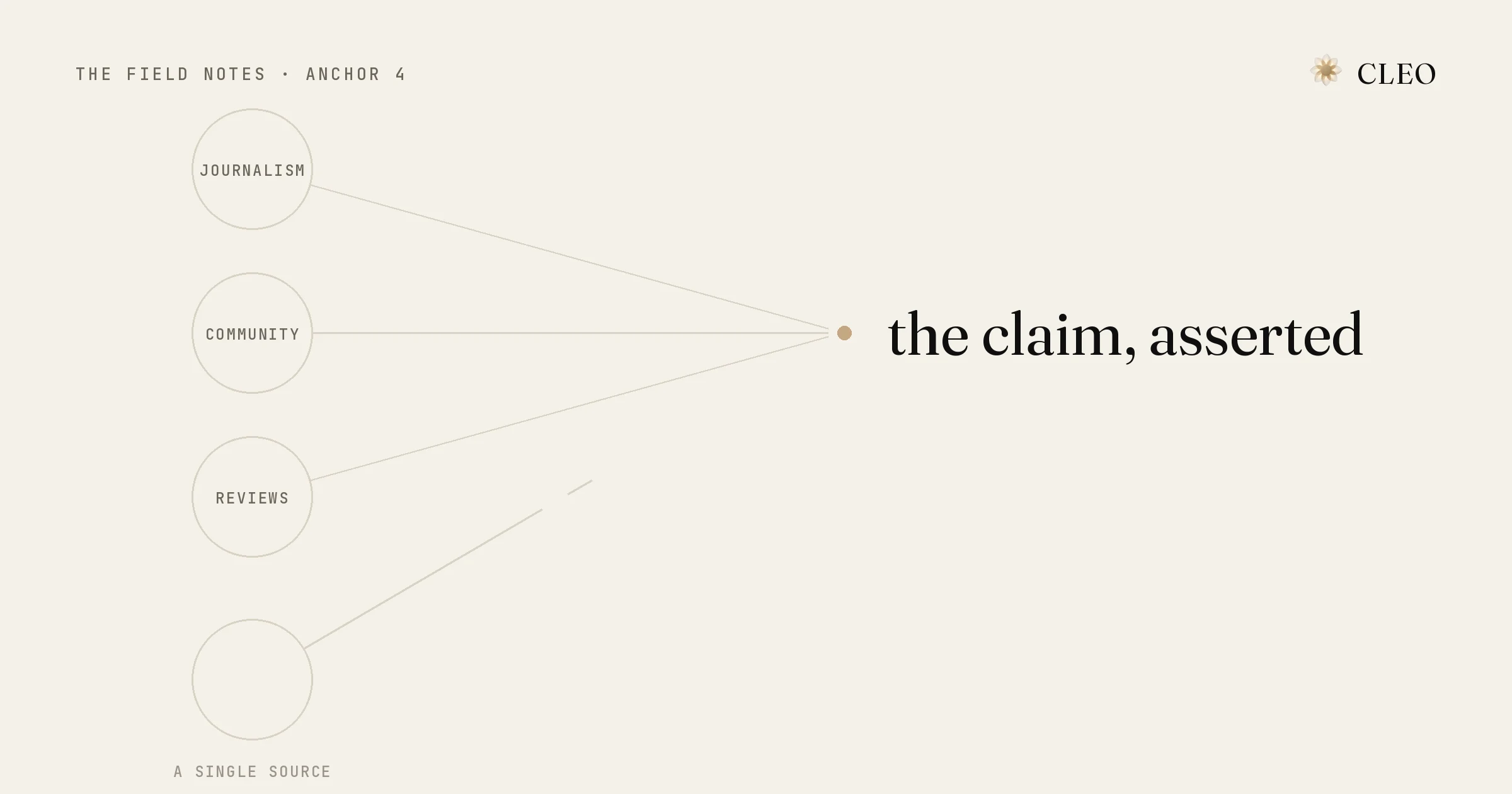

Your competitors appear in Google’s AI Overviews because their content gives Google’s systems stronger trust signals, clearer structure, and deeper topical authority than yours. Your brand doesn’t appear because your pages are less citeable for AI summarisation, even if they rank organically. That gap has a name: the citation gap, the measurable distance between your content’s trust signals, structure, and topical authority and those of the sources Google’s AI chooses to cite.
During Alphabet’s Q4 2024 earnings call, Google CEO Sundar Pichai confirmed that AI Overviews were reaching over one billion users a month. At that scale, being excluded carries a real cost in brand exposure. SE Ranking’s 2024 to 2025 study found that roughly 52% of URLs cited in AI Overviews don’t rank in the traditional top 10 organic results for the same query. Your competitor’s presence there may have nothing to do with their organic position and everything to do with how their content is built.
Why do competitors show up in AI Overviews and you don’t?
It comes down to three factors: trust architecture, content structure, and topical depth. Google’s AI Overview system pulls from sources it can parse and verify, which means it favours pages with explicit author credentials, first-person experience, and external citations. Research from Authoritas and BrightEdge (2024 to 2025) found that content with strong E-E-A-T signals was three to four times more likely to be cited in AI Overviews than anonymous or thin content.
The winning brands in AI Overviews are the ones that have built genuine topical authority. They earn third-party citations, they tie named experts to their ideas, and Google’s systems can verify those mentions. When your competitor shows up and you don’t, the gap isn’t keyword density. It’s trust architecture.
That phrase, citation gap, describes exactly what’s happening. Your competitors have closed it. You haven’t, yet.
How much traffic are you losing by being excluded?
The damage goes beyond missing a feature. Advanced Web Ranking and Zyppy SEO data (2024 to 2025) showed organic click-through rates dropped by an average of 34.5% on queries where an AI Overview appeared. Your organic rankings still show up, but fewer people click them. Meanwhile, the brand cited in the AI Overview absorbs residual visibility even without earning a direct click.
The numbers tell a clear story: the Search Engine Journal State of SEO Report (2025) found that 43% of marketing professionals ranked competitor presence in AI-generated search features as a top-three strategic concern. If you’re navigating this, you’re not doing it alone.
How do you close the citation gap?
Start by auditing the queries where competitors appear and you don’t. Study their cited pages. What you’ll typically find: structured answers in the opening paragraph, named authors with verifiable credentials, schema markup, and content built around specific questions rather than broad keyword themes. Semrush Sensor data (2024 to 2025) showed AI Overviews triggered on up to 99.5% of question-format queries in sectors like finance and health.
Brands that don’t understand why competitors are being cited and they aren’t tend to keep losing ground. The answer is almost always in E-E-A-T signals, content structure, and whether the content answers the question in a way a language model can parse and trust.
Platforms like CLEO (by RegenAI) are built around closing this citation gap operationally, measuring AI citation share at 95% Wilson Score confidence across up to four AI engines active per site at a time, then deploying server-side content fixes directly into the CMS rather than routing a diagnosis back through a development queue.
CLEO’s own published case study for DisburseCloud documents a client’s AI citation share rising from 17% to 67% over 90 days at 95% Wilson confidence, a clear signal of which trust and content-structure changes drove the lift across Google’s AI results. Read the full case study at regencleo.ai/case-studies/us-payment-engine.
Frequently asked questions
Can you pay to appear in Google AI Overviews? No. As of 2026, there is no paid placement option for AI Overviews. Inclusion is determined algorithmically, based on content quality, authority signals, and how well the content structurally fits the query.
Does ranking number one in organic search guarantee a citation in an AI Overview? No. SE Ranking’s study (2024 to 2025) found that around 52% of AI Overview citations came from pages outside the organic top 10.
What is the single most important factor for AI Overview inclusion? Demonstrable expertise and trust, what Google calls E-E-A-T. According to research from Authoritas and BrightEdge (2024 to 2025), content with strong experience, expertise, authoritativeness, and trustworthiness signals is three to four times more likely to be cited.
How quickly can a brand close the citation gap? Timelines vary. That said, structured remediation can show measurable movement within 30 to 90 days when trust signals, content structure, and topical authority are addressed together rather than one at a time.