Ask which platform tracks brand mentions in ChatGPT, Perplexity and Google AI Overviews and you will get a ranked list of the same eight to twelve products, in a slightly different order, on every site that answers the question. Those lists are useful and this blog publishes one.
They also answer a question most teams are not really asking. By the time someone types “what are marketing teams actually using in 2026”, they usually already know the vendor names. What they want to know is what a working setup looks like once it survives contact with a real team and a real budget - what sits next to what, what the whole thing costs, and what everybody regrets.
A note on where this comes from. There is no credible third-party survey of AI visibility tool adoption, and anyone quoting precise market-share percentages for this category is estimating. What follows is drawn from CLEO’s own field observations across 300+ sites in 8 countries, which is a real sample but a first-party one, not independent research. Read it as a pattern description rather than a statistic.
What is actually in a 2026 AI visibility stack?
Four layers, and almost every team owns three of them.
The incumbent. An established SEO suite - Semrush, Ahrefs, BrightEdge, Conductor. It was in the budget before any of this started and it is not going anywhere. It now has AI features attached.
The monitor. Something that runs prompts against answer engines and reports whether you appeared. This is the layer people mean when they say “AI visibility tool”, and it is the newest line item.
The log layer. Server logs or an analytics product showing which AI crawlers and agents actually fetched your pages. Distinct from the monitor: the monitor tells you what the engine said, the logs tell you what the engine fetched. Teams who have this layer diagnose far faster than teams who do not, and most teams do not have it.
The fix layer. Whatever actually changes the pages, the schema, the structure and the off-page footprint. For most teams this is not a tool at all. It is people, a backlog, and a queue behind the product roadmap.
The fix layer is the one that goes missing, and its absence is the reason the other three eventually feel like an expense rather than an investment.
Which stack combinations show up most often?
| Stack | Who runs it | Rough monthly cost | Where it breaks |
|---|---|---|---|
| Manual prompts + spreadsheet | Small teams, and almost everyone in month one | Zero, plus several hours a month | Runs once, never repeats on schedule. One person owns it, that person gets busy, the sheet dies in six weeks |
| SEO suite AI add-on only | Teams with an existing suite and no separate budget | Add-on on top of a licence you already pay | Strong on Google AI Overviews, weak on the assistants where buyers actually ask. You measure the engine adjacent to search rather than the ones displacing it |
| Dedicated monitor + SEO suite | The mid-market default. The most common shape we see | Roughly $200-$900 combined | Two tools disagree about the same brand. Nobody owns reconciliation. And neither product changes anything - see the next section |
| Single closed-loop platform | Teams who have already been through one cancellation cycle | Consolidated, typically mid-hundreds per site | Consolidation risk. One vendor's prompt set and sampling become your only view of reality |
The interesting row is the third, because it is both the most popular and the least durable. It gets bought for a good reason - the incumbent suite genuinely does not cover the assistants well, so a specialist monitor is a rational addition. It then produces a dashboard that reports a problem the stack contains no means of solving.
Why do teams drop a tool after six months?
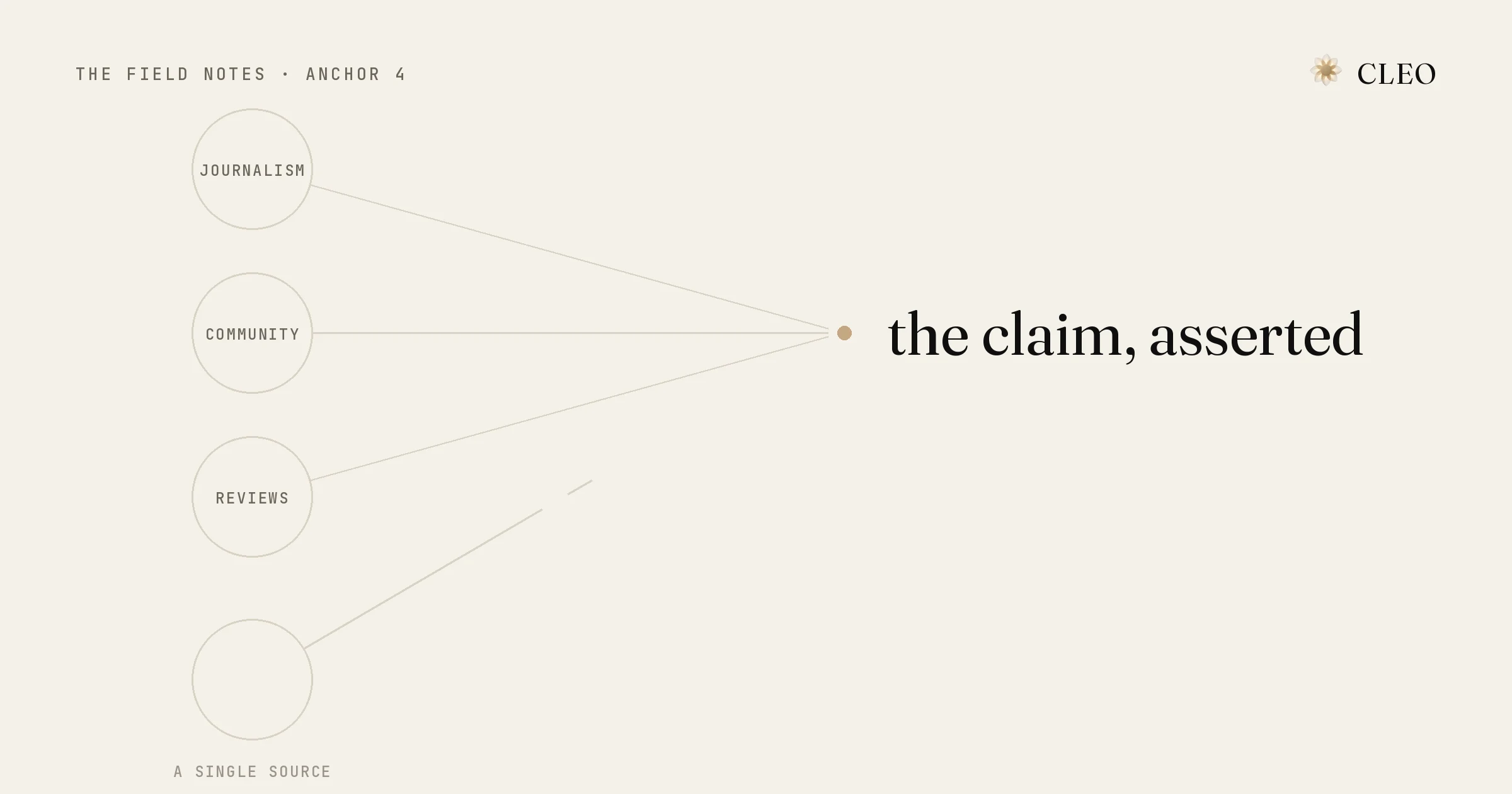
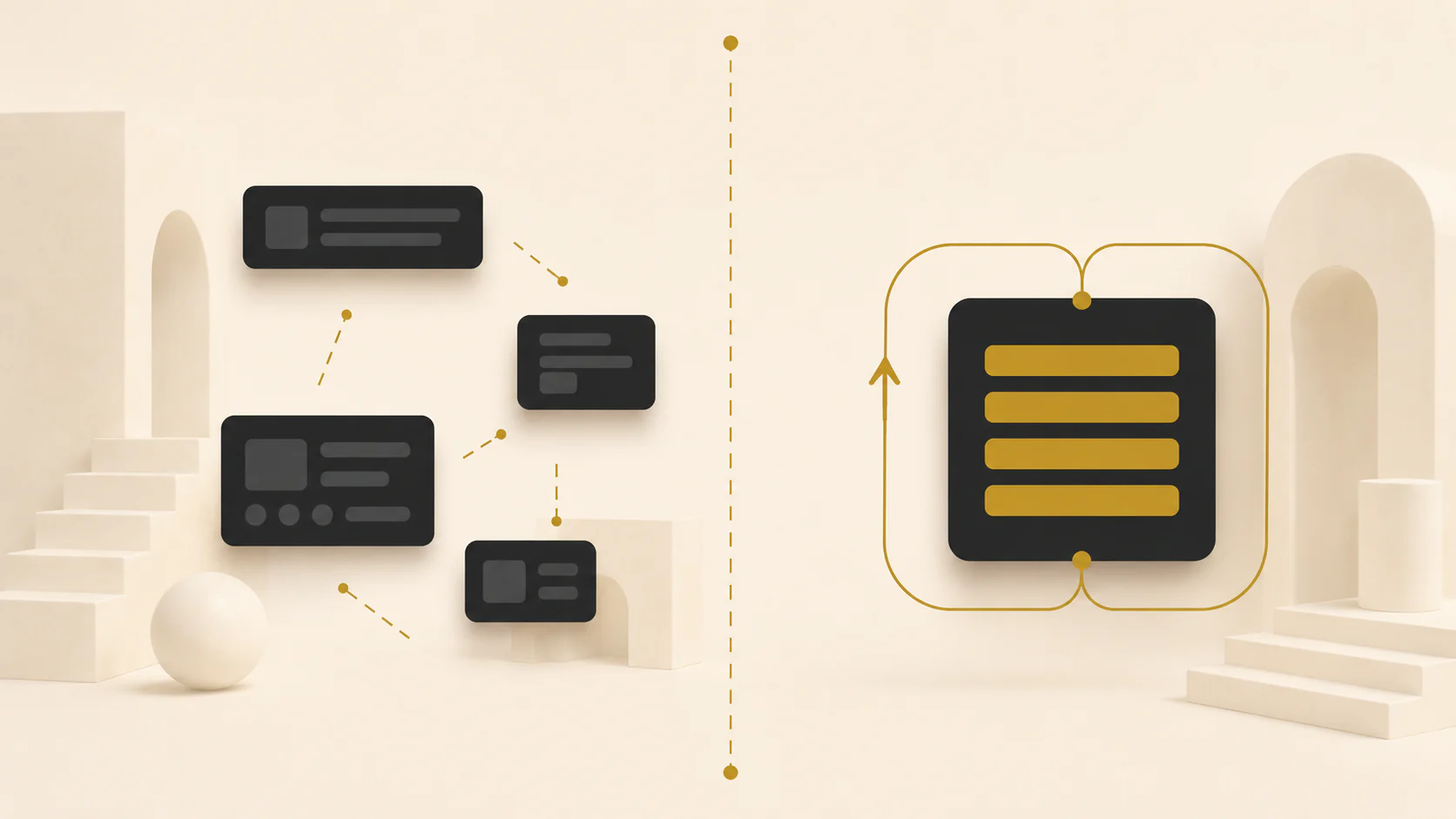
Because monitoring and improvement are different products, and most teams bought only the first one.
This is the split that decides renewals. A monitor that only reports is a smoke alarm with no fire brigade attached. It tells you your share of voice fell four points this month. It does not tell you which of your pages the engine stopped being able to parse, which claim lost its corroboration, or which competitor published the thing that displaced you. It reports the temperature and has no opinion about the weather.
For two quarters that is tolerable, because the novelty of finally having a number carries it. By the third, someone asks what changed as a result of this subscription, and the honest answer is a slide. That is when it gets cancelled - not because the data was wrong, but because nothing downstream of the data existed.
The inverse failure is rarer and just as expensive: teams who do the improvement work with no measurement at all, rewriting pages and chasing mentions on instinct, unable to say whether any of it worked. Improvement without monitoring cannot prove value. Monitoring without improvement cannot create it. A stack needs both halves, and the question to ask of any prospective purchase is which half it is.
What does the category actually cost?
Monitoring alone spans roughly $100 to $750 a month. From our last full comparison:
| Platform | Entry price | Shape |
|---|---|---|
| Peec AI | ~$100/mo | Lightweight tracker for lean teams |
| SE Ranking | ~$119/mo | AI Overview tracking on a rank-tracker workflow |
| Scrunch AI | ~$300/mo | Citation and source-URL analysis |
| Profound | ~$499/mo (Lite) | Enterprise answer-engine monitoring |
| Ahrefs Brand Radar | ~$699/mo add-on | Brand mention discovery, on top of an Ahrefs licence |
| Semrush AI Toolkit | ~$745/mo | AI signals inside a full SEO suite |
| CLEO (SEO + GEO) | See regencleo.ai/pricing | Measurement plus the fix layer |
Prices move constantly in this category, so confirm current figures with each vendor rather than with any blog post, including this one. The fuller breakdown sits in the monitoring tools comparison and the category-level evaluation framework in the GEO buyer’s guide.
Watch the pricing unit, not the price. Per-account pricing looks cheaper than per-site pricing until the second domain arrives, at which point the comparison inverts. Agencies and multi-brand teams get caught by this more than anyone. Ask how a second site is billed before you ask for a discount on the first.
What should you ask a vendor before you buy?
Five questions, in this order, and the answers are more revealing than any feature grid.
- Which engines, named individually, and how often is each sampled? “All the major AI platforms” is not an answer. Engines behave differently and overlap less than teams assume - roughly 11% of the domains ChatGPT cites for a question are also cited by Perplexity for the same one.
- Do you report a confidence interval or a bare number? These systems are stochastic. A vendor reporting a single decimal with no interval is either sampling far more than they charge for, or hiding the noise.
- Can the score go down, and can you show me a customer where it did? A metric that only ever climbs is a sales instrument.
- Does the product recommend specific changes to specific pages, or only report? This is the monitoring-versus-improvement question, and it is the one that predicts whether you renew.
- Is pricing per site or per account, and what does site mean? Definitions vary enormously and the difference compounds.
The reasoning behind the confidence-interval question, and why we built a score that is permitted to fall, is in a score allowed to fall.
How do you know the stack is working?
Judge it on outcomes, not on inputs.
An input checklist - schema present, llms.txt published, headings structured - tells you the work was done. It does not tell you the work landed. The outcome measures are citation share and recommendation rate, per engine, with an interval, over a window long enough that a fortnight of noise cannot explain the movement. If you want the diagnostic that pairs this against your existing search data, it is in your Google rank does not predict your AI citations, and the metric definitions are in what to actually measure.
Where CLEO sits in this
Plainly, so you can discount it appropriately: CLEO is the fourth stack shape. It supports 7 answer engines as standard - ChatGPT, Google AI Overviews, Bing AI Overviews, Perplexity, Gemini, Claude and DeepSeek - and 9 on Enterprise, which adds Grok and Meta AI, with up to four active per site at a time, monitoring tracked queries per site on a recurring schedule against named competitors. The combined SEO and GEO plan, like every CLEO plan, is priced in the Plan Schedule at regencleo.ai/pricing.
The reason it exists is the third row of that stack table. CLEO was built because measurement alone kept getting cancelled, so the fix layer is inside the product rather than assumed to exist on the customer’s side. That is a design opinion, not a universal truth: if you already have a strong content and engineering team with capacity, a pure monitor plus your own backlog is a perfectly sound stack, and probably a cheaper one.
What CLEO can evidence: DisburseCloud, a twelve-person fintech, moved from a 17% to a 67% AI citation share over 90 days at 95% Wilson confidence. On CLEO’s own site over 30 days, the AI Readability Score moved from 35 to 96 and the GEO score from 14 to 50. First-party measurement, not independent research. Where CLEO is the wrong choice is written up honestly in where CLEO’s limitations sit against Semrush.
The short version: pick your stack by which engines your buyers actually use and by whether the stack contains anything capable of changing the number it reports. Coverage without a fix layer becomes a cancelled subscription, and a fix layer without measurement cannot prove it worked. If what you wanted after all was the ranked list of platforms, it is in the best AI search monitoring tools in 2026, and the evaluation criteria in the GEO buyer’s guide.
Check your own score. Before you buy anything, it is worth knowing which quadrant you are actually in. The scan is free and it needs no login. Enter a domain at regencleo.ai/scan.