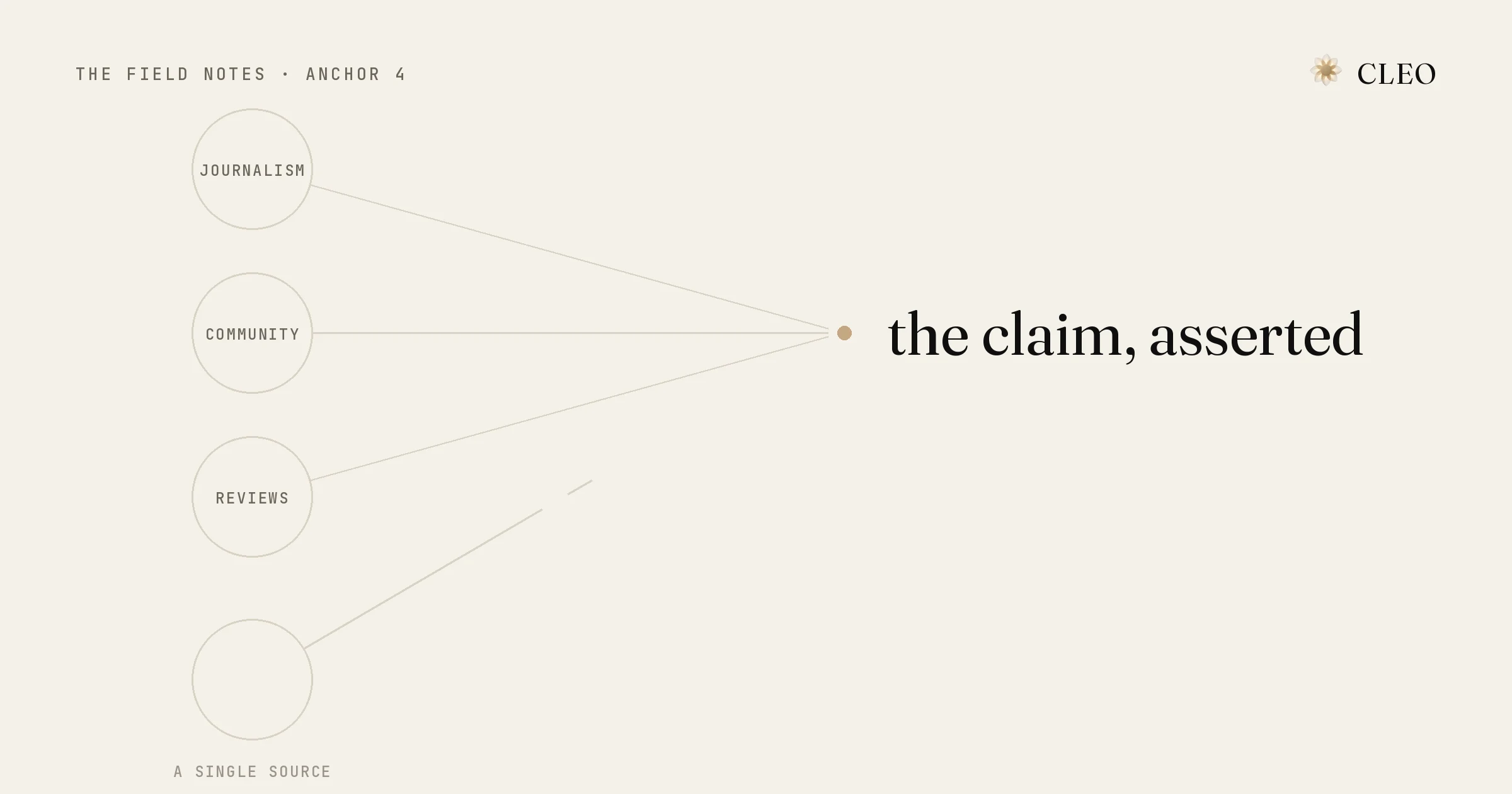
Before an answer engine asserts something about a brand, it looks for agreement, and the brands that give it agreement are the brands it cites. Everything below serves that sentence.
Two findings put numbers to it. In 5WPR's May 2026 research, brands present on four or more third-party platform types were 2.8 times more likely to be cited in ChatGPT responses than brands present on one. In Ahrefs' study of 75,000 brands, web mentions correlated with AI visibility roughly three times more strongly than backlinks did, 0.66 against 0.22; the currency SEO taught a generation to hoard is not the currency these systems count first.
This piece explains the mechanism behind both numbers, shows why the engines' disagreement with one another makes breadth rational rather than merely virtuous, and closes with the audit: one spreadsheet, one afternoon, one honest picture of which of your claims exist anywhere beyond your own domain.
i · The mechanism: consensus before assertion
A search engine hands the reader ten documents and lets her judge them. An answer engine answers in its own voice, and a voice carries a burden a list never did: the system must decide what it is prepared to repeat without hedging. The basis it uses is the oldest one in editing. It retrieves several candidate sources for each answer, weighs what they independently agree on, asserts the agreed, and softens or drops the contested and the single-sourced. A claim that lives in one place, especially a place with a stake in the claim, is treated the way a careful editor treats a single-source story: held, attributed cautiously, or left out. A claim found in three unrelated rooms is treated as a fact about the world.
Two properties of this mechanism decide most of what a team should do about it.
The first is that independence is measured by ownership, not by URL. Your site, your blog, your profiles, and your press releases cluster as one voice; ten perfectly consistent owned statements corroborate roughly as well as one. Only rooms you do not control can second you.
The second is that agreement is checked at the level of specific facts: what the product is, which category it belongs to, who it serves, what it costs, what it integrates with. A stale price on a comparison page does not merely fail to help; it enters the consensus as a dissenting voice, and dissent forces the engine to hedge everywhere. This is why the least glamorous work in the field, correcting third-party facts, keeps appearing in this month's pieces. It is consensus repair, and consensus is the unit the mechanism actually reads.
One limit, stated honestly, because the published record contains counterexamples and pretending otherwise would fail our own evidence rule. Heavily trusted single sources do get asserted confidently. When a committee contains its own chair, the chair's word can carry alone, which is how a Wikipedia entry or a dominant reference page sometimes speaks for a category unseconded. Cross-checking is a strong tendency, not a law. The audit below exploits the tendency rather than assuming the law: most brands are nobody's chair, and for them, agreement across independent rooms is the only reliable route to being asserted rather than hedged.
ii · Why breadth pays: the engines do not agree with each other
If every engine consulted the same rooms, a brand could corroborate itself once and be done. They do not. In the large comparative studies, the cited-domain overlap between ChatGPT and Perplexity runs at roughly one domain in nine: ask the two engines identical questions and nearly ninety per cent of the sources they lean on differ.
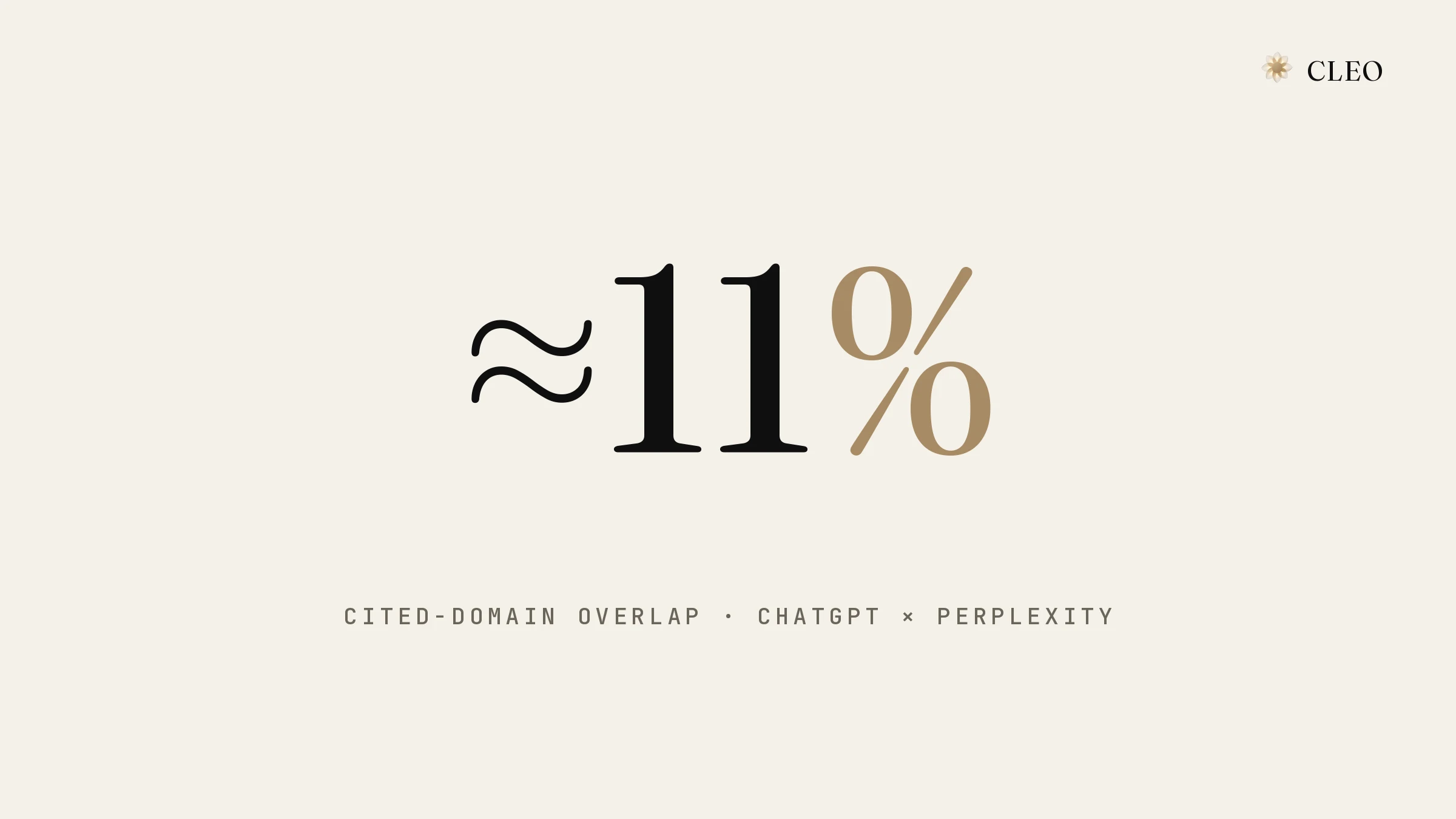
The source families diverge just as visibly. The Muck Rack editions find journalism carrying about a quarter of citations overall, with sharp per-model differences in which outlets; the review-platform studies find the trust sites weighted heaviest by different engines again. Whatever the mix in your category, the structural point survives every dataset: each engine trusts its own committee, and the committees barely share members.
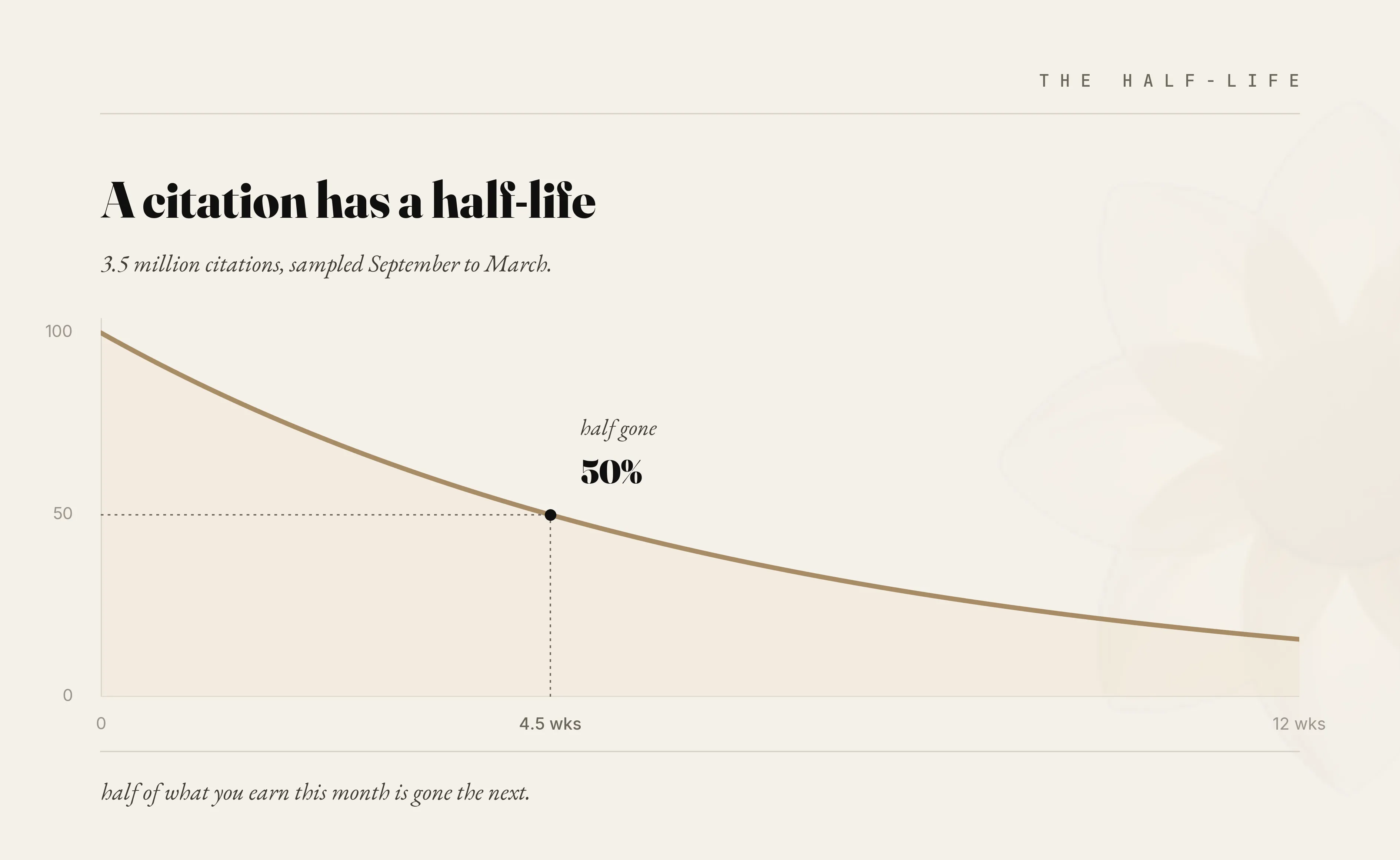
The committees are also re-seated without notice. When Google made Gemini 3 the default model for AI Overviews on 27 January 2026, roughly 42 per cent of previously cited domains were replaced within weeks, in SE Ranking's 100,000-keyword before-and-after study, while the most-cited incumbents held their seats almost untouched. A presence corroborated in one room, on one engine, is one policy change from silence.
This is the argument for breadth, stated plainly. Presence across many independent room types is not a virtue signal; it is coverage of divergent retrieval systems, any one of which can change its behaviour overnight. Credit where the argument stands on prior work: Lily Ray has argued through 2026, from the practitioner side, that third-party reputation and corroboration, not on-page cleverness, decide whether engines trust a brand at all. And it is the mechanism-level companion to a finding our founder has already published, the concentration of AI citations into a small set of domains; that essay stands as written and this piece does not restate it.
iii · The corroboration audit: one spreadsheet
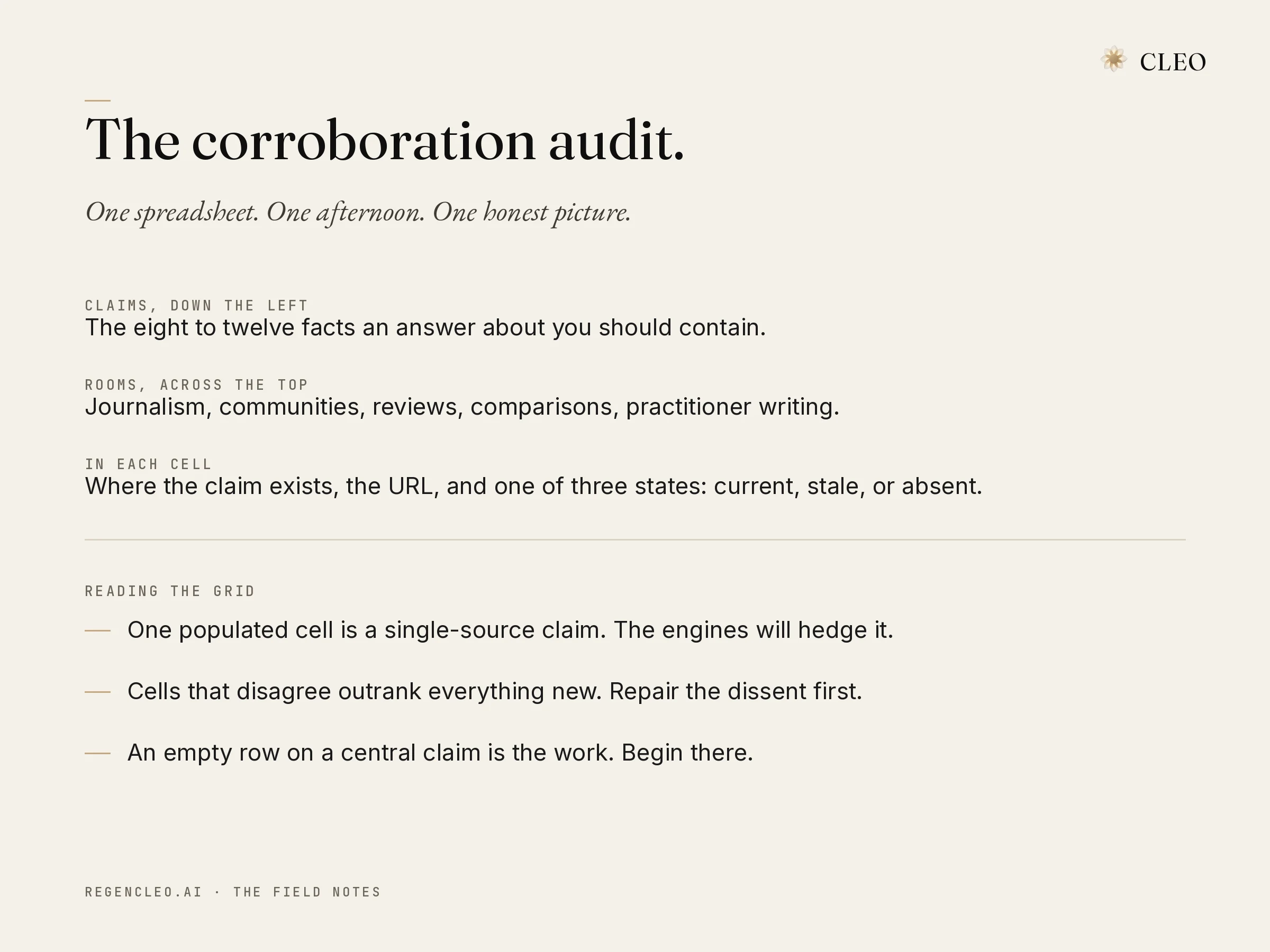
The audit turns the mechanism into a table a team can act on in an afternoon. Down the left, your core claims, the eight to twelve facts an answer about you should contain: what you are, the category, who it is for, the price point, the two or three capabilities a buyer decides on, the founding facts a profile would carry. Across the top, one column per room type from the earned map: journalism, communities, reviews, comparisons, practitioner writing. In each cell, record where that claim exists in that room, with the URL, and one of three states: current, stale, or absent. No weighting and no scores in the first version; the honest grid is the deliverable.
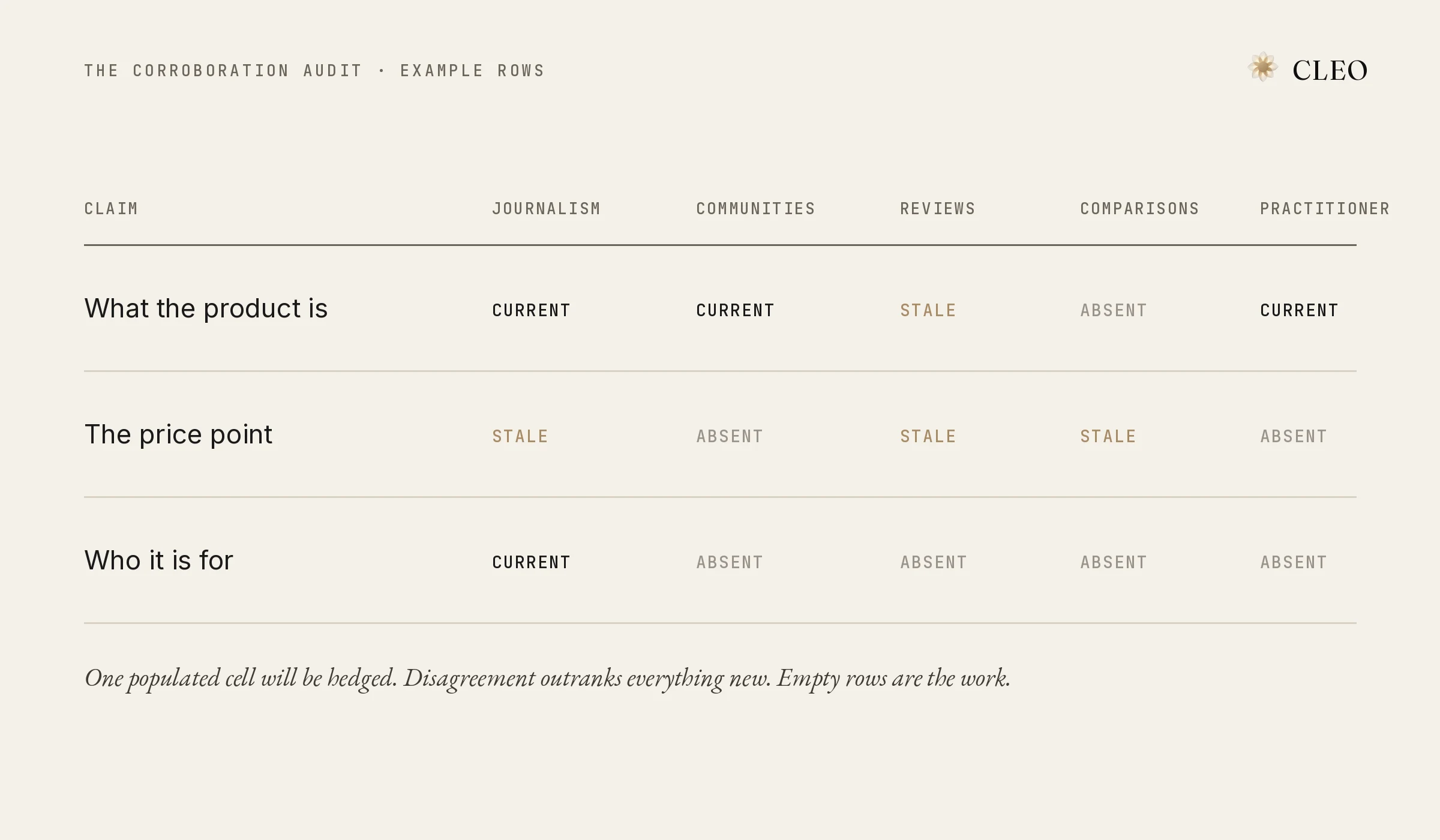
Reading the grid takes three rules. A row with one populated cell is a single-source claim; whatever it says, the engines will hedge it. A row whose cells disagree is worse than an empty one; the dissent is what the engines will surface, and repairing it outranks creating anything new. And an empty row on a claim you consider central is the finding that reorganises quarters: the fact you most want asserted about you exists nowhere the consensus can see. Empty rows are the work.
Our own grid this month, for the record, runs on the same method and carries the panel's usual caveats, with one more weight on the practitioner side of the scale. Both weightings are already on the record rather than asserted fresh here: the per-engine source-family breakdown and the owned-versus-earned split sit in the earlier earned-presence field note, and nothing in this month's grid revises them.
The cadence that keeps the audit honest: rerun the grid quarterly, and after any pricing, positioning, or product change, because each such change converts a row of current cells into stale ones at a stroke. Corroboration is not a campaign. It is agreement, maintained.
One voice is a claim. Three independent voices are a fact. The engines are counting voices.