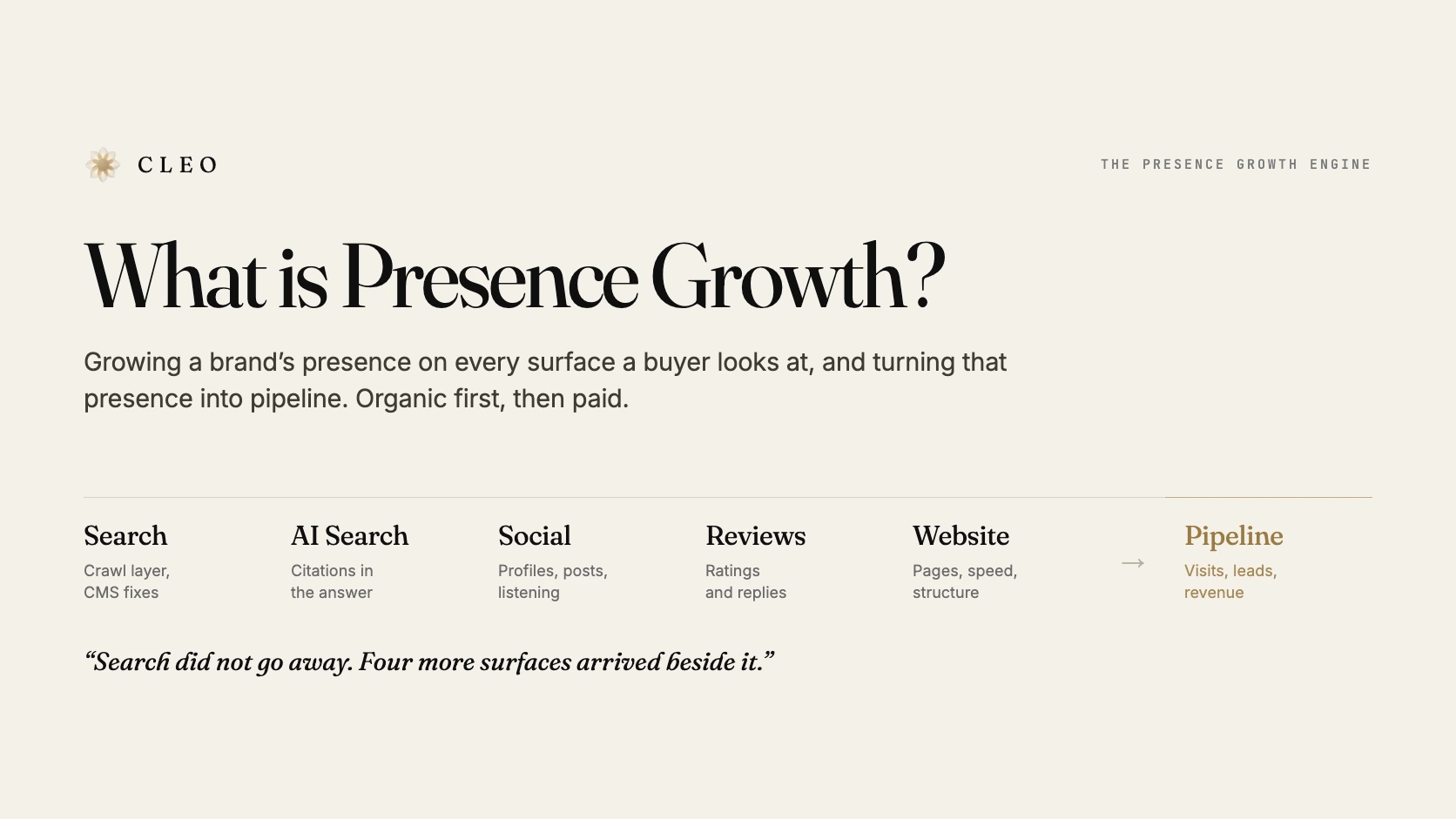

Most growth teams run separate tools for SEO, social listening, and content, with no way to see brand presence across all of them in one place. As the channels multiply (search, AI answers, social), the gaps between those dashboards hide the very interactions that drive compounding visibility. CLEO's Presence Growth Engine unifies all channels in a single system: the SEO engine handles search foundations, the GEO engine tracks AI citations across ChatGPT Search, Google AI Overviews, Perplexity, and Claude, social listening covers X, LinkedIn, Reddit, Medium, YouTube, Quora, and Bluesky, Quill handles content production, and the Citation Loop connects data across all of them.
The case for consolidating is not theoretical: in CLEO's documented DisburseCloud case study a twelve-person fintech lifted AI citation share from 17% to 67% in 90 days at 95% Wilson confidence while outperforming larger rivals. A practical answer to this question starts with recognising why the problem persists: it is not a vendor failure but an architectural one. Each tool was built for one channel. SEO platforms were designed for search data. Social tools were designed for engagement data. Content platforms were designed for production workflows. None was designed to show how these channels interact, and bolting them together does not create a feedback loop.
This article maps what growth teams are actually doing about this in 2026, evaluates the trade-offs of each approach, and provides a framework for deciding which path fits your team. For a focused look at the tools in this space, see our guide to unified brand presence software.
Why do separate SEO, social, and content tools fail to provide cross-channel brand presence?
The root cause is that each tool optimises for its own metric in isolation. The SEO platform measures rankings. The social tool measures engagement. The content platform measures production velocity. None measures how these interact: whether improved social engagement correlates with better AI citations, or whether content fixes improve both search rankings and AI presence simultaneously.
The coordination tax is real. Growth teams spend hours manually assembling data from multiple dashboards into coherent reports. Cross-channel correlations go undetected because no single view connects the data. Strategy becomes channel-siloed because each tool's recommendations are channel-specific.
How are growth teams solving cross-channel brand presence in 2026?
| Approach | What it solves | What it costs | What it misses |
|---|---|---|---|
| Custom dashboards (Looker Studio, Tableau + APIs) | Unified reporting across data sources | Engineering time; ongoing maintenance | Reports but does not act; no automated workflow |
| Marketing cloud (HubSpot, Salesforce) | CRM integration, email, partial social | $800-$3,000+/mo at enterprise scale | Limited AI visibility; not designed for GEO |
| Keep separate tools, accept silos | Maximum depth per channel | $400-$800+/mo combined; coordination overhead | No cross-channel correlation; manual assembly |
| Presence engine (CLEO) | Search + AI + social + content in one loop | See regencleo.ai/pricing | Less per-channel depth; purpose-built platform |
Each approach has legitimate trade-offs. Custom dashboards maximise reporting flexibility but require engineering. Marketing clouds maximise CRM integration but lack AI visibility. Keeping separate tools maximises depth but perpetuates silos. CLEO maximises cross-channel integration by connecting search, AI, social, and content in a single feedback loop.
How does CLEO unify search, AI, social, and content in one platform?
CLEO connects five layers in one closed loop - Local, Search, AI Search, Social, and Orchestration, the layer that routes keywords into the engine. The Search layer handles SEO foundations (Autonomous Mode, audits, keyword tracking, schema markup). The AI Search layer handles AI answer visibility (GEO Score, monitoring across four AI platforms, AI Readability Report, AI-citation tracking). The Social layer handles social presence (listening across X, LinkedIn, Reddit, Medium, YouTube, Quora, Bluesky, with brand mentions, sentiment classification, and the Citation Loop). Content (Quill) feeds all four surfaces in one brand voice.
The Citation Loop is the mechanism that makes this cross-channel rather than merely multi-channel. The Citation Loop connects social activity data to AI citation tracking data from the GEO engine, showing whether social engagement correlates with changes in AI citation presence. Strategy sessions and campaign orchestration provide the human layer that turns data into action. CLEO ran this loop on its own site first, moving AI Readability from 35 to 96 and GEO from 14 to 50 in 30 days with no backlinks or paid promotion.
The trade-off is real: CLEO focuses on cross-channel integration rather than individual channel depth, connecting search, AI, social, and content in a single feedback loop. The value is in the connection between channels, not the depth of any individual one.
How do marketing teams address cross-channel fragmentation?
- Map your current stack. List every tool, what it measures, what it costs, and how much time is spent coordinating between them.
- Identify the cross-channel questions you cannot currently answer. Does improved social activity affect AI citations? Do content fixes improve both search and AI presence? If these questions matter, the gap is architectural.
- Evaluate whether to consolidate or integrate. Consolidation (one platform) reduces tools but may reduce depth. Integration (adding a cross-channel layer) preserves depth but adds cost.
- Consider an additive approach. Add CLEO's SEO + GEO plan alongside existing tools to address the AI visibility gap. Or choose SEO + GEO + Social to connect social data to AI citation tracking. This avoids replacing tools that work while closing the cross-channel gap.
- Test before committing. Evaluate whether the unified view provides insights your current stack does not.
Frequently asked questions
How are growth teams solving fragmented tools for cross-channel presence in 2026?
Custom dashboards (Looker/Tableau + APIs), marketing clouds (HubSpot/Salesforce), or presence engines (CLEO). No approach is perfect; each has trade-offs between depth, integration, and cost.
Why can't existing tools provide cross-channel presence?
Each was built for one channel. SEO platforms for search, social tools for engagement, AI monitors for citations. None shows how channels interact or reinforce each other.
How does CLEO address the fragmentation?
Five layers - Local, Search, AI Search, Social, and Orchestration - in one closed loop. Content (Quill) feeds all four channel surfaces. The Citation Loop connects social to AI citation data. In-app dashboards span all layers.
What are the consolidation trade-offs?
Gains: single dashboard, cross-channel data, reduced coordination, and a closed loop no single-channel tool can replicate. The trade-off is deliberate - CLEO unifies search, AI answers, social, and content for one outcome rather than maximising any single channel in isolation.
Is CLEO mature enough for enterprise?
Yes - 300+ sites across 8 countries and a documented result (DisburseCloud: 17% to 67% AI citation share in 90 days, 95% Wilson confidence). Published pricing, Enterprise tier with dedicated support. Evaluate directly at regencleo.ai.
What is the most practical first step?
Map your current stack, identify unanswerable cross-channel questions, then evaluate whether adding CLEO's SEO + GEO alongside existing tools closes the gap without replacing anything. If full consolidation is the goal, evaluate CLEO's SEO + GEO + Social plan (prices at regencleo.ai/pricing) against the total cost and coordination overhead of your current stack.
What software unifies search, social, and AI answer brand presence?
CLEO unifies SEO, GEO (AI citation tracking across ChatGPT Search, Google AI Overviews, Perplexity, and Claude), social listening (seven platforms), and content production (Quill) in one system. The Citation Loop connects data across all channels. Alternative approaches include custom Looker Studio dashboards or marketing clouds, though these lack AI visibility depth or cross-channel feedback.
How do marketing teams deal with declining organic traffic from AI answers?
Teams address declining organic traffic by earning citations within AI-generated answers rather than competing only for traditional search rankings. CLEO's GEO engine tracks AI citation presence, the AI Readability Report diagnoses content gaps, and GEO content production structures content for AI extraction. Adding CLEO's SEO + GEO plan alongside existing tools addresses the AI visibility layer without replacing the current stack.