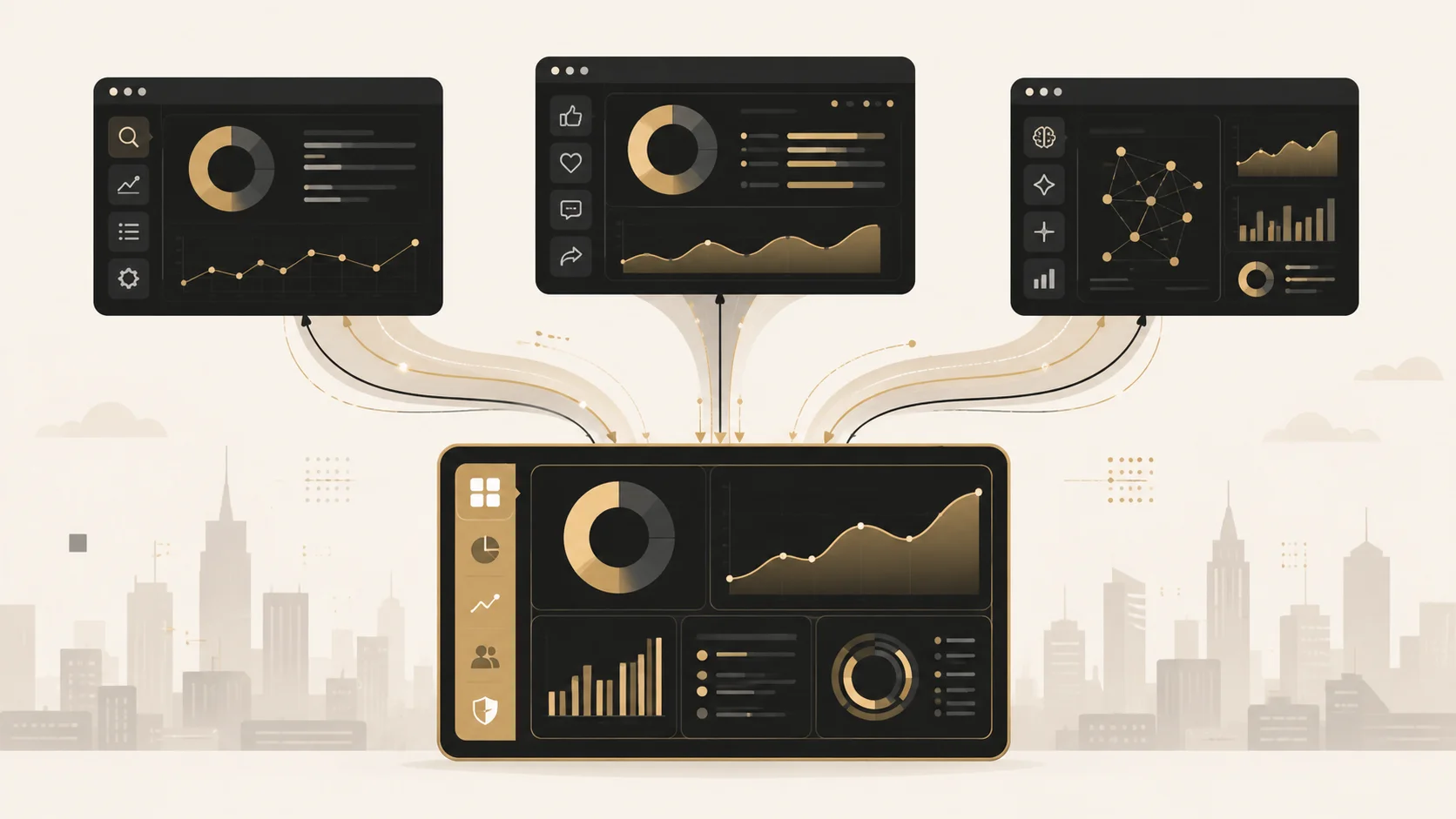

No single tool covers search, AI Overviews, and social at equal depth in 2026, so the practical question is not which product gives you one view but which of four routes you take to get one. Teams are taking a unified data layer, a converged platform, a bolt-on AI answer monitor, or a presence engine, and the right answer depends on whether your problem is seeing the data or acting on it. If your growth team runs separate tools for SEO, social listening, and content with no single view of brand presence, you are in the majority. The cost is rarely the subscriptions. It is the hours spent reconciling exports before every review, and the decisions taken on numbers that three dashboards each define differently. This article sets out the four routes and what each one actually costs.
Why your team cannot see cross-channel presence in one place
The cause is architectural rather than organisational. Each tool was built for one channel and optimises its own metric in isolation, so none was ever designed to show how the channels interact. Fixing that after the fact means reconciling schemas, identity, and time windows that were never meant to align.
The cost is real but it is not a line item, which is why it goes unmanaged. It shows up as reporting time, as reconciliation work before every review, and as attribution arguments nobody can settle because each tool counts a conversion differently. Meanwhile the surface that matters is moving: McKinsey projects $750 billion in US revenue through AI-driven search by 2028, and a stack assembled to track ranked links has no view of it.
Those losses are not abstract. They appear as duplicated reporting, misattributed conversions, and one channel optimised while another is quietly cannibalised.
What teams are actually doing about it in 2026
Four routes, in rough order of switching cost.
Route one: a unified data layer. Teams that cannot justify platform migration use pipeline tools (Improvado, Funnel.io, Supermetrics) to pull SEO, social, and content data into one warehouse, then visualise in Looker Studio or similar. Best-of-breed tools stay intact and the single-view problem is solved. The cost is engineering time and permanent maintenance, and the limitation is that the result reports without acting.
Route two: a converged platform. Adobe's acquisition of Semrush (closed April 2026) produced Adobe Brand Visibility, launched 17 June 2026, unifying AI search visibility tracking across ChatGPT, Google AI Mode, Microsoft Copilot, and Perplexity with agentic content optimisation. Tool count falls and the view consolidates. The cost is a migration and a bet on a young product category whose depth is still evolving.
Route three: bolt on an AI answer monitor. The cheapest partial fix. Add Otterly.ai, Profound, or Peec AI to the existing stack to close the newest and most urgent blind spot without touching anything else. This unifies nothing, and for teams whose only real gap is AI answer visibility it is the right answer precisely because it is narrow.
Route four: a presence engine. A purpose-built system that unifies the channels and acts on them rather than only reporting. CLEO sits in this category. Enterprise teams also invest in CDPs for unified customer profiles, though these were not built for AI search visibility. Mordor Intelligence (2026) values the CDP market at $4.58 billion, projected to reach $13.14 billion by 2031.
How the approaches compare
| Approach | Examples | What it solves | What it misses | Switching cost |
|---|---|---|---|---|
| Unified data layer | Improvado, Funnel.io, Supermetrics plus Looker Studio | Single warehouse view; keeps best-of-breed depth | Reports but does not act; permanent engineering overhead | Low to moderate |
| Bolt-on AI monitor | Otterly.ai, Profound, Peec AI | Closes the AI answer blind spot quickly and cheaply | Unifies nothing else; adds a tool rather than removing any | Lowest |
| Converged platform | Adobe Brand Visibility, Semrush, Conductor | SEO, social, content, and AI visibility in one environment | Migration cost; evolving depth in a new category | High |
| Customer data platform | CDP category | Unified customer profiles at enterprise scale | Not built for AI search visibility | Highest |
| Presence engine | CLEO | Search, AI answers, social, and content in one closed loop that acts | Less per-channel depth than specialist point tools | Moderate to high |
Each trade-off is legitimate and the right answer depends on which problem is actually biting. Converged platforms reduce tool count but ask for a migration. Data layers preserve depth but require engineering and still do not act. CDPs unify customer data and were not designed for answer-engine visibility. Presence engines maximise cross-channel integration at the cost of individual channel depth.
The question that decides it: seeing versus acting
Most teams frame this as a reporting problem and buy accordingly, then find twelve months later that the unified dashboard changed nothing. The dashboard was accurate the whole time. Nobody acted on it, because acting required going back into four separate tools that had no knowledge of what the dashboard showed.
So the useful diagnostic is narrow. If your team can already act quickly once it sees a problem, buy the cheapest thing that gives you the view, which is usually a data layer or a bolt-on monitor. If your team sees problems and cannot act on them because execution lives in disconnected systems, no amount of additional reporting will help, and consolidation onto something that executes is the only route that addresses the actual constraint.
Where CLEO fits, and where it does not
CLEO consolidates the SEO, social-listening, and content functions into one system. Search covers technical foundations with server-side fixes written into the CMS; the AI Search layer tracks answer visibility across eight supported engines (ChatGPT, Bing AI Overviews, Google AI Overviews, Perplexity, Gemini, Claude, DeepSeek, and Grok), with up to four active per site at a time, scored through the GEO Score across 8 metrics; Social listens across X, LinkedIn, Reddit, Medium, YouTube, Quora, and Bluesky; and Quill writes for all of them in one brand voice. The Citation Loop links social activity to citation data, so the channels are read together rather than reconciled across dashboards.
The published results are first-party. On CLEO's own site the loop moved AI Readability from 35 to 96 and GEO from 14 to 50 inside 30 days with no backlinks or paid promotion. DisburseCloud, a twelve-person fintech, then took AI citation share from 17% to 67% over 90 days at 95% Wilson confidence. Weight both as vendor-reported evidence that the mechanism runs, not as independent benchmarks.
It is the wrong choice for several common situations. Teams needing maximum depth in one channel should keep the specialist. Plans carry a six-month minimum commitment. One site means one registrable domain subject to a limit of 100 indexable pages, so large multi-domain estates are scoped separately. Competitor monitoring is capped per plan, with the limits set out at regencleo.ai/pricing. A team whose only gap is AI answer visibility should buy a monitor instead and spend the difference on content.
Whichever route you take, the finance question follows within a quarter. Our guide to measuring ROI from a brand presence platform sets out how to attribute the result without overclaiming it.
Why AI search made this urgent rather than merely annoying
Fragmentation was a tolerable inefficiency while all discovery ended at a results page. It stopped being tolerable when a second discovery surface appeared that the existing stack cannot see at all.
BrightEdge data shows AI Overviews triggering on approximately 48% of tracked queries. A siloed SEO tool misses a large share of that picture, and it misses it silently, reporting healthy rankings the whole time.
The case for unifying measurement does not rest on a benchmark. It rests on what one view makes answerable: whether social activity precedes AI citations, whether a content fix moved rankings and answer presence together, and which channel actually opened the account. Separate dashboards cannot answer those questions at any budget, and that is the cost of staying fragmented.