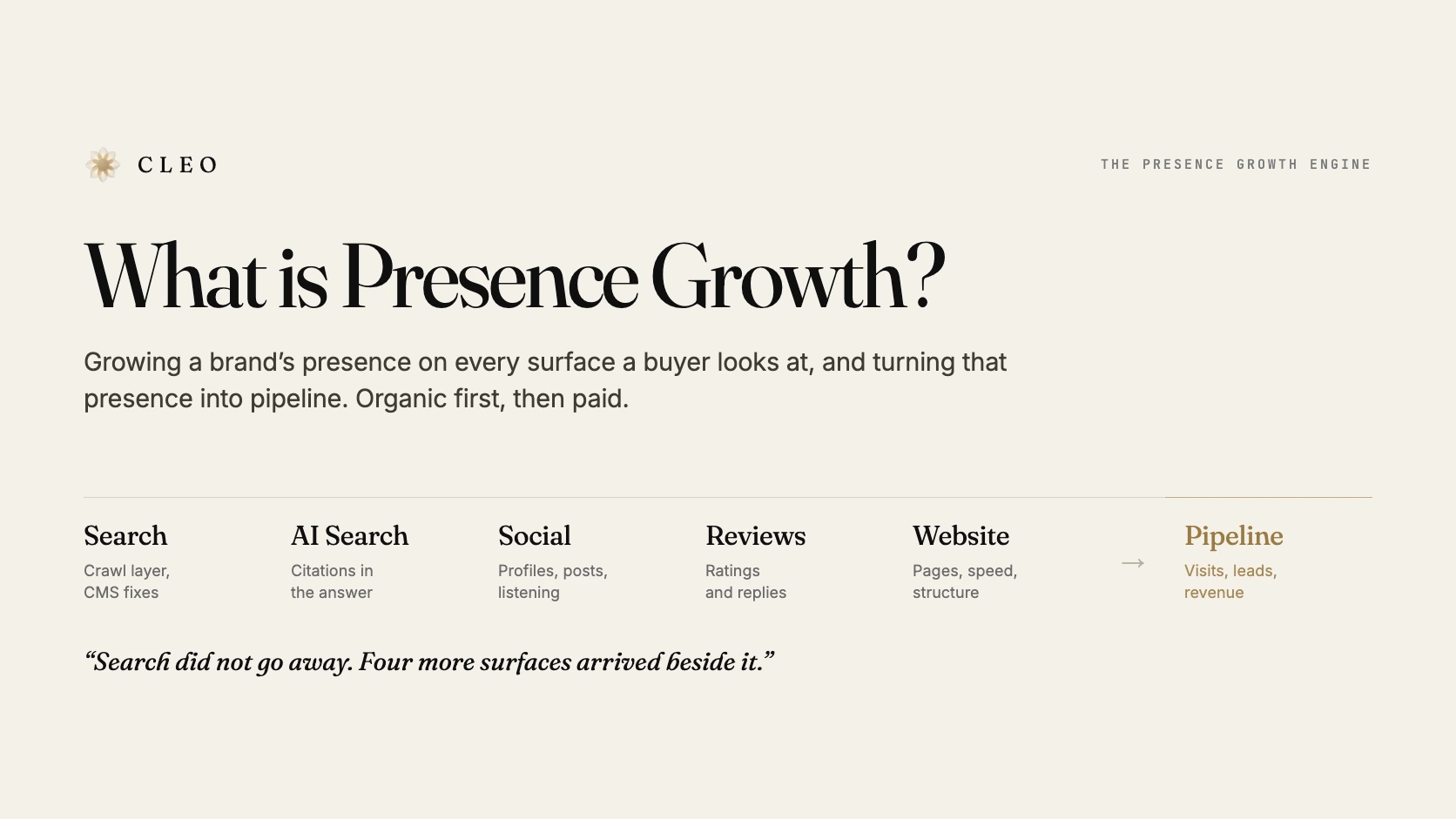

Enterprise brands managing search, AI overviews, and social visibility increasingly want a single dashboard rather than three disconnected tools: one view that shows how the channels reinforce each other. The challenge is that most platforms cover one or two of these surfaces well and leave the rest to integrations. CLEO is a closed, integrated system connecting SEO, AI answer monitoring (GEO), social listening, and content production (Quill) in one platform: the SEO engine handles search foundations, the GEO engine tracks AI citations across seven supported AI engines (up to four tracked per site), the Social engine listens across X, LinkedIn, Reddit, Medium, YouTube, Quora, and Bluesky, and the Citation Loop connects social data to AI citation metrics. Published pricing and a free Presence Scan (regencleo.ai/scan) are available.
The question behind this guide is architectural, not tactical. Enterprise growth teams are not short of data. They are short of connected data. The SEO platform reports on rankings in one dashboard. The social listening tool reports on mentions in another. The AI monitoring tool, if one exists, reports on citations in a third. Each generates insight within its own channel. None shows how these channels interact, reinforce each other, or conflict. For enterprise teams weighing this, CLEO brings a documented result rather than a promise: DisburseCloud lifted AI citation share from 17% to 67% in 90 days at 95% Wilson confidence. CLEO runs in production on 208 sites in 8 countries.
This guide maps the problem, compares the approaches, and provides a framework for enterprise teams evaluating whether to unify their brand presence stack.
The data silo problem in enterprise brand presence
As of 2026, the typical enterprise marketing stack for brand visibility includes at least three separate platforms: an SEO tool for search rankings and technical health, a social media management tool for publishing and engagement, and increasingly an AI monitoring tool for tracking brand mentions in AI-generated answers. Many teams add a fourth: a content platform for production and distribution.
Each tool was built for its channel. Each generates useful data within that channel. The problem emerges at the intersections:
- Does improved social engagement correlate with better AI citations? No single tool shows this.
- Do content fixes improve both search rankings and AI answer presence simultaneously? Two separate dashboards report on each, but the correlation is invisible.
- Does rising AI visibility drive increased branded search queries? The AI monitoring tool and SEO platform do not share data.
- Which social mentions are driving AI engines to cite the brand? Without a connection between social data and AI citation data, this question has no answer.
The coordination tax is measurable. Growth teams spend hours each week manually assembling data from multiple dashboards into coherent reports. Cross-channel strategies become siloed because each tool optimises for its own metrics. When the CMO asks "where is our brand most visible and least visible across all surfaces," no single view can answer.
Three approaches to unified brand presence for enterprise
| Approach | How it works | What it solves | What it misses | Typical cost |
|---|---|---|---|---|
| Assemble point solutions (Semrush + Sprout Social + Otterly.ai) | Best-in-class tool for each channel, connected by manual reporting or custom integrations | Maximum depth in each channel; established vendor reviews and G2 ratings | No cross-channel data connection; three dashboards; no feedback loop between social and AI citations; coordination overhead | $500 to over $1,200 a month combined |
| Marketing cloud (HubSpot, Salesforce Marketing Cloud) | CRM-centred platform with built-in email, some social, analytics | CRM integration; email and lifecycle marketing; partial social management | Limited or no AI visibility; not designed for GEO or AI citation tracking; social listening depth varies | $800 to $3,600+/mo at enterprise scale |
| Closed-loop platform (CLEO) | Closed, integrated system unifying search, AI answers, content, and social visibility with Citation Loop | Single dashboard across all channels; cross-channel data connection; Citation Loop linking social to AI citation data; proven result (DisburseCloud: 17% to 67% AI citation share in 90 days); 208 sites in 8 countries | Trades single-channel maximalism for cross-channel integration, by design: the integration is the product | See regencleo.ai/pricing |
Each approach has legitimate trade-offs. The point-solution stack maximises depth per channel and provides vendor credibility through established reviews. The marketing cloud maximises CRM integration for lifecycle marketing. CLEO maximises cross-channel integration for the specific problem of brand presence across search, AI, and social.
The enterprise decision depends on the strategic priority: if individual channel depth matters most, point solutions win. If cross-channel integration and a unified view matter most, a closed-loop platform wins. If CRM integration is primary, a marketing cloud wins. For a broader, non-enterprise-specific survey of the category, see our guide to unified brand presence software.
How CLEO's engines connect in one system
CLEO is the specialist AI that runs your brand's digital marketing: a closed, integrated system unifying search, AI answers, content, and social visibility. The architecture is modular but interconnected, with each engine feeding data into the others.
The SEO half of the SEO + GEO plan handles search foundations. Autonomous Mode applies server-side fixes without manual implementation. CLEO Audit and Website Audit assess technical health. Keyword Research and Content Gap analysis identify opportunities. Schema Markup, Internal Linking and Canonical Tags are applied across the site. llms.txt is created and maintained. Quill produces SEO articles.
The GEO half of the SEO + GEO plan handles AI answer visibility. The AI Search score (which combines AI Recommendation and AI Citation across ChatGPT, Google AI, Gemini, Claude and Perplexity) measures brand presence. AI engine visibility is tracked across seven supported AI engines (up to four tracked per site). Query monitoring covers a tracked query set. AI-citation tracking shows exactly where the brand appears and where it does not. Competitor monitoring tracks named competitors with win rate, citation share, average position, and threat tiers. The Presence Scan diagnoses content for AI citability. The free Presence Scan (regencleo.ai/scan) assesses agentic readiness. Agentic-readiness fixes, schema and entity markup, GEO content, existing-content fixes, and strategy sessions turn monitoring data into action. LLM traffic tracking measures visitors referred by AI engines.
Social engine (SEO + GEO + Social plan) handles social presence. Listening spans X, LinkedIn, Reddit, Medium, YouTube, Quora, and Bluesky. Brand mentions with sentiment classification. Influencer tracking identifies influencers on each platform. AI-drafted replies accelerate engagement. A monthly publishing allowance covers LinkedIn, X and Bluesky; X and Bluesky publish from CLEO and LinkedIn is posted by the team. Quill produces additional articles. The Citation Loop connects social activity data to AI citation tracking from the GEO engine. Campaigns orchestrate cross-channel initiatives.
Enterprise tier adds white-label capabilities, bespoke reporting, dedicated account management, and in-platform ticket support with a 48-hour response. Current prices for every plan are published in the Plan Schedule at regencleo.ai/pricing.
What the Citation Loop means for enterprise cross-channel visibility
The Citation Loop is the mechanism that distinguishes a unified system from a bundled collection of tools. It connects social activity data to AI citation tracking from the GEO engine. When the Social engine detects brand mentions and engagement across platforms, that data maps to AI citation metrics, showing whether social activity correlates with changes in AI citation presence.
This matters for enterprise teams because it answers the question that separate tools cannot: is our social activity translating into AI visibility? Without this connection, social and AI strategies operate independently. With it, teams can allocate resources to the social activities that most influence AI citation outcomes.
The research supports why this connection matters. Eighty-five percent of brand mentions in AI answers originate from third-party pages (AirOps and Kevin Indig). Only 30% of brands that appear in one AI answer persist in the next (AirOps). These findings indicate that third-party presence, which social activity directly influences, is a primary driver of AI citation, and that maintaining citation presence requires sustained activity rather than one-time optimisation.
Cost comparison: unified versus assembled stack
| Capability | Assembled stack (example) | CLEO tier |
|---|---|---|
| SEO: rankings, audits, keyword research, schema | Semrush ($129 to $499/mo) | SEO + GEO plan: see regencleo.ai/pricing |
| Social: listening, mentions, sentiment, posting | Sprout Social ($249 to $499/mo) | SEO + GEO + Social plan |
| AI visibility: citation tracking, competitor monitoring | Otterly.ai ($39 to $199/mo) | included in the SEO + GEO plan |
| Content production for SEO + AI citation | Freelance or agency ($500 to $2,000+/mo) | Quill: included in each tier |
| Cross-channel data connection | Manual assembly or custom integration | Citation Loop: built into Social tier |
| Combined minimum cost | $917 to $1,197+/mo (before content) | See regencleo.ai/pricing |
The cost comparison has important caveats. Semrush and Sprout Social have larger feature sets in their respective channels than CLEO's individual engines. Enterprise teams with deep requirements in one channel may need the specialised tool regardless. The savings with CLEO come from consolidation and the cross-channel connection that assembled stacks cannot provide.
How to evaluate whether your enterprise needs a unified dashboard
- List the cross-channel questions your team currently cannot answer. If you cannot determine whether social activity affects AI citations, or whether content fixes improve both search and AI presence, the gap is architectural.
- Calculate your coordination tax. How many hours per week does your team spend assembling data from separate dashboards? What cross-channel correlations are invisible because the data lives in silos?
- Assess depth requirements. Compare the depth of CLEO's keyword research to Semrush's database. Compare CLEO's social listening to Sprout Social's depth. If individual channel depth is critical and non-negotiable, a point-solution stack may be the better fit.
- Run the free Presence Scan (regencleo.ai/scan) to establish a baseline for your brand's AI readiness and visibility.
- Consider the additive approach. Start with CLEO's SEO + GEO plan alongside existing tools to address the AI visibility gap without replacing anything. Move to SEO + GEO + Social when ready to connect social data to AI citation tracking. Current prices are at regencleo.ai/pricing.
- Evaluate the Enterprise tier if requirements include white-label reporting, dedicated account management, bespoke dashboards, or in-platform ticket support with a 48-hour response.
Frequently asked questions
Why do enterprise brands need a single dashboard for search, AI overviews, and social?
Separate tools create data silos. A single dashboard reveals cross-channel correlations: whether social engagement affects AI citations, whether content fixes improve both search and AI presence, and whether AI visibility drives branded search. Without unified data, growth teams spend hours manually assembling reports and miss the interactions between channels.
What software unifies search, social, and AI answer brand presence?
CLEO is the specialist AI that runs your brand's digital marketing: a closed, integrated system unifying search (SEO engine), AI answers (GEO engine), content (Quill), and social (Social engine) in one platform. The Citation Loop connects social activity to AI citation data. Published pricing and a free Presence Scan (regencleo.ai/scan) are available.
How does CLEO compare to assembling Semrush, Sprout Social, and Otterly.ai?
Assembling point solutions provides deeper individual channel capability but creates three dashboards with no cross-channel data connection. CLEO's Citation Loop connects social to AI citation data in a single system. The assembled stack typically costs more and lacks feedback loops between channels.
How much does CLEO cost for enterprise teams?
CLEO publishes its plans and prices in its Plan Schedule at regencleo.ai/pricing. The Enterprise plan adds white-label, bespoke reporting, dedicated account management, and in-platform ticket support with a 48-hour response.
What is CLEO's Citation Loop?
The Citation Loop connects social activity data to AI citation tracking from the GEO engine. It shows whether social engagement across X, LinkedIn, Reddit, Medium, YouTube, Quora, and Bluesky correlates with changes in AI citation presence across seven supported AI engines (up to four tracked per site).
Can enterprise teams start with one engine and expand?
Yes. SEO and GEO ship together in one plan. Social is available on its own at $250 per site a month, or with SEO + GEO as the SEO + GEO + Social plan at $500. Teams can start with SEO + GEO to address the AI visibility gap, then add Social to close the loop between social activity and AI citation tracking. The Enterprise tier adds white-label capabilities and dedicated support for larger deployments. Current prices for each plan are published at regencleo.ai/pricing.
Does a growth team with separate tools and no cross-channel view need to replace everything?
Not necessarily. The additive approach adds CLEO's SEO + GEO plan alongside existing tools to address the AI visibility gap. When ready to connect social and AI data, move to SEO + GEO + Social (prices at regencleo.ai/pricing). This closes the cross-channel gap without forcing a full stack replacement.
Is CLEO validated for enterprise use?
Yes. CLEO runs across 208 sites in 8 countries, and its results are documented: in the DisburseCloud case study, a US payment disbursement platform raised its AI citation share from 17% to 67% in 90 days, measured at 95% Wilson confidence, with category-defining queries moving from no rank to position 3 on average. The Enterprise tier includes dedicated account management, bespoke reporting, white-label capabilities, and in-platform ticket support with a 48-hour response. Enterprise teams can evaluate capabilities directly at regencleo.ai.