This is Part 3 of CLEO’s three-part series on AI visibility. Part 1 showed the lift on CLEO’s own site, two dates and three numbers. Part 2 explained the eight measures behind the score and why a number worth trusting has to be a number that is allowed to fall. This is the piece that finishes the thought, and it is the one no one running a launch wants to read aloud.
The lift is real. The lift is also perishable. If you treat presence as something you achieve once and bank, you have misread what you are holding.
Here is the reframe the rest of this rests on. In classical search, visibility behaves like a stock. You acquire a ranking and, short of a major shift, you keep it; the changes you do see arrive slowly enough to watch in a dashboard. In AI answers, visibility behaves like a flow. It exists only while it is being fed, and it has a measurable half-life, which is the part most teams have not internalised.
A citation is a rotation, not a ranking
The difference between the two is mechanical, and it is the single most important thing to understand about this category.
A Google ranking is read from an index. The engine has already crawled the web, scored the pages, and stored the result; when you search, it hands back what it stored. That is why rankings move gradually, and why a page can hold position three for a year.
An AI citation is selected at the moment the question is asked. Most answer engines run on retrieval-augmented generation: for each query they assemble a fresh set of sources, judge freshness and specificity in real time, and write the answer from what they just pulled. Nothing is stored as a verdict. The page is re-evaluated every single time it is needed. Which is why a page can keep its Google position and quietly vanish from the AI answer covering the same topic: the two systems are asking different questions about it, and only one of them remembers yesterday.
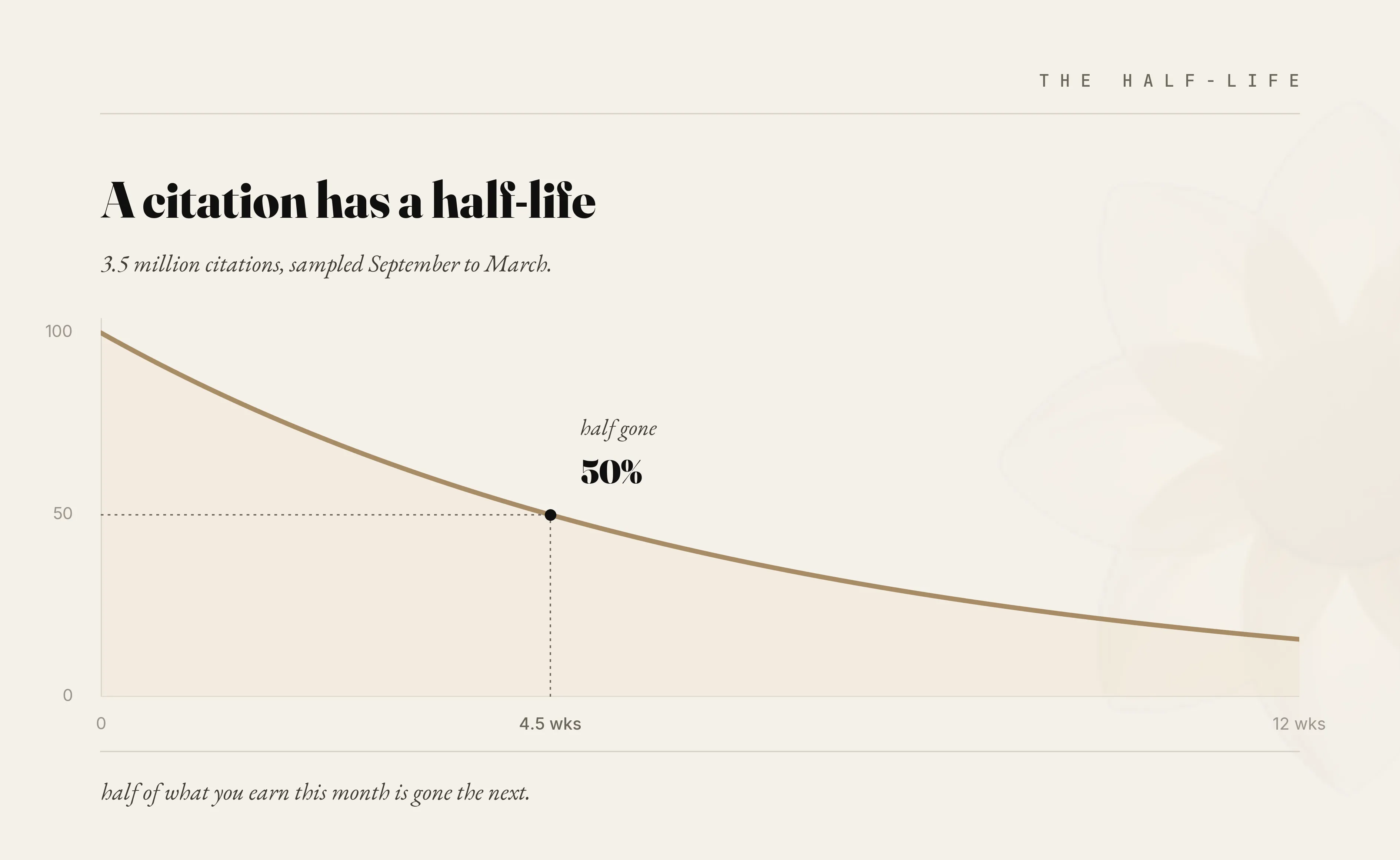
This is not a thesis CLEO is asking you to take on faith. Between September 2025 and March 2026, one analysis tracked 3.5 million citation events across the major AI platforms and measured how long a cited source stayed cited. The median half-life was roughly four and a half weeks. Half of the citations a piece of content earned in a given month were gone by the next.
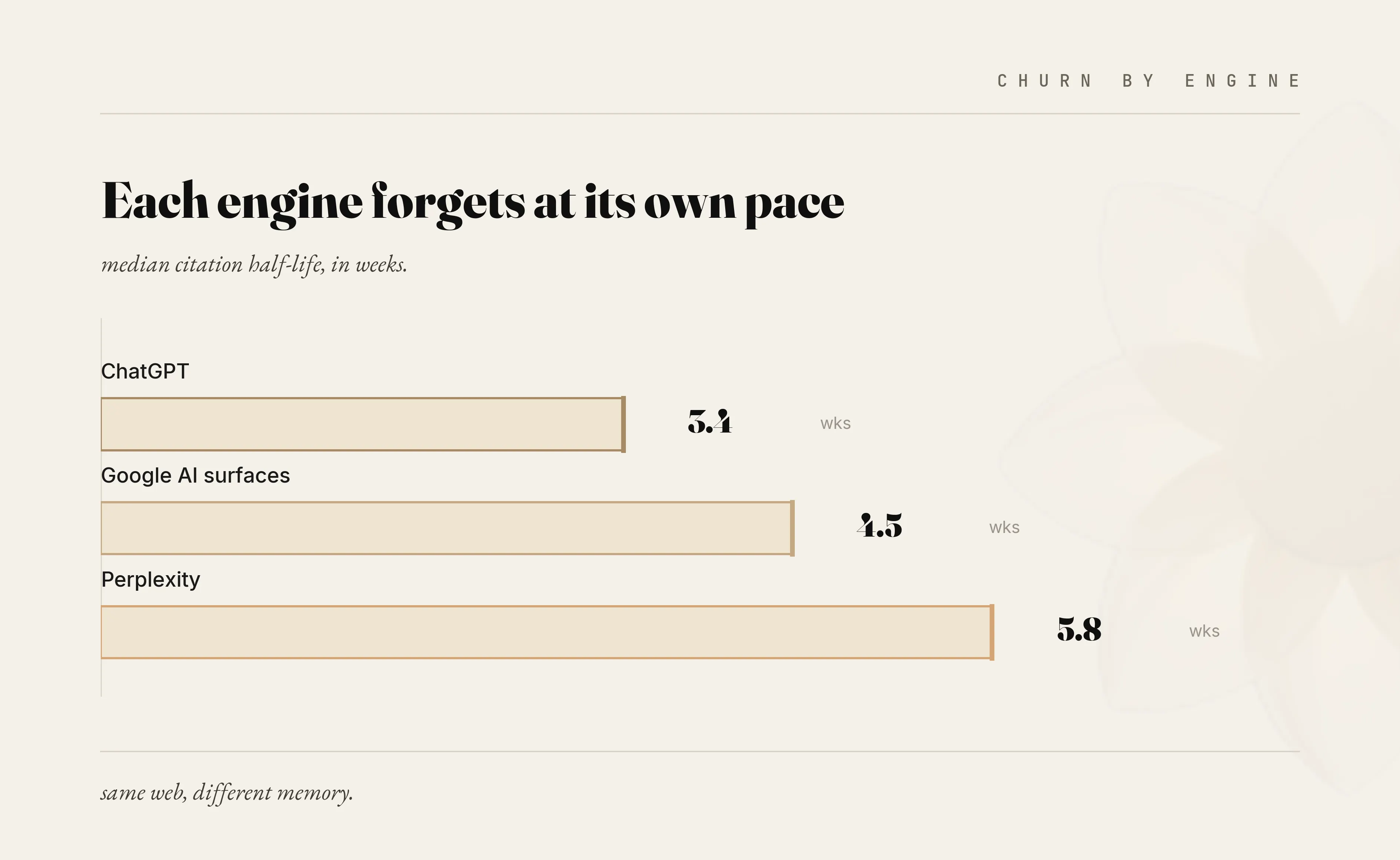
The churn was uneven. ChatGPT cycled its sources fastest, at about 3.4 weeks. Perplexity held its citations almost 70% longer, near 5.8 weeks. Google’s AI surfaces clustered in the middle.
Sit with that for a moment. If half of your AI presence decays inside a month, a quarterly check-in is not a cadence. It is a postmortem.
The loop you build decays in ordinary ways
The visibility loop is real, and it compounds: a machine-readable page earns an initial AI citation, that citation builds domain authority, and that authority makes the next citation cheaper to earn. CLEO described this engine in the first piece. The critical caveat is that every link in that loop can thin. Most of that thinning is undramatic and self-inflicted.
Owned pages go stale. Retrieval favours the current and the specific, so a page that was rich a quarter ago grows relatively thinner as the category’s vocabulary moves on around it. You did not get worse. The bar rose, and you stood still.
Schema drifts. A redesign reshuffles the markup, the structured data the crawler leaned on breaks quietly, and the machine-legibility you wrote into the source - the exact work that moved regencleo.ai’s numbers from 35 to 96 on readability - goes silent without a single visible error on the page.
The entity fragments. When a brand’s name, description, and positioning say slightly different things across its site, its profiles, and its press, the model has a blurrier entity to resolve. A blurry entity is a weak one. In large analyses, the volume and consistency of brand mentions predicts AI citation more strongly than backlinks do: in one study of 75,000 brands, roughly three times more strongly. The thing most likely to earn a citation is a coherent, frequently referenced identity, which is precisely the asset that erodes when left untended.
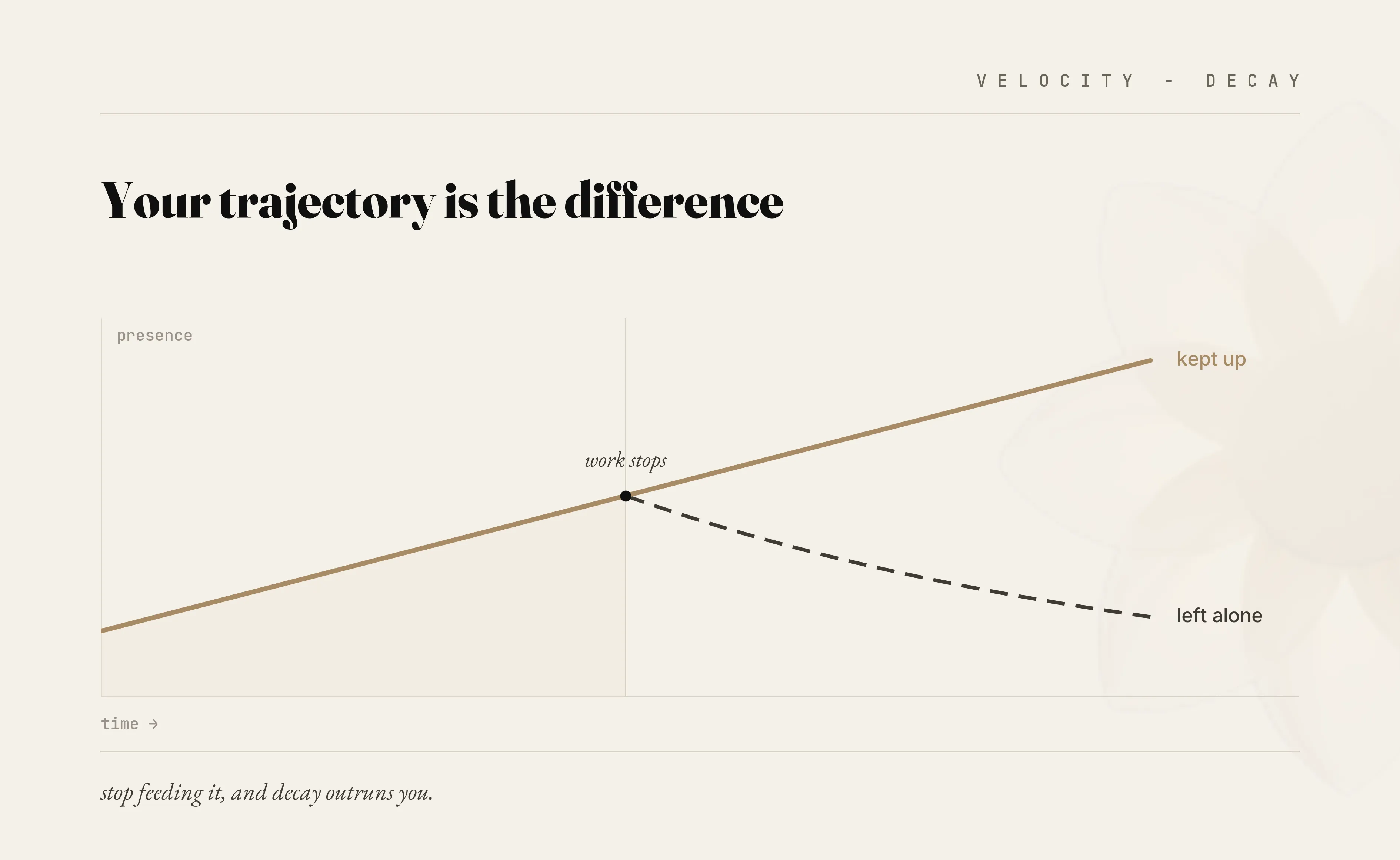
There is a clean way to hold all of this in your head. AI visibility has a velocity, the rate at which you earn new citations, and a decay, the rate at which old ones fall away. Your real trajectory is the difference between the two. Stop publishing and stop maintaining, and your velocity drops to zero while your decay keeps running at a four-and-a-half-week half-life. The arithmetic only resolves one way.
Then there is the part you do not control
Everything above is yours to fix. What follows is not.
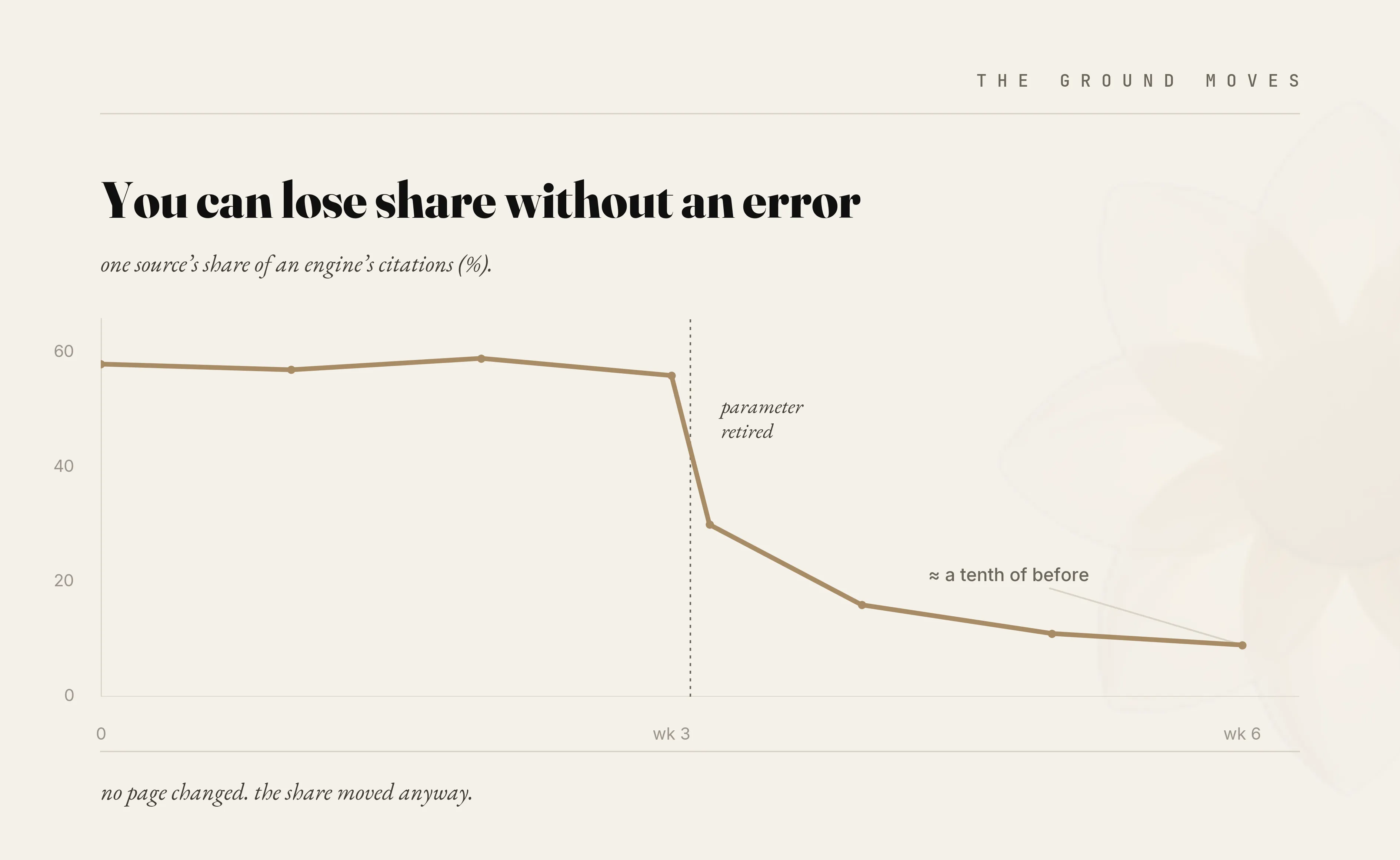
In mid-September 2025, Google retired a single search parameter, the one that had let tools read past the first page of results. No brand changed a page. Within weeks, the share of citations one major platform had been feeding into ChatGPT’s answers collapsed toward a tenth of what it had been. Anyone who had quietly come to depend on that platform as their route into the answer lost most of it overnight, and nothing they had done caused it. The ground three layers upstream simply moved.
That was not an anomaly. It is the ambient condition. Independent trackers watching B2B brands have recorded month-to-month swings of five to eight points in how the models cite a brand, with no corresponding change in the brand’s own content: the model was retrained or reweighted, and the brand drifted with it. The engines also disagree with one another: cross-platform studies find only about one domain in ten is cited by both ChatGPT and Perplexity, so a position earned on one buys you nothing on the next. And the part people assume is permanent is not. Roughly 60% of ChatGPT’s answers draw on parametric memory, what the model absorbed during training, which is frozen at a cutoff and re-weighted with every new training run. Being “known” by a model is not a deposit. It is a position the next training cycle gets to reconsider.
The list of sources these engines trust is short, and it turns over in weeks. You can do everything correctly and still lose share to a decision made by people you will never meet, about systems you cannot see.
So what does maintenance actually look like
If presence decays whether or not you make mistakes, the only defence is a practice. This is the part CLEO would want a competitor’s marketer to read, because it is true regardless of who does the work.
Measure on the clock the citations keep, not the one your calendar prefers. If sources cycle every four to six weeks, a monthly read is the floor and a weekly one is better. An annual audit tells you what used to be true. The cadence is set by the decay rate, not by the reporting season.
Watch the ecosystem, not only your own page. A large share of your presence rides on third-party domains: the publications, references, and aggregators the engines pull from. When your number falls, the cause is often a source you depended on falling first. Know which domains carry you, because those are your load-bearing walls, and you do not own them.
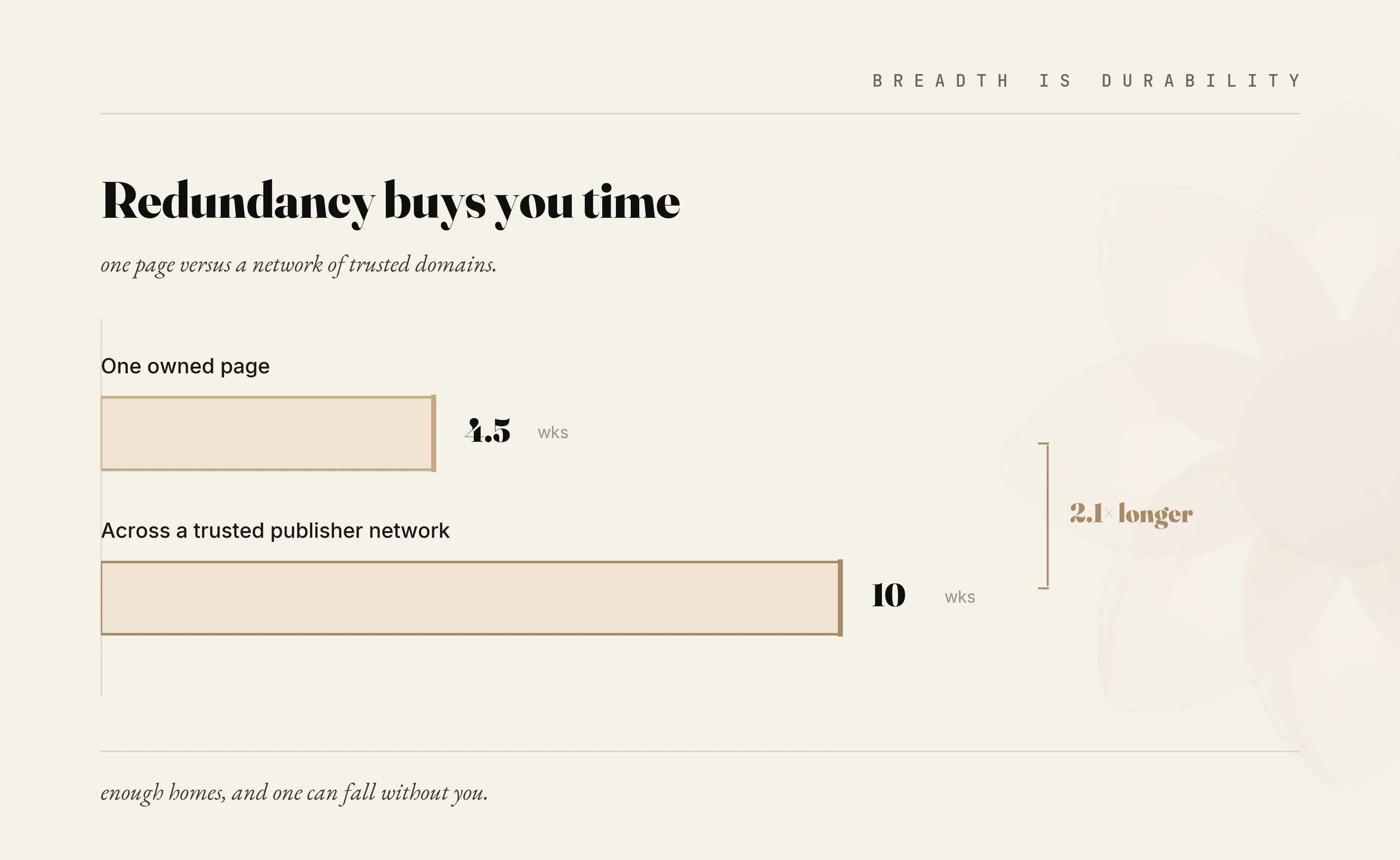
Build breadth, because redundancy is durability. The same study that found a four-and-a-half-week half-life found that content distributed across a network of trusted domains held its citations for closer to ten weeks - roughly twice as long. The mechanism is intuitive: if your information lives in enough credible places, individual sources can rotate out of an answer without you disappearing from it. It is also why earned media does the heavy lifting. Across more than a million citations, better than 80% traced to earned, non-paid sources rather than brand-owned pages. One excellent page on your own domain is a single point of failure.
Re-fix as the standards move. What counts as “readable” to a crawler is not fixed. Schema vocabularies change, the engines change what they reward, and the markup you shipped last spring may not be the markup that earns a citation next spring. Legibility is a moving target, not a milestone.
Treat it as a standing function, not a project with a launch date. Assign refresh dates. Track what is in active rotation and what has fallen out of it. The teams that build this muscle now will hold visibility straight through the cycles that quietly empty their competitors’ presence out from under them.
The honest cost
CLEO has tried to be plain in every piece, so it will be plain here. This is not a launch you point at and forget. It is a discipline you keep, indefinitely, because the thing it protects is sitting on ground that keeps moving.
The fixes CLEO wrote into its own site in May are still working. It wants to be precise about why, because the reason is the whole point: it is not that they were clever. It is that someone keeps re-reading what the engines reward this month, keeps re-measuring the same site the same eight ways, and keeps re-writing as the standards drift. The score held because the work did not stop. The compounding is genuine, and it does reward patience, but only for whoever keeps working through the flat stretch instead of declaring victory at thirty days. The flat stretch is where most presence dies, and it dies of neglect, not of failure.
So the series closes where it has to. CLEO can show you a lift. It can show you the number behind it and prove it is allowed to fall. And it can tell you, without flinching, that it will fall if the work stops, because presence is not a state you arrive at. It is a position you hold.
Check your own score. If you want to see where your own site stands, the scan is free and it needs no login. Enter a domain at regencleo.ai/scan. The floor is the first honest thing it will tell you.
This is Part 3 of a three-part series on AI visibility. Part 1: CLEO won’t promise a ranking. Here is the lift. · Part 2: A Score Allowed to Fall - The Reason to Trust It.