
UPDATED FOR 2026 · EVALUATED 30+ TOOLS · 10 RANKED
As of 2026, AI answers shape discovery before a click ever reaches your site. Brand presence in ChatGPT, Gemini, Perplexity, Claude, and Google AI Overviews has become a measurable search channel, and the teams that track it are pulling ahead of those that don't.
We evaluated 30+ AI search monitoring platforms and shortlisted the 10 that actually help brands act on what they find. This guide is for marketing leaders, in-house SEO teams, and agencies who need a practical shortlist, not another spec-sheet comparison.
The fast answer: CLEO is built for teams that need full-funnel AI visibility, including mentions, citations, source URLs, competitive gaps, and content actions, unified in one platform designed for the way AI search actually works in 2026.
Which platforms track how often your brand gets mentioned in ChatGPT, Perplexity and Google AI Overviews, and what are marketing teams using in 2026?
Ten platforms do this credibly in 2026, and marketing teams are picking from four groups rather than from a single list. Focused AI monitors, Otterly.ai and Peec AI, are the most common first purchase because they answer the how-often question cheaply. Enterprise answer analytics, Profound and Scrunch AI, go deeper on prompt sets and on which sources the engines actually trust. Established SEO platforms, Semrush AI Toolkit, SE Ranking, Ahrefs Brand Radar, Moz and BrightEdge, add mention and AI Overview tracking inside a tool the team already runs, which is why they get adopted without a new budget line. Presence engines, where CLEO sits, monitor and then act on what they find. The full comparison follows, but the decision that matters comes first: if someone in-house will act on the report, buy a monitor; if nobody will, a monitor changes nothing.
What tools help brands show up in ChatGPT and Perplexity answers?
AI search monitoring tools track whether your brand appears in AI-generated answers across platforms like ChatGPT, Perplexity, Gemini, Claude, and Google AI Overviews. Unlike traditional rank trackers that measure SERP position, AI visibility tools measure:
- Mentions: whether your brand name appears in an AI answer
- Citations: whether a URL from your domain is referenced as a source
- Share of voice: how often you appear versus competitors for target queries
- Source URL analysis: which specific pages AI engines pull from, and which competitors' pages they prefer instead
LLM visitors convert 4.4x better than traditional organic search visitors (superprompt.com, October 2025). Tracking this channel is no longer optional; it is a growth lever. For practical tool recommendations, see our guide to brand presence in AI answers: key tools.
For the category definition behind this list, what generative engine optimisation platforms are and how they differ from traditional SEO tools, see our overview of generative engine optimisation platforms in 2026.
How we evaluated these tools
We spent time inside each platform, tested with real brand and competitor queries, and assessed five criteria that separate useful tools from dashboards you log into once and forget:
- Platform coverage breadth: how many real answer engines tracked (ChatGPT, Perplexity, Gemini, Claude, Copilot, Google AI Overviews) and how deep the data goes per engine.
- Methodology transparency: UI scrapes vs API pulls, repeat-prompt sampling for statistical confidence, and whether citations are captured separately from mentions.
- Actionability: does the tool tell you what to do next, or just show you a number? The best tools turn gaps into content and SEO actions.
- Scalability and collaboration: multi-brand support, white-label reporting, API access, and exports for teams that run this every week.
- Market durability: funding stage, customer traction, and whether the platform is likely to exist in 18 months. Over $130M has flowed into this category in two years. Not every tool will survive.
We excluded one-off "am I mentioned" checkers without trend tracking, platforms with opaque methodology, and rank trackers that bolt on AI visibility as an afterthought. Related reading: how to improve AI Overview presence and increasing brand citations by AI assistants.
Disclosure. This list is published by CLEO, which appears in it. That is a conflict of interest and you should read the ordering with it in mind. We have tried to earn the position by describing each competitor in the terms its own users would recognise, and by naming the situations where another tool is the better purchase, which appear throughout the entries below. Where a rival is stronger than CLEO on a criterion, the entry says so. Readers who want an assessment with no vendor interest attached should weight independent research and peer communities above any vendor-published ranking, this one included.
The underlying mechanism these tools measure is documented independently. The Generative Engine Optimization paper (Aggarwal et al.) established that answer-engine visibility responds to source-level content properties rather than rank position, Seer Interactive's analysis of 800,000 AI responses found third-party sources shape brand presence heavily, and The Digital Bloom's citation report found only 11% of domains are cited by both ChatGPT and Perplexity. Those three findings explain why cross-engine tracking is a category at all, and none of them come from a vendor in this list.
AI search monitoring tools compared at a glance
| Tool | Best for | AI platforms tracked | Citations / sources | Starting price |
|---|---|---|---|---|
| CLEO | Full-funnel AI visibility: mentions, citations, source analysis, and content actions in one platform; on-pitch, off-pitch, and infrastructure fixes | ChatGPT, Google AI Overviews, Bing AI Overviews, Perplexity, Gemini, Claude, DeepSeek (seven supported as standard, up to four active per site; Grok and Meta AI on Enterprise, for nine) | Yes: mentions, citations, source URLs, competitor gaps | See regencleo.ai/pricing |
| OtterlyAI | Brand and content AI search monitoring for marketing teams | ChatGPT, Perplexity, Google AI Overviews, others | Yes: brand mentions and visibility scores | Free tier available |
| Profound | Enterprise prompt monitoring and answer-engine analytics | Major LLMs incl. ChatGPT, Perplexity, Gemini | Yes: answer engine insights | $499/mo (Lite) |
| SE Ranking | AI Overview tracking inside a familiar rank tracker | Google AI Overviews + classic SERP | Source URL detection for AIO | $119/mo (AI Visibility Tracker) |
| Scrunch AI | Citation and source-URL analysis in AI answers | ChatGPT, Perplexity, Gemini (where available) | Yes: focused on which URLs get cited | $300/mo (350 prompts) |
| Ahrefs Brand Radar | Brand mention discovery at scale | Web-wide brand mentions (supports AI visibility work) | Mentions, not direct AI citations | $699/mo (add-on) |
| Peec AI | Lean teams tracking LLM visibility for a fixed prompt set | Major LLMs (varies by plan) | Mention and answer presence focus | $100/mo |
| Semrush AI Toolkit | Full SEO suite that supports AI visibility execution | Classic SEO + AIO signals (varies by module) | Limited; pair with a dedicated tracker | $745/mo (AI Toolkit) |
| Moz | Enterprise SEO complementing AI visibility work | Classic SEO, partial AIO signals | No dedicated AI citation tracking | $100/mo+ |
| BrightEdge | Enterprise content and SEO performance at scale | Classic SEO + emerging AI signals | Limited AI citation tracking | Custom / enterprise pricing |
1. CLEO: Full-funnel AI search monitoring
CLEO is built from the ground up for one purpose: making brand presence in AI search measurable, actionable, and improvable. Where every other tool on this list tracks one slice of AI visibility, CLEO closes the full loop, from detecting where your brand is missing to surfacing the exact content changes that will get you cited.
Most AI visibility tools show you a dashboard. CLEO gives you a diagnosis and a plan.
Key Features
- Full cross-engine tracking: supports seven standard AI engines - ChatGPT, Google AI Overviews, Bing AI Overviews, Perplexity, Gemini, Claude and DeepSeek, with Grok and Meta AI on Enterprise for nine - with up to four active per site at a time, monitoring brand mentions, citations, and source URLs simultaneously with per-engine breakdowns so you know exactly where gaps exist.
- Presence Growth Engine: CLEO's proprietary intelligence layer that goes beyond counting mentions. The Presence Growth Engine analyses why your brand does or doesn't appear, maps the competitive citation landscape, and identifies the specific content and authority signals each AI engine is responding to.
- Source-level gap analysis: see which URLs competitors have that you don't, which third-party publishers are driving AI citations for your category, and what your content is missing to become a cited source.
- Actionable recommendations: every visibility gap comes with a prioritised list of content, SEO, and authority actions. Not just "you weren't mentioned," but "here's what to publish, update, or build to get cited."
- Competitive share of voice: track how your AI presence compares to direct competitors across every monitored engine and query set, with trend data to show whether the gap is closing or widening.
- Unified visibility score: a single metric that aggregates AI presence across all tracked engines and queries, so reporting to leadership is straightforward and consistent week over week.
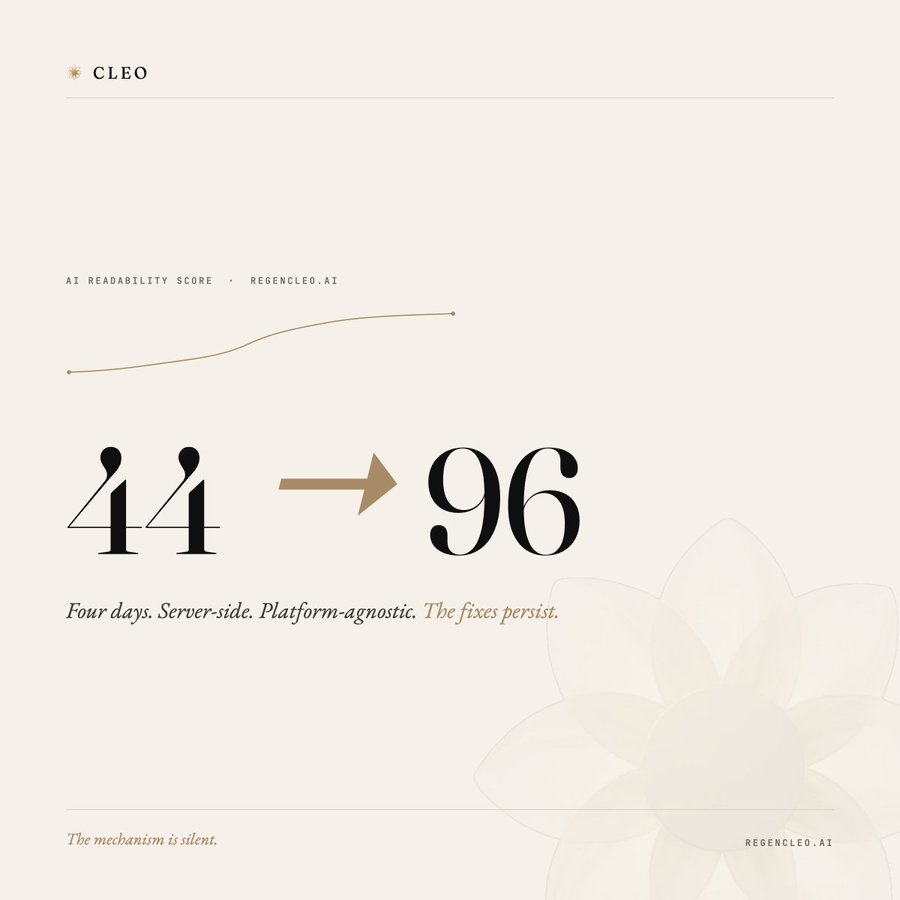
- AI Readability Score (ARS) audit: scores every tracked page for citation-readiness, flagging thin coverage, missing structured answers, and topical gaps that reduce AI engine inclusion likelihood. Available on GEO tiers and above.
- Fix-Suggestions tab: a dedicated Intelligence Dashboard tab that surfaces full AI-generated recommendations for every visibility gap. Not a list of generic tips; each suggestion is query-specific, engine-aware, and prioritised by estimated impact so teams know exactly where to focus.
- Impact & Result tracking: closes the loop between AI visibility improvements and real traffic outcomes. CLEO connects to GA4 to surface AI referral traffic and integrates with Google Search Console to track branded search volume, so you can see whether improvements in AI citations translate into measurable traffic gains.
The 8 metrics that make up CLEO's GEO Score
CLEO's GEO Score is not a single data point; it is a composite of eight precision metrics, each measuring a distinct dimension of how AI engines perceive and surface your brand. Together they give a complete, auditable picture of your AI visibility:
- AI Presence Rate: how often your brand appears in AI-generated answers for your tracked query set, across all monitored engines.
- Answer Prominence: where in the answer your brand appears. A mention buried in the final clause is worth less than a lead citation. Prominence tracks this distinction.
- Citation Rank Index: when your URLs are cited as sources, how prominently do they rank within the citation list? First-cited sources carry materially more authority signal than later ones.
- Share of Voice: your brand's relative presence versus named competitors for the same query set, making competitive movement immediately visible.
- Recommendation Rate: how often AI engines actively recommend your brand (not just mention it) in response to solution-seeking queries. This is a leading indicator of commercial intent alignment.
- Sentiment Score: the tone and framing around your brand in AI answers. Neutral mentions and positive endorsements are tracked separately from cautionary or negative framing.
- Citation Drift: tracks whether the URLs AI engines cite for your brand are stable or shifting over time, signalling whether your content authority is consolidating or fragmenting.
- Confidence Interval: the statistical reliability of your GEO Score data, so you know exactly how much weight to put on the numbers.
What CLEO fixes: on-pitch, off-pitch, and infrastructure
Most AI visibility tools stop at measurement. CLEO extends into a three-tier fix framework that covers every layer where AI citation gaps originate.
On-pitch fixes: direct content improvements that change what AI engines see and cite.
- Query-specific content briefs: the Fix-Suggestions tab generates AI-written recommendations for each visibility gap, covering what angle to take, what entities to include, and which questions to answer to match how the engine frames that query.
- AI Readability Score (ARS) audits: scores every tracked page for citation-readiness, flagging thin coverage, missing structured answers, and topical gaps that reduce inclusion likelihood.
- AI-citable article production: the SEO + GEO plan includes Quill-generated articles, purpose-built to close specific citation gaps identified by the Presence Growth Engine.
- Schema and structured data recommendations: surfaces missing or malformed markup that limits how AI engines extract and attribute your content.
Off-pitch fixes: improvements to the external signals AI engines use to evaluate source authority.
- Third-party source mapping: identifies which publishers, review sites, and industry outlets AI engines consistently pull from in your category, so you know exactly where earned coverage will move the needle.
- Competitor citation analysis: shows which off-site pages competitors have that you don't, and which external mentions are driving their citation advantage.
- Backlinking submissions: the SEO + GEO plan includes basic link submissions (social bookmarking, classified ads, directory submissions) to build the off-site authority signals that correlate with AI citation frequency. Enterprise plans scope allowances to the engagement.
- Entity and mention gap analysis: flags where your brand is absent from the third-party sources AI engines treat as authoritative for your niche.
Infrastructure fixes: technical and server-side changes that affect how AI engines crawl, process, and attribute your content.
- Server-side canonical corrections: CLEO deploys canonical tag fixes directly server-side, resolving duplicate content signals that cause AI engines to cite competitor versions of similar content instead of yours.
- CMS-direct technical SEO fixes: the SEO + GEO plan's agentic tools identify and implement technical fixes (crawlability, indexation, page structure, internal linking) directly in your CMS without developer queues.
- Crawl signal diagnostics: surfaces technical barriers, including blocked paths, slow response times, and mis-structured sitemaps, that reduce how thoroughly AI engines process your site before generating answers.
- Citation Drift monitoring: tracks whether the URLs AI engines cite for your brand are stable or shifting, which often signals an underlying technical issue (URL changes, redirect chains, or content fragmentation) rather than a content problem.
Together, these three fix layers mean CLEO doesn't just tell you where you're missing. It tells you whether the problem is in your content, your off-site authority, or your technical foundation, and gives you the tools to address all three.
Benefits
- Turns AI monitoring into a clear content and SEO roadmap, not just a report.
- Covers every major AI engine in one place, with no need to stitch together data from multiple tools.
- Source-level analysis shows exactly which URLs, domains, and publishers are winning citations and why.
- On-pitch, off-pitch, and infrastructure fix layers mean every type of visibility gap has a clear resolution path.
- Presence Growth Engine intelligence means you spend less time interpreting data and more time acting on it.
- Designed for teams that run AI visibility as an ongoing program, not a one-time audit.
Pricing
Regencleo prices its plans per site/domain. Current plans, prices and allowances are published in its Plan Schedule at regencleo.ai/pricing. What each plan covers:
- SEO + GEO: autonomous server-side fixes directly in your CMS, plus the AI answer visibility engine. Includes CLEO Audit, Website Audit, Keyword Research, Content Mapping, Meta Tags, Schema Markup, Canonical Tags, llms.txt, Quill SEO articles, and Backlinking (basic links). Best for founders doing the work themselves.
- GEO half (included in SEO + GEO): monitors how AI engines see your brand across your tracked queries on seven standard engines (ChatGPT, Google AI Overviews, Bing AI Overviews, Perplexity, Gemini, Claude and DeepSeek, plus Grok and Meta AI on Enterprise for nine), with up to four active per site at a time, with the full 8-core GEO metrics suite (AI Presence Rate, Answer Prominence, Citation Rank Index, Share of Voice, Recommendation Rate, Sentiment Score, Citation Drift, Confidence Interval), ARS (AI Readability Score) audit, competitive tracking, LLM traffic tracking, CLEO AI Audit, agentic-readiness infrastructure fixes, and AI-citable articles via Quill. Includes Strategy sessions. Best for growth-stage brands exploring AI search visibility.
- SEO + GEO + Social: adds social listening across 7 platforms (X, LinkedIn, Reddit, Medium, YouTube, Quora, Bluesky), AI-drafted on-brand replies, self-serve posting (X and Bluesky from CLEO; LinkedIn posted by you on LinkedIn), a monthly publishing allowance across LinkedIn, X and Bluesky, Quill long-form content with AI images, AI-citation tracking via the Citation Loop, and Campaign orchestration. Best for brands turning visibility into recommendation.
- Enterprise: everything, scoped to the engagement. Custom limits, white-label, bespoke reporting. Dedicated account management and priority, same business day.
CLEO covers cross-engine tracking, source-level gap detection, server-side fixes, and content recommendations in one platform, where many point solutions costing $300–$700/mo address a single dimension of AI visibility.
Who it is not for: Teams that want a quick one-time brand mention check with no ongoing monitoring. For everything else, including agencies, in-house SEO teams, content teams, and marketing leaders who treat AI search as a growth channel, CLEO is a comprehensive platform worth evaluating.
2. OtterlyAI: AI search monitoring for brands and content
OtterlyAI is a Gartner Cool Vendor for AI in Marketing 2025 and serves over 20,000 marketing professionals. It monitors brand visibility across AI search engines including ChatGPT, Perplexity, and Google AI Overviews, and is listed in the Semrush App Center as an integration partner.
Key Features
- Cross-engine brand mention and visibility tracking
- Visibility score and share of voice metrics
- Content monitoring for AI-driven discovery
- Integration with Semrush workflow
Benefits
- Established platform with analyst recognition and a large user base
- Good starting point for teams new to AI visibility monitoring
- Free tier available for initial testing
Pricing
Free tier available. Paid plans vary by prompt volume and features. Check OtterlyAI's site for current pricing.
How it compares to CLEO: OtterlyAI is a solid monitoring layer, reliable for teams getting started with AI visibility tracking. CLEO builds on the same foundation by adding source-level gap analysis and an actionable content roadmap, so teams can move from knowing they appear (or don't) to understanding exactly why and what to do next. The two tools serve different stages of maturity: OtterlyAI is a strong entry point; CLEO is the natural next step when visibility improvement becomes the goal.
3. Profound: Best for enterprise AI answer engine monitoring
Profound is built for organisations that treat answer-engine performance as an ongoing program. Backed by $58.5M in Series B funding led by Sequoia, it is one of the most well-resourced platforms in the category. Its strongest differentiator is depth around prompt tracking, brand inclusion trends, and enterprise-grade analytics through its Answer Engine Insights and Agent Analytics modules.
Key Features
- Tracks brand and competitor appearances across major AI answer engines
- Prompt-level views: are we in the answer or not, over time
- Surfaces what users actually ask AI at scale, to prioritise coverage
- Agent Analytics for tracking AI agent behaviour relevant to your brand
Benefits
- Enterprise-grade depth for teams with dedicated AI visibility workstreams
- Strong trend data for executive reporting
- Well-funded and likely to invest heavily in platform development
Pricing
$499/mo (Lite). Enterprise tier with API and dedicated support is custom. Significant investment, appropriate for larger organisations with analyst capacity.
How it compares to CLEO: Profound is a strong analytics platform for enterprise teams that need deep LLM reporting and executive-ready dashboards. CLEO complements this by adding the action layer, turning monitoring data into prioritised content and SEO recommendations. Teams that use Profound for visibility reporting often find CLEO valuable for the implementation side.
4. SE Ranking: Best for AI Overview tracking inside a rank tracker
SE Ranking layers AI Overview monitoring on top of a rank tracker many teams already use. Its real value is keyword-level AIO appearance plus source URL detection, the two questions teams need answered fast: did we show up, and which page got pulled in.
Key Features
- AI Overview appearance tracking for monitored queries
- Source URL detection mapped to specific keywords
- Visibility trends side-by-side with classic SERP movement
Benefits
- Familiar rank-tracker workflow means low adoption friction
- Good for teams whose primary AI visibility concern is Google AI Overviews
- Bootstrapped, with no VC pressure to expand scope prematurely
Pricing
$119/mo for the AI Visibility Tracker module on top of an SE Ranking plan.
How it compares to CLEO: SE Ranking excels at AI Overview tracking within a familiar rank-tracker environment. For teams whose visibility priorities extend beyond Google to ChatGPT Search, Perplexity, or Claude, CLEO covers those engines with the same depth. The two tools work well together: SE Ranking for Google-centric workflow, CLEO for full cross-engine visibility.
5. Scrunch AI: Best for citation and source-URL analysis
Scrunch AI is most useful when your team cares less about whether a brand was mentioned and more about which URLs and publishers AI assistants actually cite. That source-level view makes it valuable for content strategy: you can see missing sources, competitor citations, and which pages to refresh. Backed by $19M Series A from Decibel and Mayfield.
Key Features
- Tracks the URLs and domains repeatedly cited for a query set
- Reveals competitor citations and content opportunities
- Reporting views built for content and SEO teams
Benefits
- Best-in-class source URL analysis among specialist tools
- Clear use case for content teams optimising for citation likelihood
Pricing
Starts at $300/mo for 350 custom prompts and three personas. Enterprise and AXP pricing on request.
How it compares to CLEO: Scrunch AI delivers strong source-URL intelligence for teams where citation analysis is the primary focus. CLEO includes the same source-level gap analysis as part of a broader visibility platform, alongside cross-engine monitoring and content recommendations. Teams that want citation intelligence within a complete AI visibility stack will find CLEO consolidates what Scrunch AI does well, plus everything else.
6. Ahrefs Brand Radar: Best for brand mention discovery at scale
Brand Radar is best understood as a brand-monitoring layer that supports AI visibility work, not a dedicated AI answer tracker. It excels at finding patterns in brand mentions across the web, comparing share of presence over time, and identifying the third-party sources that future AI citations may pull from.
Key Features
- Discovers and monitors brand mentions across the web
- Compares brand presence with competitors over time
- Connects naturally with the broader Ahrefs research workflow
Benefits
- Powerful for teams already deep in the Ahrefs ecosystem
- Web-wide mention discovery helps explain which third-party sources AI engines trust
Pricing
$699/mo as an add-on on top of an existing Ahrefs subscription, making it one of the most expensive options in this roundup.
How it compares to CLEO: Brand Radar is a strong choice for teams already invested in the Ahrefs ecosystem who want to understand third-party source influence on AI citations. CLEO adds the layer of direct AI answer monitoring, tracking what engines actually say about your brand, alongside the source signals Brand Radar surfaces. Used together, they give a complete picture of both influence and presence.
7. Peec AI: Best lightweight LLM visibility tracker
Peec AI fits lean teams that want repeatable LLM visibility tracking without the overhead of an enterprise platform. Define query sets, monitor whether your brand appears in answers over time, compare competitors, and share results without building a custom process. Raised $1.9M to date.
Key Features
- Tracks LLM answer presence for defined prompts and query sets
- Trend lines for visibility over time
- Lightweight setup for ongoing monitoring by smaller teams
Benefits
- Low-friction entry point for teams just beginning LLM visibility tracking
- Affordable relative to enterprise alternatives
Pricing
Starts at $100/mo. Scales with tracked prompts and platform coverage.
How it compares to CLEO: Peec AI is a solid entry point for teams establishing their first LLM visibility baseline. As monitoring matures and teams want to act on the data, understanding why gaps exist and what content to build, CLEO provides that next layer. The two tools serve different stages of the AI visibility journey.
8. Semrush AI Toolkit: Best full SEO suite to pair with a dedicated tracker
Semrush is a public company (NYSE: SEMR) and one of the most widely used SEO platforms in the world. Its AI Toolkit adds AI Overview signals, content optimisation, and competitive intelligence on top of an already comprehensive SEO workflow. Most teams use it as the SEO core and pair it with a dedicated AI visibility tracker.
Key Features
- Keyword research and topic discovery for AI-friendly coverage
- Site audits and content optimisation workflows
- AI Overview signals within a familiar reporting environment
Benefits
- Teams already on Semrush can extend into AI signals without switching platforms
- Best-in-class keyword research and competitive intelligence
Pricing
AI Toolkit add-on starts around $745/mo on top of a Semrush plan, a significant total cost when factoring in the base subscription.
How it compares to CLEO: Semrush is best-in-class for SEO execution: keyword research, competitive intelligence, and site health. For dedicated cross-engine AI monitoring with source-level analysis and content recommendations, pairing Semrush with CLEO covers both surfaces: Semrush for SEO depth, CLEO for cross-engine AI visibility.
9. Moz: Established SEO platform with emerging AI signals
Moz is one of the longest-standing SEO platforms, trusted by agencies and in-house teams for domain authority tracking, link analysis, keyword research, and technical audits. In 2026 it has added limited AI visibility signals alongside its core SEO workflow.
Key Features
- Domain Authority and link intelligence at scale
- Keyword tracking and SERP analysis
- Site crawl and technical SEO auditing
- Emerging AI Overview presence signals (limited)
Benefits
- Trusted, mature platform with strong foundational SEO data
- Accessible pricing relative to enterprise alternatives
Pricing
Starts at $100/mo. Enterprise plans vary.
How it compares to CLEO: Moz is a dependable SEO foundation with strong domain authority and link intelligence. For teams that also need dedicated AI citation tracking and cross-engine LLM monitoring, CLEO sits naturally alongside Moz, handling the AI visibility layer while Moz handles the SEO fundamentals.
10. BrightEdge: Enterprise content performance with emerging AI signals
BrightEdge is a well-established enterprise SEO and content performance platform used by large organisations for technical SEO, content strategy, and competitive intelligence. It has added some AI Overview signals to its platform, but AI visibility monitoring is not its primary focus.
Key Features
- Enterprise-scale content performance tracking
- Technical SEO and site health monitoring
- Competitive content intelligence
- Some AI Overview and AI signal tracking (limited)
Benefits
- Strong choice for large enterprises managing content at scale
- Robust integration with enterprise data stacks
Pricing
Custom enterprise pricing. Typically a significant annual investment.
How it compares to CLEO: BrightEdge is a proven enterprise content performance platform with strong technical SEO and content intelligence capabilities. For organisations that also need dedicated AI citation monitoring and source-level gap analysis, CLEO integrates naturally alongside BrightEdge, each handling what it does best. See the full BrightEdge vs CLEO comparison.
Which AI visibility tool fits your use case?
Skip the spec sheets. Match what you actually need to what each tool does best. For a wider survey of the platform landscape, including which engines each category covers, see our guide to AI search visibility platforms.
- For a closed loop across engines: CLEO. Combines cross-engine tracking, source-level gap analysis, and actionable content recommendations in one place.
- Best for enterprise prompt monitoring: Profound. Deep LLM analytics with executive-ready reporting for organisations with dedicated AI visibility workstreams.
- Best for AI Overview tracking: SE Ranking. Keyword-level AIO appearance and source URL detection inside a familiar rank-tracker workflow.
- Best for citation and source analysis (standalone): Scrunch AI. Focused on which URLs AI assistants actually cite, valuable for content teams.
- Best for brand mention discovery: Ahrefs Brand Radar. Web-wide monitoring that helps explain the third-party sources AI engines trust.
- Best lightweight LLM tracker: Peec AI. Low-friction monitoring for lean teams tracking a defined prompt set.
- Best full SEO suite to pair with a tracker: Semrush. Comprehensive SEO execution hub; use alongside CLEO for complete AI + SEO coverage.
- Best foundational SEO platform: Moz. Strong SEO fundamentals; pair with CLEO for the AI visibility layer.
- Best for enterprise content performance: BrightEdge. Enterprise content and technical SEO at scale; complement with CLEO for AI monitoring depth.
Other generative engine optimisation platforms and tools worth knowing
These platforms did not make the top 10 but appear frequently in GEO and AEO conversations:
- Surfer SEO and Clearscope: on-page content optimisers that improve citation likelihood by strengthening topical relevance. Useful for execution, not for monitoring.
- Evertune, AthenaHQ, XFunnel: referenced in broader brand and demand monitoring conversations depending on go-to-market needs.
- Am I on AI?, Rankscale, Rankshift, ZipTie.Dev, AI Analyzer: smaller or specialised tools for quick checks and niche diagnostics. No trend tracking, not suitable for ongoing programs.
- Traffic Think Tank: practitioner community where teams share GEO and AEO playbooks. Valuable for context, not a monitoring platform.
Frequently asked questions
What are AI search monitoring tools?
AI search monitoring tools track whether your brand is mentioned or cited in AI-generated answers across platforms like ChatGPT, Perplexity, Gemini, Claude, and Google AI Overviews. The best tools go beyond mentions to show which source URLs are cited, how you compare to competitors, and what to do to improve your AI presence.
How do AI visibility tools differ from traditional rank trackers?
Traditional rank trackers measure your position in a list of blue links. AI visibility tools measure whether your brand appears in a synthesised answer, a fundamentally different format where position doesn't exist and citation is everything. Only 11% of domains are cited by both ChatGPT and Perplexity simultaneously (thedigitalbloom.com, 2025), which means most brands have significant gaps that a rank tracker will never surface.
Do I need an AI visibility tracker if I already use Ahrefs or Semrush?
Yes, for most teams. Ahrefs and Semrush are built for classic search. Their AI visibility features are add-ons, not purpose-built capabilities. To seriously track and grow AI presence, especially across multiple engines with source-level analysis, a dedicated platform like CLEO is necessary.
What metrics matter most for AI visibility monitoring?
Eight metrics drive meaningful AI visibility decisions. CLEO's GEO Score is built from all of them:
- AI Presence Rate: how often your brand appears in AI answers for your tracked queries
- Answer Prominence: where in the answer your brand appears (lead citation vs. footnote mention)
- Citation Rank Index: how prominently your source URLs are ranked within AI citation lists
- Share of Voice: your presence relative to named competitors for the same query set
- Recommendation Rate: how often AI engines actively recommend your brand in solution-seeking queries
- Sentiment Score: the tone and framing around your brand in AI-generated answers
- Citation Drift: whether the URLs AI engines cite for you are stable or shifting over time
- Confidence Interval: the statistical reliability of your score data (margin of error narrows per tier)
CLEO tracks all eight in one platform, with source gap analysis surfacing exactly which content is missing to earn more citations.
Are there free AI visibility tools?
OtterlyAI and some smaller point tools offer free tiers. These are useful for an initial check but lack the trend tracking, source-level analysis, and competitive depth needed for ongoing brand visibility management.
How much do AI search monitoring tools cost?
Point tools start at $99/mo (Peec AI, Moz). Mid-market platforms range from $119–$499/mo. Enterprise platforms (Profound, BrightEdge) are $499/mo to custom pricing. Regencleo's plans and prices are published in its Plan Schedule at regencleo.ai/pricing, delivering the depth of an enterprise platform at growth-stage pricing. One site is one registrable domain, subject to a limit of 100 indexable pages.
How do I know if my brand is being cited by AI assistants?
Start by querying ChatGPT, Perplexity, Claude, and Google AI Overviews with your target terms and documenting which brands appear. For systematic tracking, AI search monitoring tools like CLEO track citations across multiple engines, showing mention frequency, source URLs, and competitive share of voice over time.
How do marketing teams deal with declining organic traffic from AI answers?
Marketing teams address this by monitoring AI answer citations alongside traditional search rankings. LLM visitors convert 4.4x better than traditional organic search visitors, so tracking AI citation presence is a growth lever. Tools like CLEO combine cross-engine monitoring with source-level gap analysis and content recommendations, turning visibility data into actionable improvement plans.
Which vendors offer closed-loop brand presence systems?
CLEO is purpose-built as a closed-loop system that connects monitoring, diagnosis, and improvement. CLEO's Presence Growth Engine supports seven standard AI engines - ChatGPT, Google AI Overviews, Bing AI Overviews, Perplexity, Gemini, Claude and DeepSeek, with Grok and Meta AI on Enterprise for nine - with up to four active per site at a time, tracking brand citations and providing source-level gap analysis, content recommendations, and a three-tier fix framework covering on-pitch content, off-pitch authority signals, and infrastructure corrections. The Social tier adds a Citation Loop connecting social activity to AI citation data.
For how these platforms get combined in practice rather than ranked, see what marketing teams actually run in 2026: the four stack shapes, what each costs, and why a monitor with no fix layer behind it gets cancelled at renewal.
Check your score. Start with your baseline. Enter a domain at regencleo.ai/scan - the engine reads what ChatGPT, Google AI Overviews, and Perplexity say in response to your category's most-asked questions, reads where you sit in classical search, and reads what the social surfaces carry. It returns a single page, no login required. Paid GEO plans extend coverage to Claude.