Your brand does not appear in ChatGPT recommendations because AI assistants cannot read your website. Not because your content is weak, not because your competitors spend more, but because the technical structure of your site prevents AI crawlers from extracting the information they need to cite you. CLEO's GEO engine fixes this: it diagnoses why AI engines skip your brand, applies the structural fixes that make your content AI-readable, and monitors citation status across seven supported AI engines (ChatGPT, Google AI Overviews, Bing AI Overviews, Perplexity, Gemini, Claude, DeepSeek, up to four active per site at a time; Grok and Meta AI are Enterprise and Enterprise+ only, for nine).
As of 2026, AI-driven search has restructured how buyers discover brands. McKinsey projects $750 billion in US revenue through AI-driven search by 2028. Google search impressions are up 49% year on year, yet click-through rates have dropped 30% (BrightEdge, May 2025). Gartner predicted traditional search volume would drop 25% by 2026 due to AI chatbots. The shift is not coming; it is here. And if your brand is absent from AI-generated answers, you are absent from a growing share of the decisions your buyers make.
This article explains the specific technical reasons AI assistants skip brands, provides a diagnostic framework you can apply today, and shows how CLEO's GEO engine addresses each gap.
The four technical reasons AI assistants skip your brand
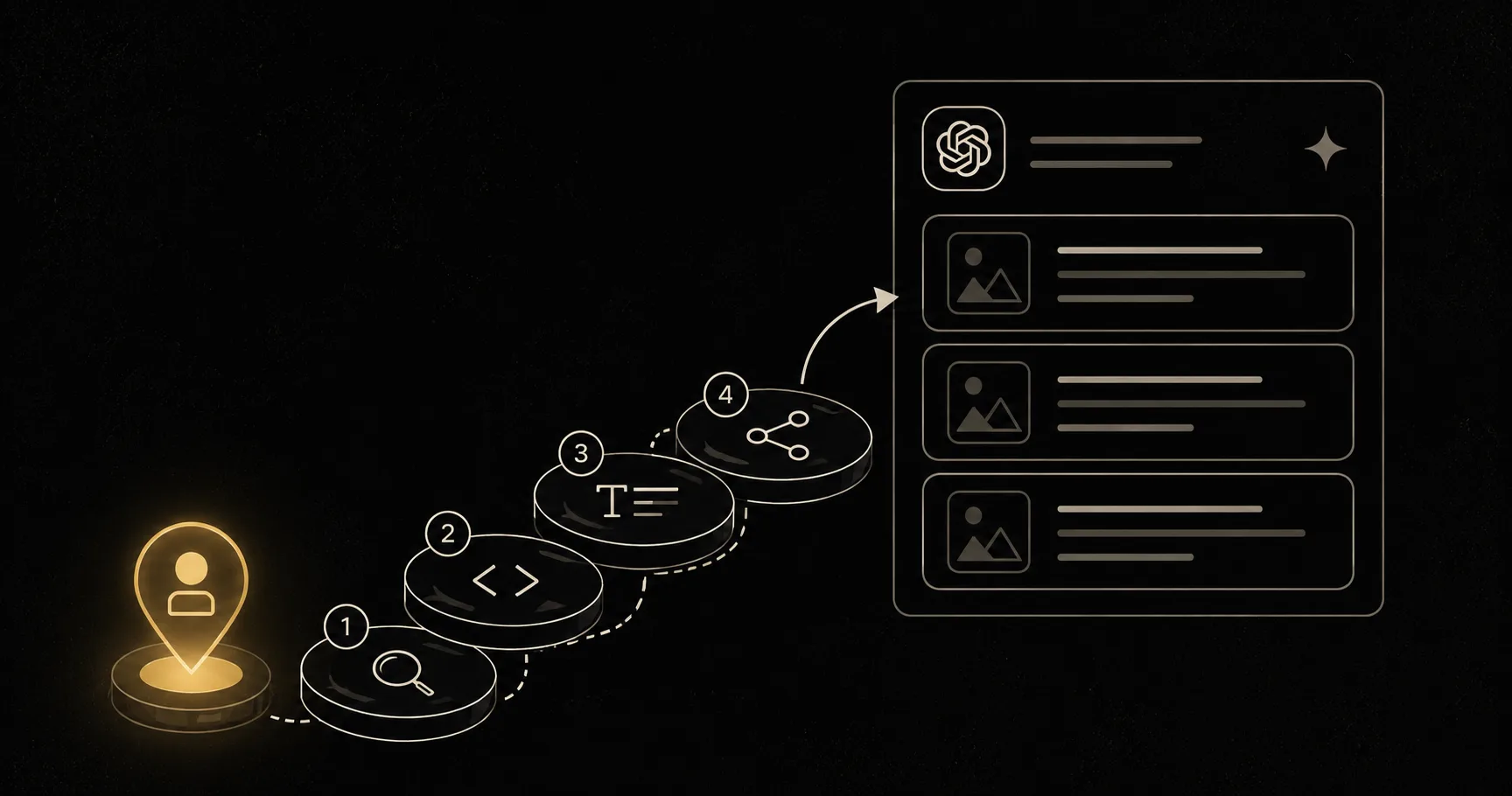
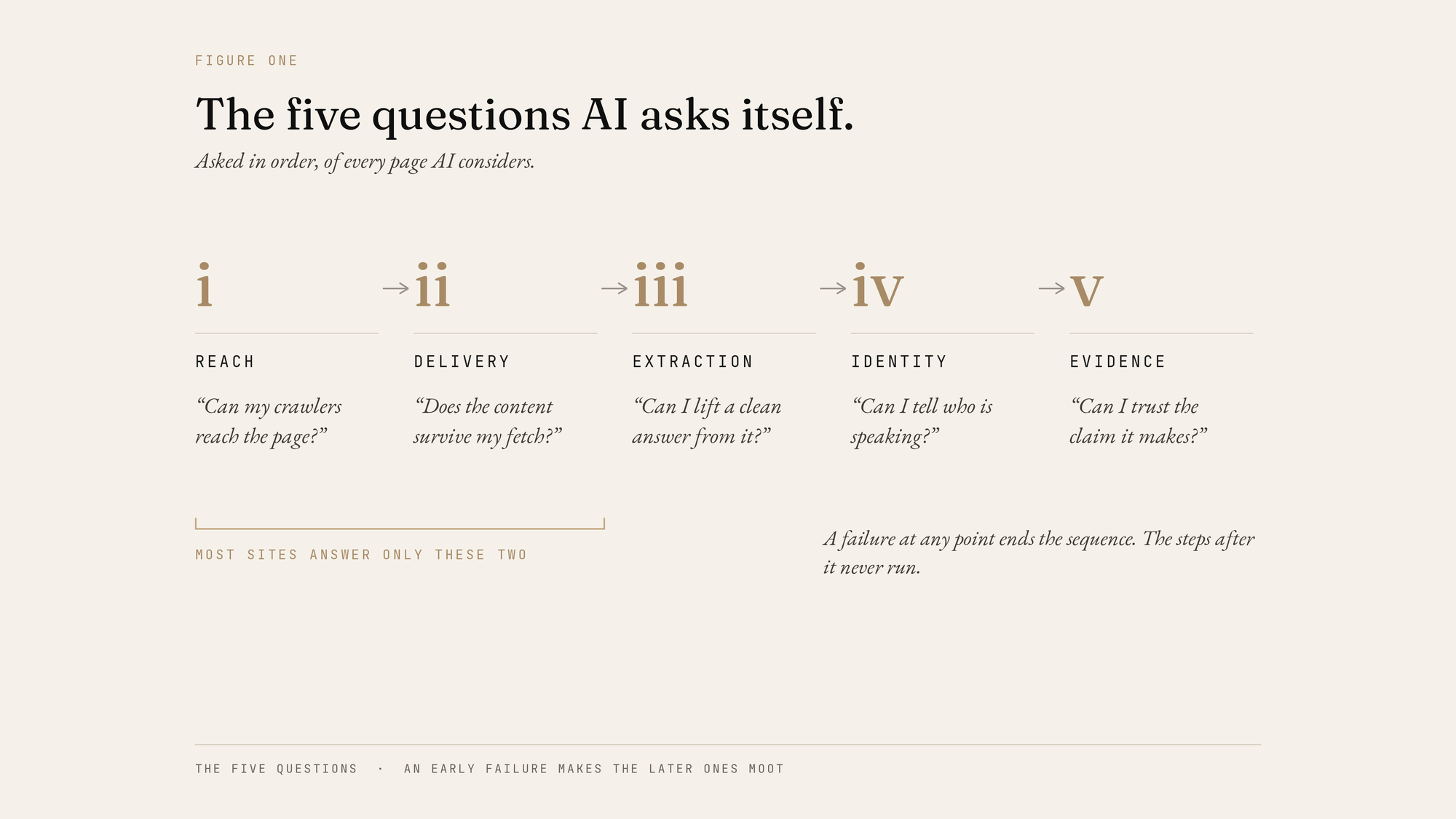
AI assistants do not rank pages the way traditional search engines do. They synthesise answers from sources they can parse, verify, and attribute. When your brand is absent from recommendations, the root cause is almost always one or more of these four structural problems.
1. JavaScript-dependent rendering
GPTBot, ClaudeBot and PerplexityBot do not execute JavaScript. They read the raw HTML your server sends in the initial response, then leave. If your homepage, product pages, or key content only render after a JavaScript bundle hydrates, a client-side fetch resolves, or a single-page application router mounts, that content does not exist for most AI crawlers. They see empty containers and script tags. Your brand, your value proposition, your differentiators: all invisible.
This is not a niche problem. Any site built as a React SPA, an Angular application with client-side rendering, or a Next.js project that relies on client-side data fetching inside useEffect is likely affected. The fix is server-side rendering: ensuring the initial HTML payload contains complete, readable content before any JavaScript runs.
2. Missing or invalid schema markup
Schema markup (JSON-LD structured data) tells AI engines what your page represents: is it an organisation page, a product page, an article, a FAQ? Without valid schema, AI engines must infer entity types and relationships from unstructured text. That inference is unreliable, especially for brands that are not already well-known entities in the AI model's training data.
The most critical schema types for AI citation are Organisation, Product, FAQPage, Article, and BreadcrumbList. These must be embedded as inline JSON-LD in the document head, present in the initial HTML, not injected by JavaScript after page load.
3. No llms.txt file
The llms.txt specification provides a structured, plain-language index at your domain root that tells AI systems what your site contains, what your product does, and where authoritative content lives. Without it, AI crawlers must infer your site structure from crawl patterns, a process that is slow, incomplete, and biased toward pages with the most external links. An llms.txt file gives AI systems a direct map.
4. Content not structured for AI extraction
Traditional marketing content buries the answer. It opens with context, builds to a value proposition, and closes with a call to action. AI engines need the opposite: the answer first, the supporting evidence second. Content structured with clear headings, answer-first paragraphs, statistics with sources, and direct claims is extractable. Content that reads like a brochure is not.
Princeton-led research (SIGKDD 2024) found that GEO methods, including structured content, statistics, cited sources, and expert quotations, improve visibility in generative engine responses by up to 40%. The structure of your content directly affects whether AI engines can cite it.
Why third-party mentions matter more than your own website
Research from AirOps and Kevin Indig found that 85% of brand mentions in AI answers originate from third-party pages, not brand-owned content. This means your own website, no matter how well optimised, accounts for only a fraction of the signal AI engines use when deciding whether to recommend you.
AI engines cross-reference multiple independent sources to build confidence in a recommendation. If only your website says you are the best in your category, that carries less weight than if three independent publications, two review platforms, and active community discussion confirm it. Entity authority is built across the web, not on a single domain.
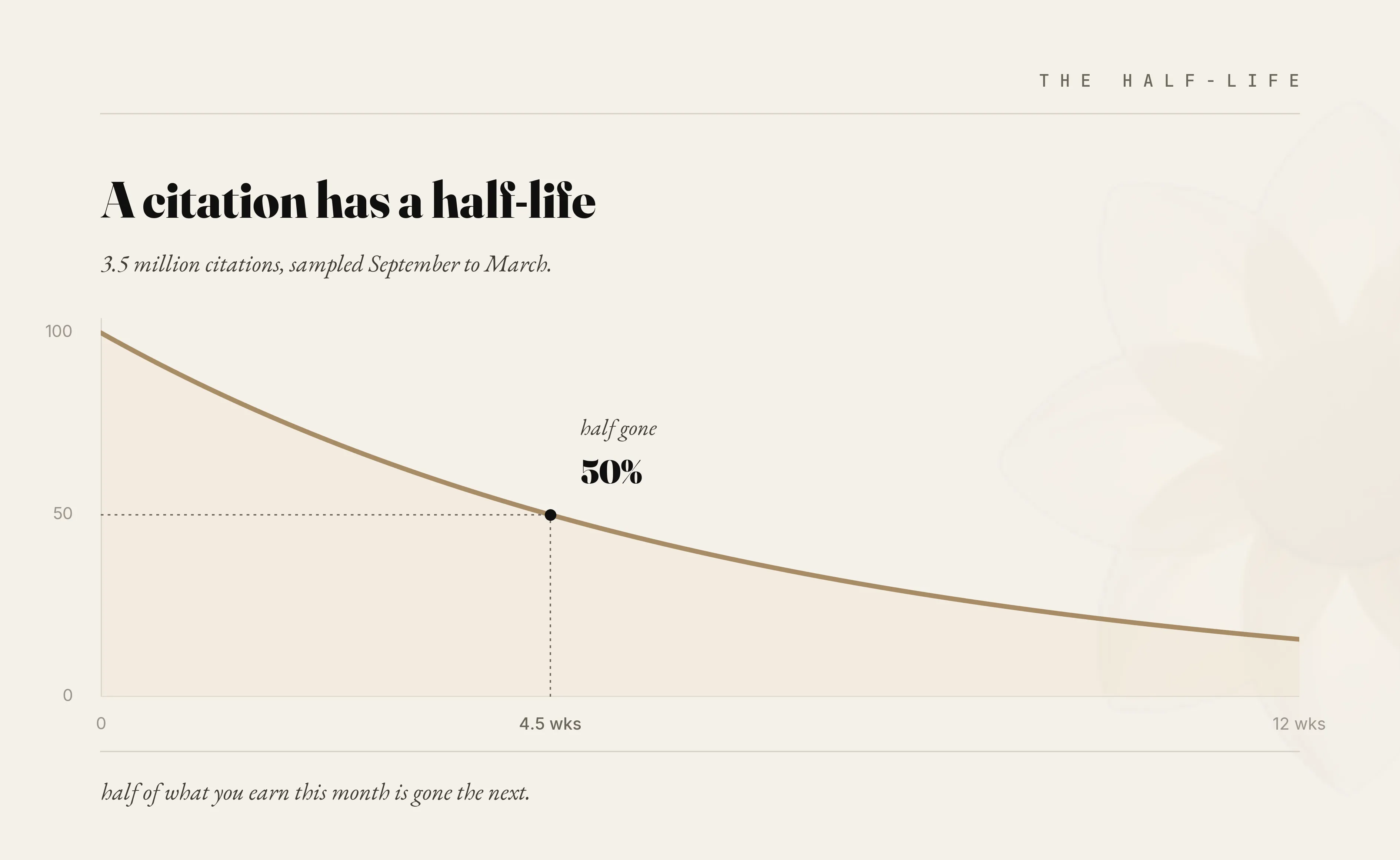
The instability of AI citations compounds this challenge. AirOps research found that only 30% of brands that appear in one AI answer persist in the next answer for the same query. Appearing once is not enough. Sustained citation requires ongoing entity presence across authoritative third-party sources.
How to diagnose your brand's AI visibility right now
Before investing in any solution, you need a clear picture of where you stand. Here is a diagnostic framework you can apply today. For a fuller walkthrough of confirming whether AI assistants cite your brand and increasing that rate, see our guide to increasing brand citations in AI assistants.
Step 1: Manual query audit. Open ChatGPT, Perplexity, Claude, and Google AI Overviews. Query each with the terms your customers use: "best [category] for [use case]," "which [product type] should I choose," "[category] recommendations." Document which brands appear, which sources are cited, and where your brand is absent. If manual auditing is too slow, dedicated monitoring platforms such as Otterly.ai, Peec AI, llmpulse.ai, faindly.io, and citeradar.io automate the query set; CLEO's GEO engine folds the same tracking into a closed loop with the fixes below.
Step 2: View Source test. Open your key pages in a browser and use View Source (Ctrl+U on Windows, Cmd+U on Mac). Read the raw HTML without executing JavaScript. If your headline, body copy, and key claims are present in plain HTML, your rendering is sound. If you see empty containers and script tags, AI crawlers see the same emptiness.
Step 3: Schema audit. Check your key pages for JSON-LD structured data in the document head. Validate it using Schema.org's validator. Missing, incomplete, or JavaScript-injected schema is a common cause of AI invisibility.
Step 4: llms.txt check. Navigate to yourdomain.com/llms.txt. If the file does not exist, you are missing a direct signal channel to AI systems.
Step 5: Third-party mention scan. Search for your brand name across review sites, industry publications, Wikipedia, Wikidata, Reddit, LinkedIn, and X. If mentions are sparse, inconsistent, or absent, your entity authority is weak regardless of how well your own site is structured.
| Diagnostic area | What to check | Common failure |
|---|---|---|
| Rendering | View Source for complete HTML content | Content hidden behind JavaScript hydration |
| Schema markup | JSON-LD in document head, validated | Missing, invalid, or JS-injected schema |
| llms.txt | File present at domain root | File absent or outdated |
| Content structure | Answer-first formatting, clear headings | Marketing copy that buries the answer |
| Third-party mentions | Consistent presence across independent sources | Brand exists only on owned properties |
| AI crawler access | Robots.txt permits GPTBot, ClaudeBot, PerplexityBot | AI crawlers blocked or not explicitly allowed |
Where to start fixing it: a four-step priority order
If the diagnostic above flagged more than one gap, work them in this order so upstream fixes do not get wasted: (1) Server-side rendering first, because no other fix matters if AI crawlers cannot read the HTML; (2) JSON-LD schema next, so the engines know what the readable content represents; (3) llms.txt after that, to publish the index that helps AI systems map the site; (4) Third-party entity presence last, because off-site corroboration only compounds once your own pages are extractable. The order matters: a brand chasing third-party mentions before AI readability spends effort the engines cannot yet verify against the source.
How CLEO's GEO engine fixes AI recommendation invisibility
CLEO is the specialist AI that runs your brand's digital marketing: a closed, integrated system that unifies search, AI answers, content, and social visibility. The GEO engine is the component that directly addresses AI recommendation invisibility.
The SEO + GEO plan (see current pricing at regencleo.ai/pricing) provides:
- AI engine visibility monitoring across seven supported AI engines (ChatGPT, Google AI Overviews, Bing AI Overviews, Perplexity, Gemini, Claude, DeepSeek, with up to four active per site at a time; Grok and Meta AI are Enterprise and Enterprise+ only, for nine)
- AI Search score (which combines AI Recommendation and AI Citation across ChatGPT, Google AI, Gemini, Claude and Perplexity), providing a quantified baseline and progress tracker
- Query monitoring for the queries your customers actually use
- AI-citation tracking so you know exactly when and where your brand is cited or dropped
- Competitor monitoring with win rate, citation share, average position, and threat tiers
- Presence Scan that diagnoses exactly what prevents AI engines from citing your content
- Free Presence Scan (regencleo.ai/scan) as a comprehensive diagnostic starting point
- Schema and entity markup implementation across your site
- llms.txt creation and ongoing maintenance
- Agentic-readiness fixes that prepare your site for AI agent interactions
- Existing-content fixes that restructure current pages for AI citability
- GEO content with AI-citable articles produced by Quill
- Strategy sessions to review data and adjust approach
A free Presence Scan (regencleo.ai/scan) is available to establish your baseline before committing.
The approach is proven on CLEO's own site and on client work. CLEO ran Presence Growth on regencleo.ai and lifted its AI Readability Score from 35 to 96, its SEO Score from 40 to 95, and its GEO Score from 14 to 50 in 30 days, driven by legibility and structure rather than backlinks or paid promotion (the CLEO runs on Orbit customer story). For client DisburseCloud, a US payment disbursement platform, category-defining queries went from no-rank to an average position of 3 and AI citation share rose from 17% to 67% in 90 days at 95% Wilson confidence (the DisburseCloud customer story).
Beyond the GEO engine: building entity authority with Social
Because 85% of brand mentions in AI answers come from third-party pages, fixing your own site is necessary but not sufficient. Building entity authority requires presence across the platforms where your category is discussed.
CLEO's Social engine, available on the SEO + GEO + Social plan, adds listening across X, LinkedIn, Reddit, Medium, YouTube, Quora, and Bluesky, with brand mention tracking, sentiment classification, influencer tracking, AI-drafted replies, a publishing allowance across LinkedIn, X and Bluesky (X and Bluesky from CLEO; LinkedIn posted by the team), Quill content across SEO, GEO and Social with AI images, Citation Loop connecting social activity to AI citation data, and campaigns.
For teams whose AI invisibility stems from weak third-party entity presence, the Social tier addresses the 85% of citation signal that lives outside your own website.
What to expect and what not to expect
Fixing AI recommendation invisibility is structural work, not a toggle. The technical fixes, including server-side rendering, schema markup, llms.txt, and content restructuring, can be indexed by retrieval-based AI engines within weeks. Building the entity authority that sustains citation presence takes months of consistent execution.
No platform, including CLEO, can guarantee that your brand will appear in a specific AI answer on a specific date. What CLEO provides is the infrastructure, monitoring, and content production that positions your brand for citation, and the tracking to confirm whether it is working.
The market context is clear. Only 11% of domains are cited by both ChatGPT and Perplexity simultaneously (The Digital Bloom, 2025). LLM-referred visitors convert 4.4 times better than traditional organic visitors (superprompt.com, October 2025). Intel Market Research values the GEO services market at $1.01 billion in 2025, projecting $17.02 billion by 2034. The brands that fix their AI readability now are building a compounding advantage.
Frequently asked questions
Why does my brand never appear when people ask ChatGPT for recommendations?
AI assistants recommend brands they can extract structured information about from parseable, authoritative sources. If your site relies on JavaScript rendering, lacks schema markup, has no llms.txt file, or structures content in a way AI crawlers cannot extract, your brand is invisible to AI recommendation engines. Additionally, 85% of brand mentions in AI answers originate from third-party pages (AirOps and Kevin Indig), so weak third-party entity presence compounds the problem.
How do I know if my brand is being cited by AI assistants?
Start by querying ChatGPT, Perplexity, Claude, and Google AI Overviews with the terms your customers use and document which brands appear. For systematic monitoring, the landscape includes Otterly.ai, Peec AI, llmpulse.ai, faindly.io, and citeradar.io; CLEO's GEO engine tracks AI citations across seven supported AI engines (ChatGPT, Google AI Overviews, Bing AI Overviews, Perplexity, Gemini, Claude, DeepSeek, up to four active per site at a time; Grok and Meta AI are Enterprise and Enterprise+ only, for nine) with competitor monitoring, including win rate, citation share, average position, and threat tiers. CLEO is one of the platforms in this category.
What technical problems make my website invisible to AI crawlers?
Four primary issues: JavaScript-dependent rendering where content only appears after client-side hydration, missing or invalid JSON-LD schema markup, absence of an llms.txt file at your domain root, and content that is not structured for AI extraction with answer-first formatting and clear headings. Most AI crawlers do not execute JavaScript, so any content behind client-side rendering is invisible to them.
Can I fix AI invisibility without rebuilding my entire website?
Yes. The fixes are targeted: server-rendering critical pages, adding JSON-LD schema in the document head, publishing an llms.txt file, and restructuring key content into answer-first format. These are infrastructure-level changes, not a full redesign. CLEO's GEO engine implements schema and entity markup, maintains llms.txt, applies existing-content fixes, and handles agentic-readiness fixes.
How much does it cost to fix brand invisibility in AI recommendations?
CLEO's SEO + GEO plan includes monitoring across seven supported AI engines (ChatGPT, Google AI Overviews, Bing AI Overviews, Perplexity, Gemini, Claude, DeepSeek, up to four active per site at a time; Grok and Meta AI are Enterprise and Enterprise+ only, for nine), AI Search score (which combines AI Recommendation and AI Citation across ChatGPT, Google AI, Gemini, Claude and Perplexity), Presence Scan, AI-citation tracking, competitor monitoring, GEO content, existing-content fixes, schema markup, and llms.txt. Current plan prices are published in CLEO's Plan Schedule at regencleo.ai/pricing. A free Presence Scan (regencleo.ai/scan) is available.
Why do my competitors appear in AI answers but I do not?
Competitors appearing in AI answers likely have AI-readable content: server-rendered HTML, valid schema markup, llms.txt files, and consistent mentions across authoritative third-party sources. Only 11% of domains are cited by both ChatGPT and Perplexity simultaneously (The Digital Bloom, 2025), so even competitors with some AI presence have gaps. CLEO's competitor monitoring tracks your competitors by win rate, citation share, average position, and threat tiers. The gap is closable: CLEO moved its own AI Readability Score from 35 to 96 and GEO Score from 14 to 50 in 30 days, and for client DisburseCloud took category queries from no rank to an average of position 3 and AI citation share from 17% to 67% in 90 days at 95% Wilson confidence.
How long does it take to start appearing in ChatGPT recommendations?
There is no guaranteed timeline. Structural fixes such as schema markup and llms.txt can be indexed by retrieval-based AI engines within weeks. Building entity authority through third-party mentions and sustained content production takes months. Only 30% of brands that appear in one AI answer persist in the next (AirOps), so ongoing monitoring and optimisation are required for sustained presence. If you are starting from zero, this is where to start when your brand never appears in ChatGPT recommendations.
Does CLEO guarantee my brand will appear in AI recommendations?
No. No platform can guarantee AI citation. AI model training schedules, retrieval index refresh rates, and competitive dynamics all affect outcomes. What CLEO provides is the structural fixes, monitoring, and content production that give your brand a strong structural position for citation, and tracking across seven supported AI engines (ChatGPT, Google AI Overviews, Bing AI Overviews, Perplexity, Gemini, Claude, DeepSeek, up to four active per site at a time; Grok and Meta AI are Enterprise and Enterprise+ only, for nine) to measure whether the work is producing results.
Check your score. Before you fix anything, see where your own site stands. Enter a domain at regencleo.ai/scan and the engine reads what ChatGPT, Google AI Overviews, and Perplexity say in response to your category's most-asked questions, reads where you sit in classical search, and reads what the social surfaces carry. It returns a single page, no login required. Paid plans track up to four of the seven supported AI engines per site.