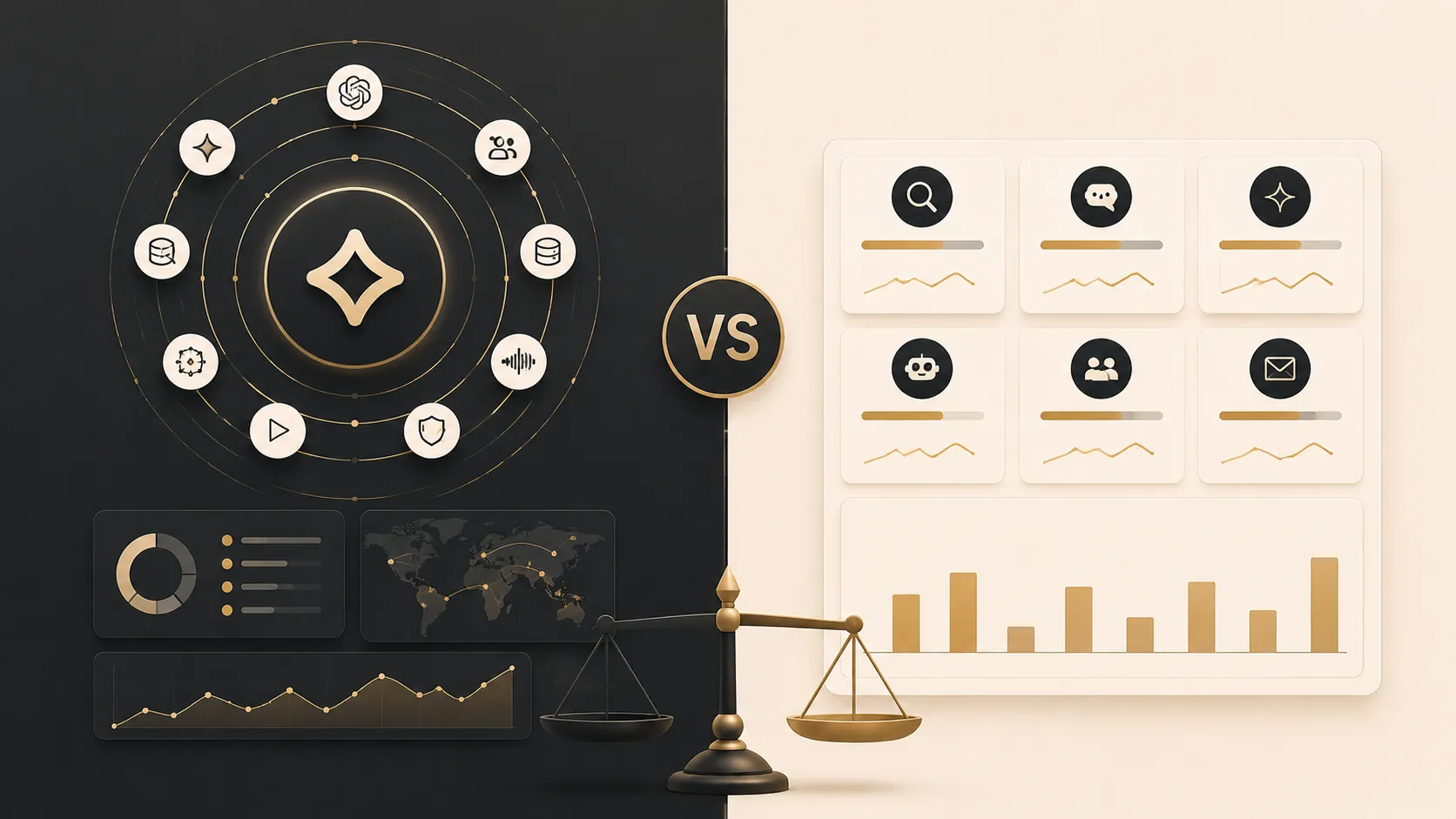
Brand-tracking tools split into two kinds: those that monitor what AI answer engines say about you, and those that also act on what they find. Otterly.ai is the first kind and CLEO is the second, which means a straight "which tracks better" comparison mostly favours Otterly.ai. This page is published by CLEO, so treat the competitor details as things to verify rather than accept, and weigh the recommendation below accordingly.
Why AI brand tracking became a discipline
AI answer engines now absorb queries that once produced search clicks, and presence in those answers is not predicted by ranking. Only 11% of domains are cited by both ChatGPT and Perplexity simultaneously (The Digital Bloom, 2025), so a brand visible in one engine is very likely invisible in another. BrightEdge's AI Overviews data shows impressions rising while click-through rates fall, and the Generative Engine Optimization research establishes that answer inclusion responds to source-level content properties rather than rank.
That combination is why tracking exists as its own category. Nothing in a rank report tells you whether you are in the answer.
Side by side
| Criteria | Otterly.ai | CLEO |
|---|---|---|
| Primary function | Focused AI search monitoring and analytics | Presence engine: monitors, then acts |
| Independent analyst recognition | Gartner Cool Vendor, AI in Marketing | None |
| Installed base | Reported 20,000+ marketing professionals | 300+ sites across 8 countries |
| Company maturity | Established in the category | Founded 2026; short track record |
| Engine coverage | ChatGPT, Perplexity, Google AI Overviews, and others | 7 supported as standard, 9 on Enterprise adding Grok and Meta AI, up to 4 active per site at a time |
| Statistical rigour | Intervals not published | GEO Score across 8 metrics, 95% Wilson intervals |
| Readability and extraction diagnostics | Monitoring-focused analytics | AI Readability Report with page-level fixes |
| Applies technical fixes | No | Yes, server-side into the CMS |
| Content production | No | Quill, SEO and GEO-structured articles |
| Social listening joined to citations | No | 7 platforms via the Citation Loop |
| Ecosystem fit | Semrush App Center integration | Self-contained; no App Center presence |
| Setup effort | Low, fastest to first answer | Higher; it is a programme, not a dashboard |
| Commitment | Low | Six-month minimum. See regencleo.ai/pricing |
Verify current features and pricing with both vendors directly. This category moves quarterly and vendor-published comparison tables, this one included, age quickly and are never disinterested.
When Otterly.ai is the better buy
Four situations, and they are common ones.
Measurement is the whole requirement. If you want to know where your brand stands in AI answers and your team can act on findings with tools it already owns, a focused monitor is the correct purchase. Buying content production and autonomous remediation you do not intend to use is wasted spend, whatever the feature comparison says.
Semrush is your centre of gravity. The App Center integration means the monitoring data lands where the team already works. Workflow adjacency beats feature count more often than vendors admit.
Procurement requires third-party validation. Otterly.ai has Gartner recognition. CLEO does not. For organisations where analyst validation is a gating requirement rather than a preference, this decides it outright.
You are not ready to commit. CLEO's six-month minimum exists because a compounding loop cannot demonstrate compounding inside one cycle. That reasoning is genuine, and it is still a risk transferred onto the buyer. A team exploring whether AI visibility is a real problem for them should not sign a six-month contract to find out.
When CLEO is the better buy
The case is narrow and rests on execution capacity rather than measurement quality.
Developer time is the bottleneck. If you already know what needs fixing and the fixes sit in a backlog behind a sprint queue, a tool that writes canonical tags, schema, meta tags, and alt text server-side into the CMS changes the outcome in a way a report cannot. Otterly.ai tells you; it does not do it.
Content capacity is thin. Monitoring a gap you cannot produce content against documents the problem accurately for a year without changing it.
You need the social join. Answer engines corroborate across independent sources before citing, and Seer Interactive's study of 800,000 AI responses found third-party sources shape brand presence heavily, while Stacker measured citation lift from expanded distribution. If distribution moves citations, seeing both in one system is worth something. Neither product except CLEO joins them.
CLEO's published evidence: its own site moved AI Readability from 35 to 96, SEO from 40 to 95, and GEO from 14 to 50 in 30 days; DisburseCloud, a twelve-person payment disbursement platform, moved AI citation share from 17% to 67% in 90 days at 95% Wilson confidence. Both are first-party and unaudited. Reporting them with confidence intervals is better practice than most of the category manages, and it does not make them independent evidence.
How to decide
- Query manually first. Before buying either, ask ChatGPT, Perplexity, and Claude the questions your buyers ask. This costs nothing and tells you whether the gap justifies any spend at all.
- Test cross-engine accuracy in trial. Compare what each platform reports against what you observe directly. Monitoring accuracy matters more than feature count, and both vendors should be checked this way rather than trusted.
- Ask for sample sizes and intervals. Any tracker returning a bare percentage with no sample depth is reporting one draw from a distribution. Demand the methodology from both.
- Separate the measurement decision from the execution decision. They are different purchases with different timelines. Conflating them is how teams end up with a platform they use as a dashboard.
- Match commitment to certainty. Low certainty about the problem argues for low commitment. Revisit the broader platform once measurement has made the case.
For the three-way view including Scrunch AI, see CLEO vs Otterly.ai vs Scrunch AI.