
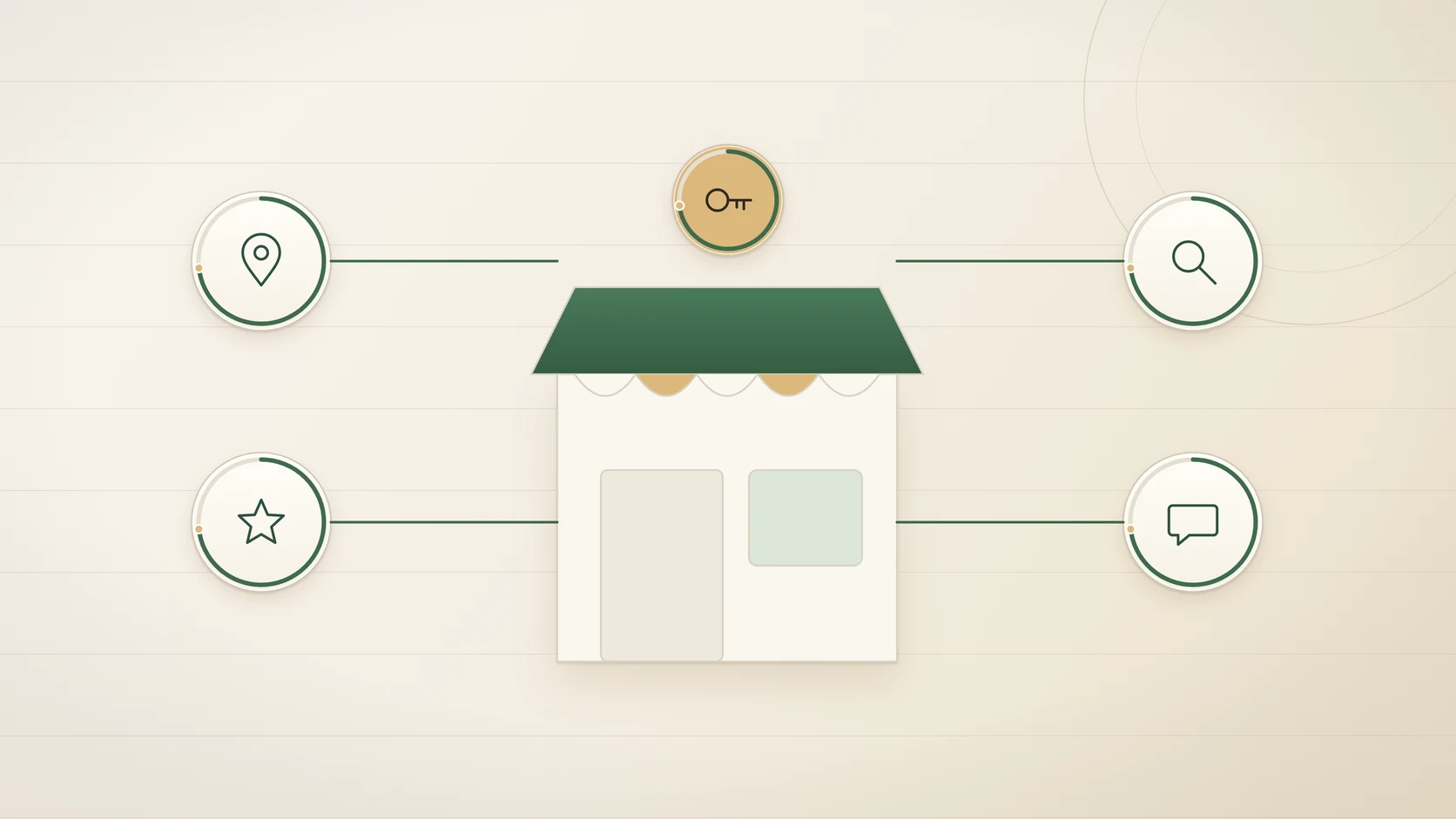
A single platform makes sense when one person looks after search, the Google Business Profile, reviews and social alone, and the details have to match everywhere. Separate tools can work just as well, but only if someone takes on keeping them in step. The buyer matters here. The SBA Office of Advocacy’s 2025 Small Business Profile for the United States counts 36.2 million US small businesses, and roughly 82% of those have no employees. For most, the marketing department is one person with a phone. Before choosing any setup, the first thing worth checking is whether the business details match across every channel.
What each of the four channels is for
Every channel holds a different piece of the same public record about the business:
- Website search pages: the pages that answer questions and rank for them, with detail written as plain text that a reader and a machine can both parse.
- Google Business Profile: the listing in Maps and local results, where hours, categories, services and photos live.
- Reviews: the customers’ account of what happened, along with the business’s reply.
- Social: the visible stream of recent activity, showing that a business is open and paying attention.
They’re four views of one set of facts, not four separate projects.
How the channels feed each other
The four channels feed one another because search engines and AI assistants read all of them and compare what they find.
Take a plumber who starts doing Saturday call-outs. This is how it plays out:
- She updates her website and posts about it on social.
- She leaves the Business Profile alone, so it still reads closed.
- A customer asks an AI assistant who is available that weekend, and the assistant reads the profile.
- She loses the job to a competitor whose listing is current.
The website and the post were accurate. The profile decided the outcome.
What breaks when each channel is managed separately
Separate tools break down at the handoffs. Nobody is tasked with carrying a change from one channel over to the next. Tools that are purchased and never connected sit idle.
It’s worse for a small business, since there’s nobody around to reconcile the gaps.
Two channels add their own pressure, and the pattern shows up in both:
- Reviews: The FTC’s consumer review rule has been in effect since 21 October 2024. It prohibits fake reviews, including AI-generated ones, review suppression, and incentives conditioned on a review expressing a particular sentiment. Any tool that automates review requests or generates replies warrants close scrutiny against it.
- Social: Each new channel is one more place a fact can drift. Every addition makes a disconnected setup costlier.
Picture a bakery that replies warmly to a review praising its Sunday brunch. Yet the menu on its website no longer lists brunch. The reply promised something the rest of the business’s online presence can’t back up. No standalone tool could have caught the contradiction.
How to assess a small business marketing platform that covers SEO, Google Business Profile, reviews and social together
A good single platform passes a short test. A weak one falls down on at least one of these:
- One source of facts. Change the hours once, then see whether the website, the profile and the social bios all update, or just one of them.
- Reviews handled within the rules. Check that requests go to every customer, not only the satisfied ones, and that replies get approved before they go live.
- Plain exit terms. If the relationship ends, you should be able to export your content, reviews and listings.
- Every channel the business actually uses. A platform that covers three of four channels still leaves a second login for the fourth, not a solution.
Try this test. Ask the vendor to change Saturday hours live, then show you every place that change lands. If the answer is “the profile, and you update the rest,” what you’ve bought is a bundle, not a platform. That’s the practical difference CLEO by RegenAI points to when owners compare a professional, connected setup with a stack of cheaper logins: your website and Google Business Profile are written from the same set of facts, so a change to your hours is proposed for both and waits for your approval.
Common questions
Is one platform better than separate tools for a very small business?
For a business run by one person, generally yes, because the real cost is attention, not licences. The trade-off runs like this:
- One platform: a single login and a shared set of facts, so there are fewer places for details to drift apart.
- Separate tools: the better choice only if each one clearly does its own job better.
- Separate tools also need someone to own the connections between them.
Does Google Business Profile still matter if my website is strong?
Yes. Search engines and AI assistants read the profile directly, so a well-optimised website sitting beside an out-of-date listing can still lose the recommendation. Both have to say the same thing.
Can automation reply to my reviews?
It can draft replies, but a person should approve whatever gets published. Replies that promise something inaccurate, or that read like templates, wear away the trust reviews are there to build. And the FTC rule makes fabricated or manipulated reviews a legal liability, not just a reputational one.
Does a platform replace the person doing marketing?
No. It takes on the repetitive work, like copying a change across four channels, and leaves the judgement calls with the owner. A better question is which decisions the owner wants to hang on to, and whether the current setup leaves enough time to make them well.