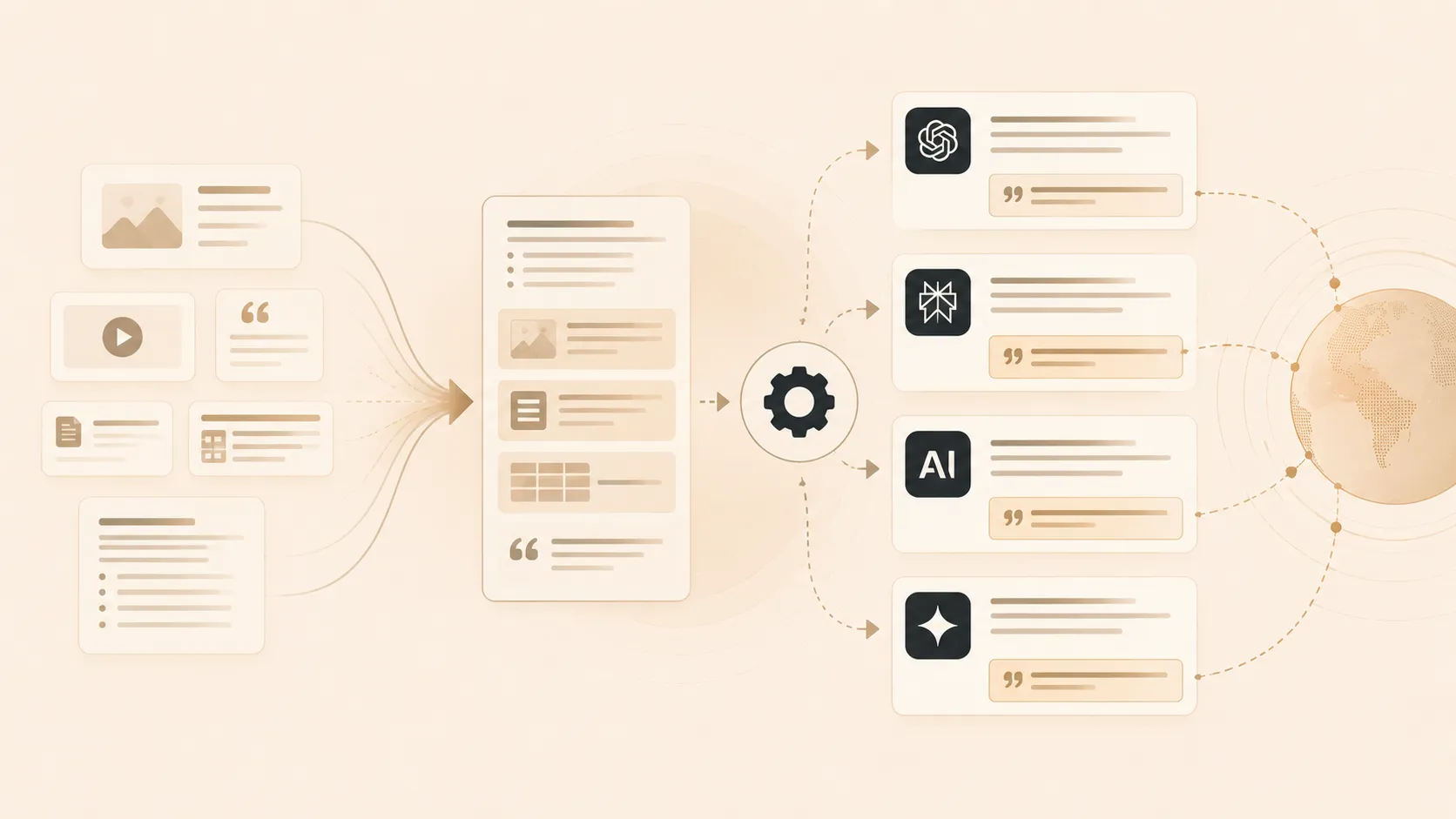

Answer engine optimisation, usually shortened to AEO, is the practice of getting a brand into the answer an AI system generates rather than into a list of links beneath it. The distinction matters because an answer has no second page. In classical search a user scans ten results and you can win from position four. In an answer you are either in the text or you are absent, and absence is invisible: the buyer never learns you existed.
AEO, GEO and SEO: what the terms actually mean
| Discipline | Unit of success | Primary lever |
|---|---|---|
| SEO | Ranked position in a list of links | Relevance and authority signals for a search index |
| AEO | Inclusion in a generated answer | Retrievability, extractable phrasing, corroboration |
| GEO | Citation within a generative engine's answer | Same as AEO, emphasising generative surfaces specifically |
AEO and GEO are used largely interchangeably. Where people draw a line, GEO tends to refer specifically to generative engines, while AEO is the broader term covering any answer surface, including featured snippets and voice assistants that predate generative models. Arguing about the boundary is not a good use of time. The work is the same work.
The more consequential relationship is between AEO and SEO, and it is not the replacement story it is often sold as.
Why SEO is a precondition, not a casualty
Different answer engines retrieve from different places, and this single fact explains most of what looks like inconsistency across the surface.
Google AI Overviews draw overwhelmingly from pages already ranking in the organic top twenty. On that surface, organic rank is not legacy work, it is the entry ticket. A page that does not rank cannot be cited, regardless of how well written it is. Engines built on other indexes retrieve independently of Google rank, which is why a brand can be strong in AI Overviews and absent elsewhere, or the reverse. Recency-weighted engines pick up fresh material fastest, which rewards publishing cadence in a way classical SEO never did.
The practical reading: only 11% of domains are cited by both ChatGPT and Perplexity simultaneously (The Digital Bloom, 2025). Treating "AI search" as one surface with one optimisation strategy is the most common and most expensive mistake in the discipline.
The three layers of the work
Retrievability
Whether the engine can get your content at all. This is infrastructure, and it fails silently. Server-rendered HTML rather than content assembled by client-side JavaScript, since many retrieval systems do not execute scripts. Presence in the relevant indexes. Crawler access granted explicitly in robots.txt for the AI user agents. Valid schema in the document head. An llms.txt file that tells an engine what the site covers and how it is organised.
Retrievability is binary and unglamorous. It is also where a surprising number of otherwise strong brands fail outright.
Extractability
Whether a passage can be lifted and used. Retrieval works passage by passage, not page by page, so a paragraph must survive being separated from everything around it. That means answer-first structure with the conclusion before the supporting detail, explicit entity naming instead of pronouns that lose their referent, and self-contained sentences that do not depend on a table or footnote elsewhere on the page.
Princeton research found that including statistics, cited sources, and expert quotations improved visibility in generated answers by up to 40%. Evidence travels; assertion does not.
Authority
Whether the engine considers you worth retrieving. This is the layer that decides most contested queries, and it is largely off-site. Roughly 85% of brand mentions in AI answers originate from third-party pages rather than brand-owned content (AirOps and Kevin Indig). A brand can have flawless infrastructure and perfectly extractable prose and still be skipped, because no independent source corroborates it.
This is also the slowest layer to move, which is why teams gravitate to the first two. Retrievability and extractability can be fixed in weeks. Authority is earned over months, and it is the difference between being eligible and being chosen.
How AEO is measured
Rank is the wrong instrument. An answer either includes you or it does not, and the useful measures are presence and share.
| Measure | Question it answers |
|---|---|
| Presence rate | How often do you appear in the answer at all |
| Citation share | What proportion of the cited sources are yours versus competitors |
| Recommendation rate | How often does the answer actively suggest you, not merely mention you |
| Sentiment | How does the answer frame you when it does mention you |
| Accuracy | Is what the answer says about you correct |
All of these are measured per query and per engine. Aggregating across engines hides the variation that determines what to do next. And because generated answers vary between runs, a single check is an observation rather than a measurement: meaningful readings come from repeated checks over time, reported with an honest sense of the error band.
Where CLEO fits
CLEO is a Presence Engine: a closed system spanning Local, Search, AI Search, Social, and Orchestration, fed by one content source, Content (Quill). The AEO work sits mostly in the AI Search layer, but the design point is that the layers are not separate projects. Content feeds every surface in one voice, and the off-site activity that builds authority is connected to the citation data that measures it.
The GEO engine covers eight supported AI engines - ChatGPT, Bing AI Overviews, Google AI Overviews, Perplexity, Gemini, Claude, DeepSeek, and Grok - with up to four active per site at a time, and reports presence, citation share, recommendation rate, sentiment and accuracy per query. The AI Readability Report grades the extractability layer with specific fixes. Autonomous Mode applies source-HTML fixes without developer tickets, which is usually where the retrievability layer stalls.
The results are measured rather than promised: for client DisburseCloud, a payment disbursement platform, CLEO took AI citation share from 17% to 67% in 90 days at 95% Wilson confidence, and on its own site moved AI Readability from 35 to 96, SEO from 40 to 95, and its GEO Score from 14 to 50 in 30 days. For a fuller vendor comparison, see the 2026 generative engine optimisation buyer's guide.
Frequently asked questions
What is answer engine optimisation?
The practice of making a brand appear inside an AI-generated answer rather than in a list of links. The unit of success is a citation or mention within the answer text, because an answer offers the user no alternatives to scan.
What is the difference between AEO, GEO and SEO?
SEO targets placement in a ranked list. AEO targets inclusion in a generated answer. GEO is used largely interchangeably with AEO, leaning towards generative engines specifically. AEO and GEO depend on retrievability, which is partly what SEO delivers.
Does SEO still matter?
Yes. Google AI Overviews draw overwhelmingly from pages already ranking in the organic top twenty, so on that surface organic rank is a precondition. Other engines retrieve from different indexes, which is why AEO is broader than SEO rather than a replacement.
What does the work involve?
Retrievability (crawlable, indexed, server-rendered, declared through schema and llms.txt), extractability (answer-first passages that survive being lifted out of context), and authority (third-party corroboration, which decides most contested queries).
How long does AEO take to show results?
The infrastructure and extractability layers can move within weeks once fixed. Authority takes months, because it depends on independent sources choosing to reference you. Any vendor promising a guaranteed citation timeline is describing something they do not control.
Check your score. Start with your baseline. Enter a domain at regencleo.ai/scan - the engine reads what ChatGPT, Google AI Overviews, and Perplexity say in response to your category's most-asked questions, reads where you sit in classical search, and reads what the social surfaces carry. It returns a single page, no login required. Paid GEO plans extend coverage to Claude.