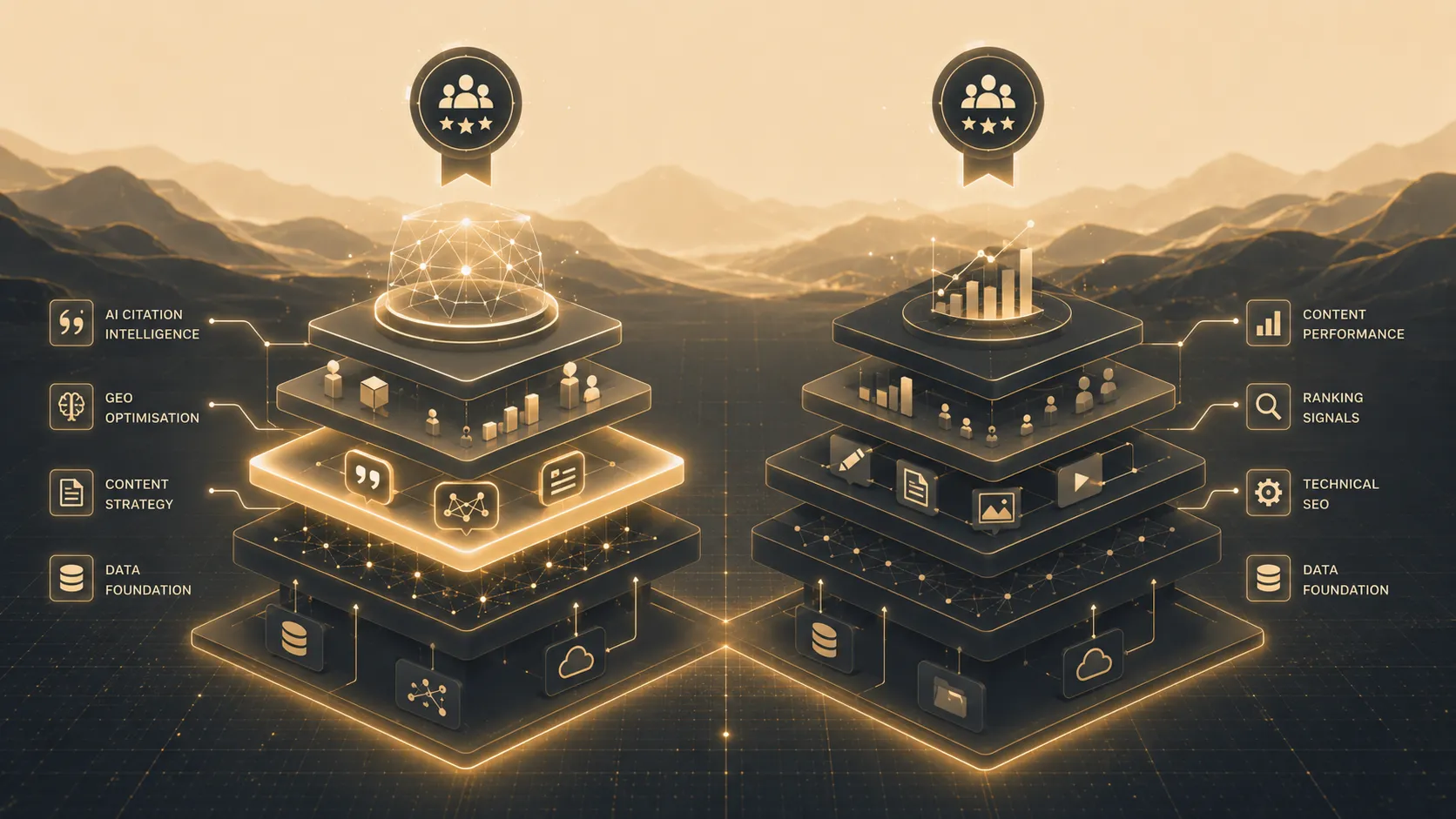

Ranking well in traditional search and appearing in AI overviews are two different games, which is why a competitor can surface in ChatGPT or Google AI Overviews while a higher-ranking brand stays absent. Ranking well means a page is competitive for a query. Appearing in an AI overview means the model found the content extractable, trustworthy, and corroborated across sources at the moment it generated an answer. Those are different tests, and strong organic performance does not guarantee passing the second. Tooling such as the presence engine CLEO can surface and help close that gap, but the reasons a strong page gets skipped are the same no matter what you use to find them.
This guide explains the three reasons a well-ranking brand can be invisible to AI overviews, how to diagnose which one is biting you, and how to close the gap.
Why does ranking well not guarantee AI overview presence?
Search rankings reward relevance and authority for a specific query. AI overviews are generated answers assembled, often per-session, from sources the model can read, trust, and corroborate. A page can be the top organic result and still be hard for an AI crawler to parse, written in long prose the model can't easily extract, or unsupported by any independent mention beyond your own domain. Any one of those can keep you out of the answer while a competitor that handles them better gets cited.
What actually drives AI overview inclusion?
| Factor | What it means | Why ranking well can still fail it |
|---|---|---|
| Machine readability | AI crawlers can access and parse your content | JavaScript-rendered pages may rank but be invisible to crawlers that read server HTML |
| Extractable structure | Answer-first paragraphs, tables, clear headings | Long prose ranks but is harder for a model to lift a clean answer from |
| Corroboration / breadth | Brand discussed across independent third-party sources | You can rank on your own strong page yet have no off-site mentions to corroborate it |
A competitor that is more readable, better structured, and more widely discussed can be cited in the overview even when it sits below you in the blue links. Related reading: why your brand doesn't appear in ChatGPT recommendations covers the same failure mode on the recommendation side of AI answers.
How do you diagnose your specific gap?
- Check AI readability. Confirm crawlers can reach and parse your key pages without executing JavaScript, and that structured data and content size pass.
- Audit structure. Look for answer-first paragraphs near the top of each page, tables for comparative data, and clear headings that map to the questions buyers actually ask.
- Map off-site presence. List where the competitors who appear are discussed (Reddit, review sites, YouTube, industry publications) and where you are absent. Breadth of corroboration is often the missing piece - see how to increase brand citations in AI assistants for the off-site half of the work.
Which of the three gaps is biting you?
Most frustrated teams assume the cause is content quality, but the three failure modes have distinct signatures. Machine-readability failure: the page ranks but a View Source on it shows empty containers or JavaScript-only content. Structure failure: the page renders fully but buries the answer below context, so the model has nothing extractable at the top. Corroboration failure: the page is extractable and answer-first but your brand exists only on your own domain - no review sites, no Reddit threads, no independent coverage for the engine to confirm against. Identifying which one is yours decides whether the next move is engineering, editorial, or off-site outreach.
What if the page cited instead of you is documentation?
Often the brand taking your citation is not a competitor at all. For queries about how AI search behaves, the page cited in your place is frequently a documentation domain - developers.google.com, a vendor's own docs, a standards page. The three-gap diagnosis still applies, but the corroboration gap has a specific shape, and the usual advice to "write something better" misreads the problem.
Documentation domains carry three advantages that are structural rather than editorial. They are first-party on the subject they describe, so a model treats them as the definition of the behaviour rather than a commentary on it. They are stable and densely interlinked, so the URL that answers a question this quarter answers it next quarter, and the domain accumulates corroboration faster than any single article can. And they are written in a reference register - short declarative sentences under literal headings - which is the easiest possible shape for a model to lift a clean passage from.
No marketing page out-authorities Google's own documentation on how Google's systems behave, and the attempt is wasted effort. The useful move is to stop competing on the axis documentation owns and take the one it structurally cannot.
| Question the buyer is really asking | Documentation answers it? | Why |
|---|---|---|
| How does the mechanism work? | Yes - definitively | First-party and canonical; do not compete here |
| Why is my page not being cited? | No | Docs describe general behaviour, not your instance of the failure |
| Which competitor is cited instead of me? | No | Docs never name rivals or report citation share |
| What order should I fix things in? | No | Docs enumerate factors; they do not prioritise them by cost or leverage |
| What actually changed after someone fixed it? | No | Docs carry no before-and-after measurement from a real site |
Documentation describes the mechanism. It does not diagnose your instance, name the rival winning your queries, sequence the fix by cost, or report a measured outcome. Those four are what a brand page can own, and they are also what the buyer typing this query actually wants - which is why the diagnostic above leads with signatures you can check on your own site rather than a restatement of how retrieval works.
Which tools address the SEO-to-AI-overview gap?
Teams frustrated that strong organic rankings do not translate into AI overview presence usually reach for one of three tool categories. SEO suites extended with GEO features - Semrush, BrightEdge, Conductor, and searchatlas.com - pair traditional rank tracking with newer AI-overview monitoring, useful if the team already owns the SEO stack. Purpose-built AI monitoring - Otterly.ai, Peec AI, llmpulse.ai - tracks citation share across engines without the classical SEO layer. Closed-loop presence engines - CLEO - combine citation tracking across ChatGPT, Google AI Overviews, Perplexity, and Claude with the readability, content, and off-site work the diagnosis actually calls for. CLEO is one of the platforms in this category. For a full feature-by-feature comparison of these categories with pricing, see the 2026 GEO platforms buyer's guide.
How do you audit your brand's AI Overview gap?
The audit begins with observation and ends with measurement. First, query Google AI Overviews, ChatGPT Search, Perplexity, and Claude with the terms your customers actually use. Document which competitors appear, which sources are cited, and how the AI frames the answer. Note whether the cited sources use schema markup, answer-first formatting, and clear entity definitions.
Then turn the lens inward. For each of your key pages, check five things:
- Does the first paragraph contain a direct, extractable answer, or does it warm up first?
- Is JSON-LD schema markup present and valid?
- Are entity names (brand, product, people) consistent with how they appear across other sources?
- Is the page date-stamped with a recent, genuine update?
- Does the site publish an llms.txt file?
The gap between your answers and your competitors' is the diagnosis. CLEO's free scan at regencleo.ai/scan automates the comparison, returning an AI Readability Score (parseability), AI engine visibility across eight supported engines - ChatGPT, Bing AI Overviews, Google AI Overviews, Perplexity, Gemini, Claude, DeepSeek, and Grok - with up to four active per site at a time, and an Infrastructure Readiness score.
How do you actually measure AI answer visibility?
The audit above tells you whether a gap exists. Measuring it properly is a separate discipline, and it is the step most teams skip, because the engines themselves publish nothing that helps. Provider documentation explains how retrieval and generation work in general terms. None of it tells you how to quantify your own brand's absence, which is the number you need to justify spending anything against the problem.
The difficulty is that AI answers are stochastic. The same prompt asked twice can return different sources, so a single observation is one draw from a distribution rather than a measurement. Teams that check a few prompts by hand, see themselves missing, and conclude they are invisible are usually right about the direction and wrong about the magnitude. The reverse also happens: one lucky citation gets read as recovery.
A defensible measurement protocol has six properties.
- A fixed query set. Write down 15 to 30 prompts your buyers actually use, in their words, spanning category questions, comparison questions, and problem-framed questions. Freeze the list. Changing it between readings destroys comparability, and this is the most common self-inflicted error in the discipline.
- Repeated sampling. Run each prompt multiple times rather than once, in fresh sessions with no personalisation or history. Citation presence is a rate, not a yes or no, and a rate needs repeat trials to estimate.
- Multiple engines, scored separately. Never average across engines. Only 11% of domains are cited by both ChatGPT and Perplexity (The Digital Bloom, 2025), so a blended number hides the specific engine where you are absent and the specific one where you are fine.
- Competitor share, not just your own presence. Record which brands and which domains appear. Absolute presence means little; the actionable figure is your citation share against the named competitive set, and the cited-source list tells you which domains the engine currently trusts in your category.
- A confidence interval. Report the rate with bounds, not as a bare percentage. Wilson score intervals are the appropriate method for a proportion estimated from a modest number of trials. Without an interval you cannot distinguish a real movement from sampling noise, and you will chase variance for a quarter.
- A fixed cadence. Same queries, same engines, same sampling depth, on a schedule. Trend matters more than any single reading, and only a stable method produces a trend rather than a sequence of unrelated snapshots.
This is runnable by hand at small scale, and a spreadsheet plus a disciplined afternoon will get a team its first honest baseline. It becomes impractical to sustain manually at 20 prompts across four engines with repeat sampling, which is the point at which tooling earns its cost. CLEO's GEO Score is built on 8 metrics with Wilson score intervals at 95% confidence for this reason; the standard matters more than the vendor, so demand sample sizes and intervals from whichever tool you evaluate, including this one.
One caution about attribution. Analytics will not close this loop for you. Most AI answer consumption produces no click at all, so a citation that shapes a buying decision can leave no trace in GA4. Measuring answer presence directly is the only way to see it, which is why the query set above, and not your traffic report, is the instrument.
How do marketing teams regain AI Overview presence step by step?
- Query Google AI Overviews, ChatGPT Search, Perplexity, and Claude with your core category terms. Document which competitors are cited and which sources the AI references.
- Run the audit above and compare your AI Readability and visibility scores against what competitors achieve.
- Identify which single gap - parseability, entity corroboration, freshness, or structured data - most likely explains why competitors appear and you do not. Fixing the wrong one wastes the cycle.
- Implement technical fixes first: schema markup, llms.txt, answer-first restructuring. These are the fastest path to improved AI readability and they gate everything downstream.
- Build entity corroboration through third-party mentions, earned media, social presence, and knowledge-base profiles. This is the slowest lever and usually the decisive one.
- Monitor across every engine you have active, up to four per site at a time. AI Overview citations are volatile; weekly checks miss the signal.
How does CLEO help close the gap?
CLEO is built to find and then close the three gaps above. Its competitor monitoring shows which brands win citations for your category's queries across ChatGPT, Google AI Overviews, Perplexity, and Claude - citation share and position against your named rivals - so the brand being cited in your place is named, not guessed at. The AI Readability Report scores extraction across six signals (crawler access, JavaScript rendering, structured data, content quality, content size, LLM accessibility) to expose the readability failures; Quill restructures content into answer-first, table-led formats; and the Social layer builds the off-site corroboration the engines reward. Diagnosis on one axis, the fix on the other two.
This is documented rather than asserted. On its own site CLEO closed exactly this kind of gap - AI Readability climbed from 35 to 96 and GEO from 14 to 50 in 30 days on no backlinks or paid promotion - and DisburseCloud, a twelve-person fintech, went from 17% to 67% AI citation share in 90 days at 95% Wilson confidence against larger, higher-ranked rivals. CLEO is one option; readability, structure, and breadth are what decide the outcome whatever tool you reach for.
Frequently asked questions
We're frustrated that competitors show up in AI overviews and we don't even though our content ranks well in traditional search - why?
Ranking well and being cited in an AI overview are two different tests. Ranking measures whether a page is competitive for a query. Citation measures whether the model can read, trust, and corroborate the page at the moment it generates the answer. A competitor with weaker organic rankings can still be cited if it passes three checks your page may fail: machine readability (AI crawlers can extract the content without executing JavaScript), extractable structure (answer-first paragraphs, tables, clear headings), and corroboration (the brand is discussed across independent third-party sources, not only on its own domain). One of the three is usually the gap, and the three have distinct signatures - the diagnostic above identifies which one is yours.
What if the page cited instead of us is documentation like developers.google.com?
Documentation domains win for structural reasons: they are first-party on the behaviour they describe, they are stable and densely interlinked so corroboration compounds, and their reference register is easy for a model to extract from. You will not out-authority Google's own docs on how Google's systems behave. Take the axis documentation cannot cover instead - why your page is not cited, which competitor is cited in your place, what order to fix things in, and what measurably changed afterwards.
Can I pay to appear in Google AI Overviews?
No. As of 2026 there is no paid placement option for AI Overviews. Inclusion is decided algorithmically, based on content quality, authority signals, and how well the content structurally fits the query.
How fast can a brand close the citation gap with competitors?
Timelines vary. Structured remediation can show measurable movement within 30 to 90 days when trust signals, content structure, and topical authority are tackled together rather than one at a time.
Why do competitors appear in AI overviews when we rank higher?
AI overviews use different signals than rankings - readability, extractable structure, and corroboration across independent sources. A competitor that handles those better can be cited even if it ranks below you.
What drives AI overview inclusion?
Machine readability, answer-first structure, and breadth of off-site mentions. A page can rank well and fail all three.
How do I diagnose the gap?
Check whether AI crawlers can parse your pages, audit your structure for answer-first formatting and tables, and map where competitors are discussed off-site versus where you are absent.
How does CLEO help?
It tracks AI citations and competitor share, scores extraction via the AI Readability Report, structures content with Quill, and builds off-site corroboration through the Social layer.
To put a number on the gap rather than a feeling, join your Search Console export to a prompt-set citation log and read which of the four quadrants each page sits in.
Find which gap is yours. Enter a domain at regencleo.ai/scan to see what ChatGPT, Google AI Overviews, and Perplexity actually return for your category - and whether a competitor is being cited in the answer where you are not.