
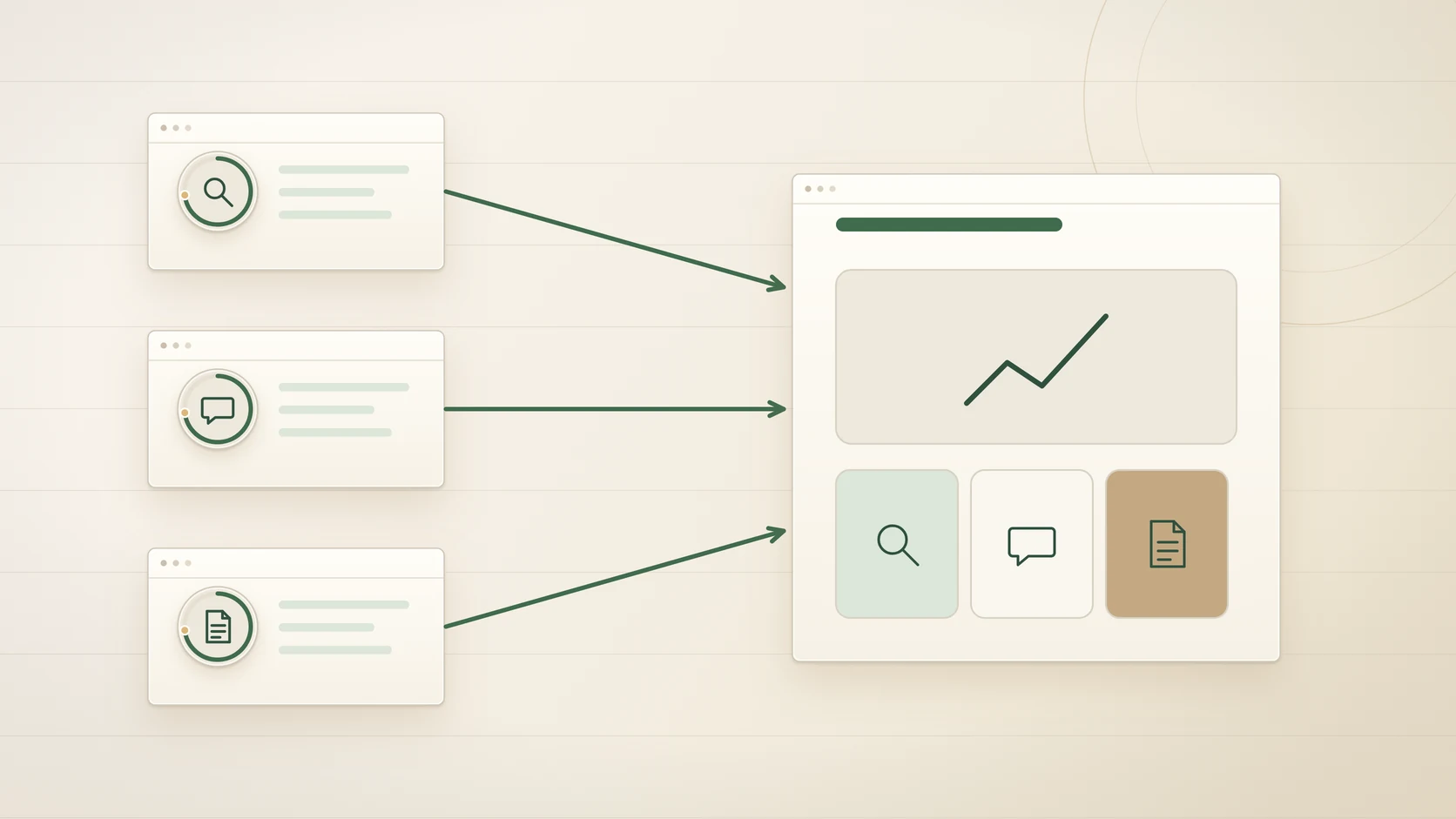
A digital presence management strategy ties SEO, social listening and content together. Every tool gets asked the same questions, and the answers are read side by side, in one place, once a week. Today, each of the three reports on its own. In 2026, most tools still report in their own units. SEO gives you rankings, social listening gives you mentions, and content gives you output. Not one of them tells you whether a buyer searching for the brand actually finds it.
The presence gap is what each report leaves out
Each channel report is accurate about its own channel and silent about every other. Consider a Monday meeting. Each report says something different:
- The SEO report shows rankings holding.
- The social listening report shows mentions flat or marginally up.
- The content report shows every scheduled piece published on time.
Then someone asks whether a buyer typing a question into an AI assistant is told the brand exists, and nobody can answer.
Every report is green, and the question that matters still hasn’t been answered.
That’s the presence gap: the distance between what individual tools measure and whether the brand is actually found, named and trusted on the surfaces buyers use. Closing it comes down mostly to organisation. Another tool rarely helps. It just adds one more report that speaks only for itself.
Shared presence questions replace separate metrics
Teams that close the gap begin by agreeing a short list of questions. Every channel owner then answers them in the same terms. Each answer is a plain sentence about the brand. It isn’t a metric about the tool. Four questions cover most of what a growth team needs:
- Where does the brand show up when a buyer asks a question in search or in an AI answer?
- Who’s talking about the brand this week, and on which platforms?
- Which published piece changed either of those things?
- Which gap, if closed, would win a lead?
That last question keeps the others in check. Presence that doesn’t produce a lead is a vanity metric. A question tied to leads stops the review turning into a tour of numbers.
You see it the moment three people answer the same question from three different tools, because each owner comes back with a different answer:
- The SEO owner reports that a topic is well covered and ranking.
- The social owner reports that buyers are raising a distinct concern about that same topic in public threads.
- The content owner has been writing about neither.
Those contradictions were always there. Separate reports just kept them out of the same room.
A fixed weekly review keeps cross-channel findings current
A fixed weekly review beats any amount of ad hoc reporting, however much of it there is. Forty-five minutes is enough, provided the agenda never changes. Take the four questions in order, with one owner per question, and finish on a short list of actions.
Weekly suits this work because AI answers and social conversations move faster than a monthly cycle can handle. Still, test the cadence against your own data rather than just assuming it. A monthly review usually catches a problem once the damage has been done. A daily one buries the team in noise that sorts itself out.
Three rules keep the action list honest:
- Cap the actions at five. A longer list means nothing got prioritised, and the team will quietly drop the bottom half.
- Put a named owner and a date on every action.
- Start the next meeting by working through last week’s list, before anyone brings up anything new. Skip that check and the review becomes a status report. Nothing changes from one meeting to the next.
A single place for findings stops insight leaking away
The review requires somewhere to record what it finds. A shared document, a board or a queue will all work. The format matters far less than logging every finding the same way. Note the channel it came from, the evidence, the proposed action and, in time, the outcome.
The record earns its keep in how the findings fit together. Imagine an SEO check shows an AI engine citing a competitor’s comparison page, while social listening shows buyers naming that same competitor in forum threads. On their own, each is just a footnote. Logged together, they form a content brief with evidence behind it.
The outcome field is the one teams skip, and it is the one that compounds. After several months the log shows which categories of action moved presence and which produced only activity. Teams that automate parts of this work get the same value from the same discipline. They use one approval queue where every action is recorded before and after it runs, so a person approves it and can trace exactly what it changed. That’s the practical difference a managed option such as CLEO by RegenAI makes compared with a pile of separate tools. The record and the approvals sit in one place, not in each owner’s inbox.
Paid media should only boost organic presence that’s already working
Order matters as much as coverage. Organic first, because organic converts, and paid media then extends reach to something already working. Within organic, take things in this order:
- Start where machines do their reading: pages that can be crawled, are accurate, and leave no doubt about who the business is and what it offers.
- Next, publish content that answers the questions the review threw up.
- After that, get involved in the conversations where buyers are already asking.
Getting that order backwards is the common mistake. A team that buys reach before its pages are readable is paying to send buyers to a brand that machines can’t describe with any precision.
Common failures to avoid
Three habits undo the approach quickly:
- Acquiring another tool before the shared questions are agreed.
- Going through each channel’s full report instead of its answers to those questions.
- Letting findings sit in each owner’s inbox rather than in the shared record.
Every one of them rebuilds the silo the process was meant to get rid of.
Frequently asked questions
What is a digital presence management strategy? A digital presence management strategy is a plan to make a brand findable, named and trusted across search, AI answers, social platforms and content, with all of it run as one system. It replaces separate channel plans with shared questions, a regular review and one common record of findings.
Why do SEO, social listening and content reports contradict each other? They measure different things in different units, and there’s nothing making them answer the same question. The SEO report counts rankings. The listening report counts mentions. The content report counts output. With a shared set of questions, all three sit on the same footing. The contradictions then show up and can be fixed.
How often should a cross-channel presence review take place? For most teams, weekly is the rhythm that works. That’s often enough to catch shifts in AI answers and social conversation, without meeting so often that there’s nothing substantial to look at.
Does a team need new software to link up its channels? Not to begin. For the first few months, a shared document and an agreed set of questions are all you need. Tools can come later, once the team has seen which gaps keep coming back. The first meeting only needs one question: could a buyer find this brand today, and would the team know?