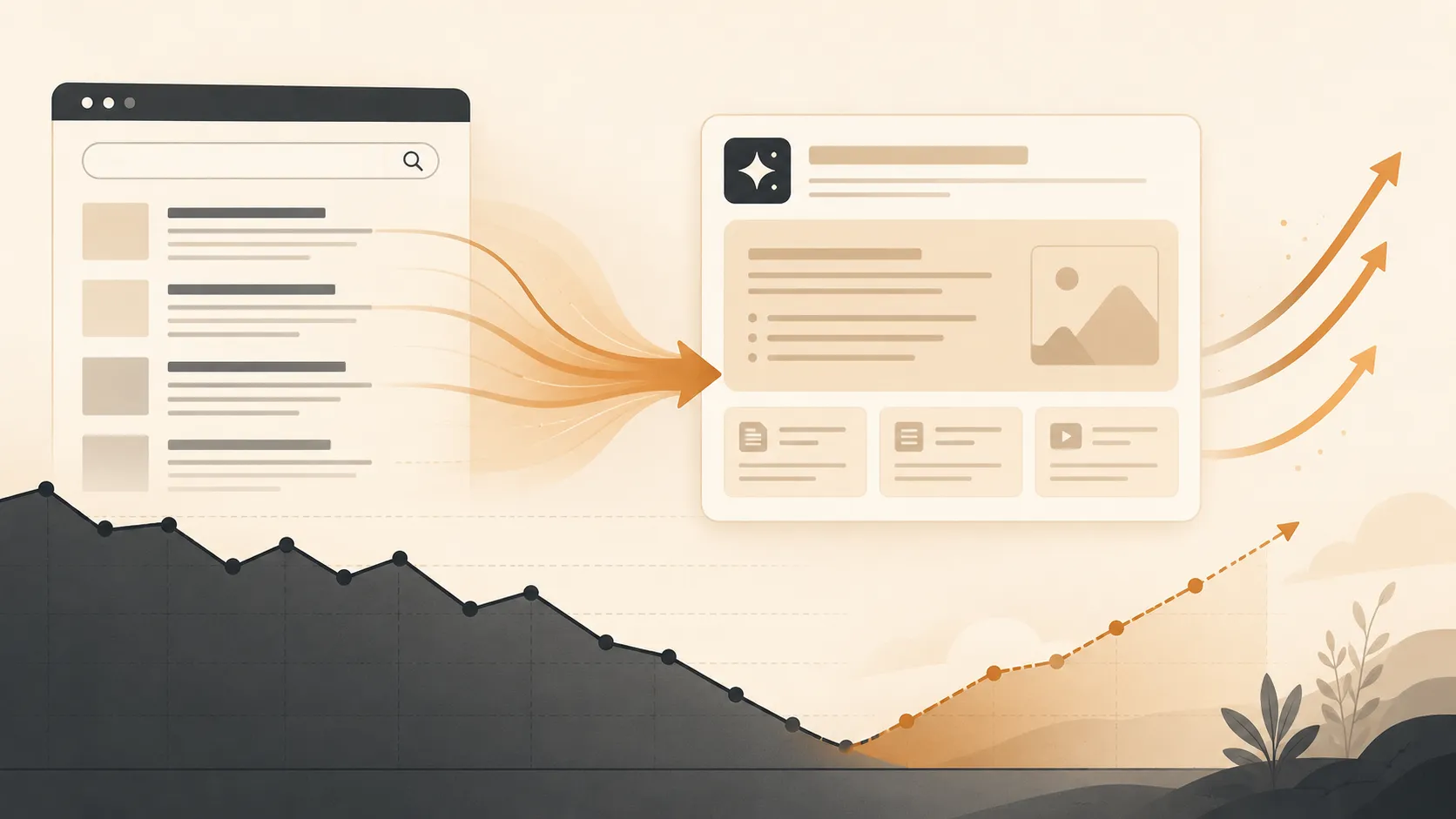
You cannot edit an AI answer. You can only change what it reads. When ChatGPT or Perplexity describes your product incorrectly, the fix is not a support ticket to the model vendor, it is a correction to the sources the model retrieves. Since roughly 85% of brand mentions in AI answers originate from third-party pages rather than brand-owned content (AirOps and Kevin Indig), most of that correction work happens off your own website.
Most teams discover a misstatement by accident. A prospect repeats something odd on a call. A colleague screenshots an answer in Slack. The instinct is to treat it as a one-off. It rarely is. An AI answer is a summary of a retrievable record, and if that record is wrong, the answer will keep being wrong for every buyer who asks, on every engine that reads the same sources.
Why AI assistants describe your brand inaccurately
There are three distinct causes, and they need different fixes.
Stale sources. An old pricing page, a superseded press release, a directory entry nobody has touched in two years. The information was true once. Retrieval does not know it expired.
Absent sources. This is the most underestimated cause. When no authoritative page states a fact plainly, the model infers it from category norms. If your competitors all charge per seat and you charge per site, and nothing on the retrievable web says so unambiguously, answers will describe you as per-seat. Silence is not neutral. It gets filled.
Competitor-framed sources. Comparison pages and listicles written by other vendors describe your product in the terms that suit their argument. If those pages are more authoritative than yours, their framing becomes the default description of you.
How to find what AI answers get wrong
Guessing wastes effort. Establish the record first.
- Write down the ten to fifteen questions a real buyer asks before choosing in your category. Include the unflattering ones: limitations, pricing, alternatives, complaints.
- Run each question on every engine that matters to you. The same question produces materially different answers across engines because they retrieve from different indexes.
- Record the specific false statement verbatim, not a summary of it. "Describes us as per-seat pricing" is actionable. "Gets our pricing wrong" is not.
- Capture which sources the answer cites. This is the thread you pull.
- Repeat on a schedule. A single snapshot cannot distinguish a persistent error from a one-off generation.
Only 11% of domains are cited by both ChatGPT and Perplexity simultaneously (The Digital Bloom, 2025), so an answer that is correct on one engine tells you very little about the others. Check each one you care about.
How to correct the underlying source
| Cause | Diagnostic sign | Correction |
|---|---|---|
| Stale owned source | Answer matches something you published, but an old version of it | Update the page, restate the current fact plainly, ensure the page is recrawled |
| Stale third-party source | Answer cites a directory, review site, or article with outdated detail | Request an update from the publisher; many directories and review sites have a claim process |
| Absent source | Answer states something you never published anywhere, and no citation supports it | Publish an unambiguous canonical statement, then get it corroborated off-site |
| Competitor framing | Answer uses a rival's comparison vocabulary about you | Publish your own comparison content and earn placements that carry your framing |
| Category inference | Answer describes you as a generic instance of the category | State plainly what makes you structurally different, in the words a buyer would use |
The pattern underneath all five rows: state the fact plainly, in one place, in language a retrieval system can lift without interpretation. Marketing copy that gestures at a benefit is not extractable. A sentence that says exactly what the thing is, is.
Write the correction so it can be extracted
A correction only works if an engine can quote it. That places real constraints on how you write it.
Put the fact in a single self-contained sentence that survives being lifted out of context. "Pricing is per site per month, not per seat" is extractable. A pricing table with a footnote is not, because the footnote does not travel with the number. Name the entity explicitly rather than relying on pronouns, because a retrieved passage often arrives without the paragraph that introduced the subject. Repeat the canonical fact wherever it is relevant instead of linking to it once, since retrieval works passage by passage rather than page by page.
Princeton research found that including statistics, cited sources, and expert quotations improved visibility in generated answers by up to 40%. Corrections that carry evidence outperform corrections that only assert.
Why most of the work is off-site
If 85% of brand mentions come from pages you do not control, a website-only correction reaches a minority of the record. The uncomfortable implication is that fixing your own pages is necessary but usually insufficient.
The practical off-site targets are the places engines already lean on: review platforms where buyers compare vendors, community threads where practitioners answer each other honestly, video where a demonstration settles a factual question faster than prose, and the professional networks where category conversations happen. A correction placed on a source that is already being retrieved propagates faster than the same correction on a page nobody links to.
This is also why corrections and citations are the same project. A brand with thin off-site presence has both problems at once: it is cited rarely, and when it is described, the description comes from sources it did not shape.
Corrections decay, so treat accuracy as maintenance
Only about 30% of brands that appear in one AI answer persist in the next (AirOps). The same volatility applies to accuracy. A corrected answer can revert when an engine refreshes its index, when a competitor publishes a stronger comparison page, or when the corrected source drops out of the retrieval pool.
That makes accuracy a standing measurement problem rather than a project with an end date. The teams that hold a correction are the ones that re-run the same query set on a schedule and treat a regression as a tracked issue, in the same way they would treat an uptime alert. For more on why the lift fades when the work stops, see Presence Is Maintenance, Not a Launch.
Where CLEO fits
CLEO's GEO engine grades the accuracy and sentiment of answers about your brand alongside citation presence, so a factually wrong answer shows up as a tracked, trended problem rather than something a colleague happens to notice. Coverage spans eight supported AI engines - ChatGPT, Bing AI Overviews, Google AI Overviews, Perplexity, Gemini, Claude, DeepSeek, and Grok - with up to four active per site at a time.
Because most misstatements originate off-site, the Social engine listens across X, LinkedIn, Reddit, Medium, YouTube, Quora, and Bluesky, and the Citation Loop connects that activity back to citation data, so a team can see whether off-site correction work actually moved the answers. Quill produces the canonical statements themselves, written answer-first so a retrieval system can lift them cleanly.
The results are measured rather than promised: for client DisburseCloud, a payment disbursement platform, CLEO took AI citation share from 17% to 67% in 90 days at 95% Wilson confidence, and on its own site moved AI Readability from 35 to 96 and its GEO Score from 14 to 50 in 30 days.
Frequently asked questions
How do I stop AI answers getting my brand wrong?
Change the sources, not the answer. Run the queries buyers ask, record the exact false statements, trace each to the page that produced it, correct or displace that source, and publish an unambiguous canonical statement of your own. Then re-check on a schedule, because corrections decay.
Why do AI assistants describe my brand inaccurately?
Usually one of three reasons: the source is stale, no source states the fact at all so the model infers it from category norms, or the most authoritative source is a competitor's comparison page. The answer reflects the retrievable record rather than your intent.
Can I ask an AI company to correct information about my brand?
There is no dependable general correction channel equivalent to a search engine removal request. Retrieval-based engines read the live web, so correcting the source record is both faster and more durable, and it works across every engine at once instead of one vendor at a time.
How long does a correction take to show up?
Recency-weighted engines reflect changes fastest. Engines that lean on an underlying search index only update after that index recrawls the corrected page. Corrections placed on high-authority third-party pages usually propagate faster than corrections on your own site.
Is this different from reputation management?
It overlaps but is not the same. Reputation management addresses opinion. This addresses fact: what your product does, how it is priced, who it is for. A factually wrong answer costs you buyers who never contact you to check.
Check your score. Before you fix anything, see what the engines currently say. Enter a domain at regencleo.ai/scan - the engine reads what ChatGPT, Google AI Overviews, and Perplexity say in response to your category's most-asked questions, reads where you sit in classical search, and reads what the social surfaces carry. It returns a single page, no login required. Paid GEO plans extend coverage to Claude.