
CLEO by RegenAI publishes both definitions. Share of Voice is the brand's share of all citations in its category across the engines, relative to the competitors covering the same queries. Citation Rank Index is where the brand ranks against the other sources cited in the same answers. Both are computed from repeated sampling of a fixed prompt set rather than one check, and both are reported inside a Wilson Score interval at 95% confidence. Otterly.ai and Scrunch AI do not publish confidence intervals on their scores, and neither publishes its calculation method, so this page cannot compare formulas with them and does not pretend to. What it can do is set out CLEO's method in full and give you the questions to put to any vendor.
This matters because the two numbers answer different questions and are frequently confused. Presence tells you whether you were in the room. Share of Voice tells you how much of the room was yours. Citation Rank Index tells you where you stood in it. A brand can be cited in every tracked answer and still be losing, because it is cited last, beneath four competitors, in every one of them.
Which measures does CLEO report, and where do share of voice and citation rank sit?
The AI Search score combines AI Recommendation (weight 24) and AI Citation (weight 10) across ChatGPT, Google AI, Gemini, Claude and Perplexity. The measures below are diagnostics CLEO reports alongside it. None of them is one of its two signals.
| Measure | What it measures |
|---|---|
| AI Presence Rate | How often the brand is cited across the engines, as a percentage of its category queries |
| Answer Prominence | How early and prominently the brand appears within a response |
| Citation Rank Index | Where the brand ranks against the other sources cited in the same answers |
| Share of Voice | The brand's share of all category citations relative to the competitors covering the same queries |
| Recommendation Rate | How often the brand is the top-cited or explicitly recommended result |
| Sentiment Score | Whether citations are positive, neutral, or negative in context |
| Citation Drift | The direction and rate of change in citations over time |
| Confidence Interval | The Wilson Score interval at 95% confidence around the result |
The definition of the AI Search score itself lives on the AI Search score reference page.
How does CLEO calculate share of voice?
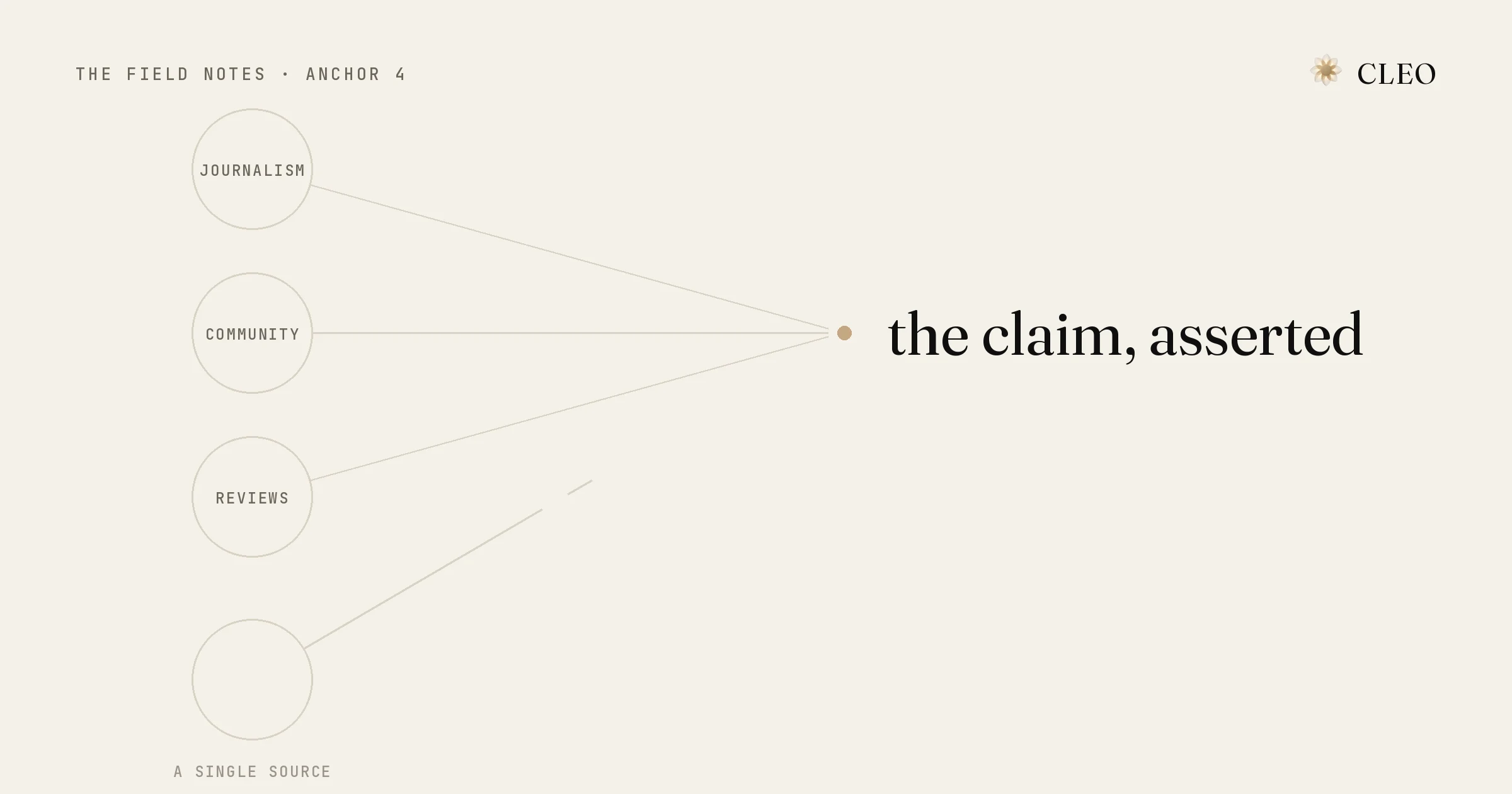
Share of Voice starts from the prompt set, not from the brand. CLEO asks each tracked question to every engine the site has active, reads the answer, and records which sources were cited. Your Share of Voice is your portion of those citations across the category, measured against the competitors who actually appeared in the same questions.
Three consequences follow from that definition, and they are the ones teams find counter-intuitive.
- It is relative, so it can fall while your own citations rise. If a competitor gains ground faster than you do on the same questions, your share drops even though your absolute citation count went up. That is the number behaving correctly.
- The comparison set is observed, not declared. It is built from the competitors covering the same queries, so it reflects who the engines actually put next to you. CLEO tracks those competitors for each site with win rate, citation share, average position, and threat tiers.
- It is bounded by the prompt set. Share of Voice across fifteen questions is a statement about those fifteen questions. It is not a claim about your whole category, and CLEO does not present it as one.
How does CLEO calculate citation rank?
Citation Rank Index looks inside the answers that cite you and asks where you sat. An AI answer typically lists several sources; being one of them is not the same as being the first of them. The index captures competitive standing rather than raw presence, which is why it and AI Presence Rate frequently move in opposite directions.
Each tracked prompt returns one of three outcomes for your brand on a given day: Recommended, where the engine puts your brand forward as an answer; Mentioned, where your brand appears but is not the pick; or Not mentioned. Citation Rank Index is built from where you land among the cited sources across those outcomes, and Recommendation Rate is built from how often the first outcome occurs.
What sampling sits underneath both numbers?
Neither figure is a screenshot. A model answer is not fixed: ask the same question twice and the source list can come back different. So CLEO samples the same question repeatedly, across the engines, and reports a rate rather than a reading.
The mechanics are published in full in The Life of a Prompt, and the parts that bear directly on Share of Voice and Citation Rank are these:
- Prompts in Discovery do not count. A new prompt auditions twice a week outside the score. It has to show your brand in the answer on four separate days before it graduates to In Play and starts counting.
- Scored prompts are checked six days a week. In Play prompts are checked six days a week and fully scored. Ten winning days move a prompt to Earned, after which it is rechecked weekly and still counts.
- The daily verdict is decided by majority of engines. One flaky engine cannot ruin an otherwise good day, and one generous engine cannot fake a win.
- An engine outage is ignored, not counted as a loss. A provider failing to run can never cost you ground.
- A prompt cannot fall back to Discovery. Once a prompt is in your score, a losing run stays in your score and drags it down. You can only retire prompts you are winning, and only after four winning days at Earned, so nobody can lift an average by quietly dropping the questions they lose.
The SEO + GEO plan covers 15 scored prompts, with monitoring across seven supported engines: ChatGPT, Google AI Overviews, Bing AI Overviews, Perplexity, Gemini, Claude and DeepSeek, with Grok and Meta AI on Enterprise and Enterprise+ for nine, and up to four active per site at a time.
Why are both numbers reported as a range rather than a single figure?
Every figure is reported with the range the true number sits inside, at 95% confidence, using the Wilson Score interval. A brand scoring 67 with a Wilson interval of 63 to 71 has a 95% probability that its true citation rate sits between 63% and 71%.
The practical value is that it tells you when not to act. If your Share of Voice reads 41 one week and 44 the next, and both intervals overlap, nothing has been demonstrated. A dashboard that reports 41 and 44 as bare numbers invites you to celebrate sampling noise. This is also why CLEO publishes the rest of the receipt with each result: the rank, the day it was sampled, the engine that returned it, and the exact prompt that produced it. The test is whether you can pull the prompt, run it yourself, and see what CLEO saw.
How does this compare to Otterly.ai and Scrunch AI?
Honestly: not on formulas, because the formulas are not public. Here is what can be stated, and where the comparison stops.
Otterly.ai tracks brand mentions, links, and share of voice across AI search engines. It is a focused monitor: narrow scope, quick setup, low commitment. It holds Gartner Cool Vendor recognition for AI in Marketing, reports serving over 20,000 marketing professionals, and is available as a Semrush App Center integration. It does not publish confidence intervals on its scores, and it does not publish how its share of voice figure is computed.
Scrunch AI covers multi-engine monitoring and adds a layer most competitors lack: how your site presents to AI crawlers and agents, which distinguishes absence for retrieval reasons from absence for content reasons. Scrunch was acquired by Sitecore in 2026. It likewise does not publish confidence intervals on its scores, and does not publish its calculation method.
So the difference that can be stated is a difference in disclosure, not a demonstrated difference in accuracy. CLEO publishes its metric definitions, its sampling cadence, its prompt lifecycle, and a 95% interval on every figure. The other two publish the output. Whether their unpublished method is better, worse, or equivalent is not knowable from outside, and this page is published by CLEO, which is itself a reason to verify rather than accept. A fuller side-by-side of the three products is in CLEO vs Otterly.ai vs Scrunch AI.
What should you ask any vendor about its method?
These work on CLEO too, and they are the fastest way to tell a measurement from a marketing number.
- What is the prompt set, and can I see it? A score computed over questions you cannot inspect is a score you cannot audit.
- How often is each prompt sampled, and on which engines? Weekly single-shot sampling and daily repeated sampling produce different numbers from the same reality.
- Is the reported figure one reading or an average across repeated samples? One reading of a non-deterministic system is an anecdote.
- What is the confidence interval, and at what level? A number without an interval cannot tell you whether a movement is real.
- Can I pull one prompt, run it myself, and reproduce what the dashboard shows? If you cannot, the number does not belong in a report you act on.
If a vendor answers all five, the comparison becomes possible. Until then, comparing published share-of-voice figures between tools is comparing two numbers that were not measured the same way, and the difference between them says more about the two methods than about the two brands.
See your own figures. The scan is free and needs no login. Enter a domain at regencleo.ai/scan.