How CLEO tracks the questions your customers ask AI engines, and how those questions turn into your GEO Score.
What a prompt is
A prompt is one real question a buyer might type into ChatGPT, Gemini, Claude or Google’s AI answers. Something like “best project management tool for small agencies”.
CLEO asks that question to every AI engine you track, reads the answer, and records one of three outcomes for your brand:
| Outcome | What it means |
|---|---|
| Recommended | The engine puts your brand forward as an answer |
| Mentioned | Your brand appears, but it is not the pick |
| Not mentioned | You are absent |
Do that every day, for every prompt, across every engine, and you get a picture of how visible your brand actually is in AI answers.
The rest of this article is about what happens to a prompt over time, because a prompt is not a static thing. It moves.
The four stages
Every prompt sits in one of four stages. The stage decides how often we check it, and whether it counts towards your score.
1. Discovery: the bench
Checked twice a week. Not in your score.
Every prompt you add yourself starts here. It is an audition. We are not asking “are you winning this?” yet, we are asking “is this question even worth fighting for?”
A prompt graduates out of Discovery once your brand shows up in the answer on 4 separate days. That is it. You do not have to win it, you just have to be in the conversation.
Because Discovery sits outside your score, adding prompts moves your GEO Score by exactly zero. That is deliberate. If adding easy questions lifted your number, the number would be worthless.
You can edit a prompt while it is in Discovery, or drop it if it turns out to be a dead end. Editing the wording restarts its evidence, because the old answers were for a different question.
2. In Play: the contest
Checked daily, Monday to Saturday. Counts towards your score.
This is where the real work happens. The prompt is now part of your GEO Score, and every day it gets a verdict:
- Win if your brand is recommended, or mentioned in the top 3
- Partial if you are mentioned further down
- Loss if you are absent
A win adds a point. A loss takes one away. A partial is worth nothing either way, because being mentioned is not a failure.
At 10 winning days, the prompt is Earned.
Two details that matter:
- The verdict is decided by majority of engines, not by any single one. Two of three, three of four. One flaky engine cannot ruin an otherwise good day, and one generous engine cannot fake a win.
- If an engine did not run at all that day, it is ignored rather than counted as a loss. An outage at a provider can never cost you ground.
3. Earned: the win
Checked once a week. Still counts towards your score.
The prompt is now a proven win, so we stop paying to re-confirm it daily and drop to a weekly check. Your visibility on it is still measured and still in your score.
Earned prompts carry a buffer of 4. Every winning week keeps the buffer topped up, every losing week takes one off it. Five bad weeks in a row and the prompt drops back to In Play, where daily checking resumes and you can win it back. It returns partway up the ladder, not at zero, so one bad week never costs you ten good ones.
The first time a prompt reaches Earned, you are rewarded with one extra Discovery slot. Win what you are contesting, and you get room to test something new. That slot is yours for good, even if the prompt later slips back or you retire it. Nothing you have earned is ever taken away.
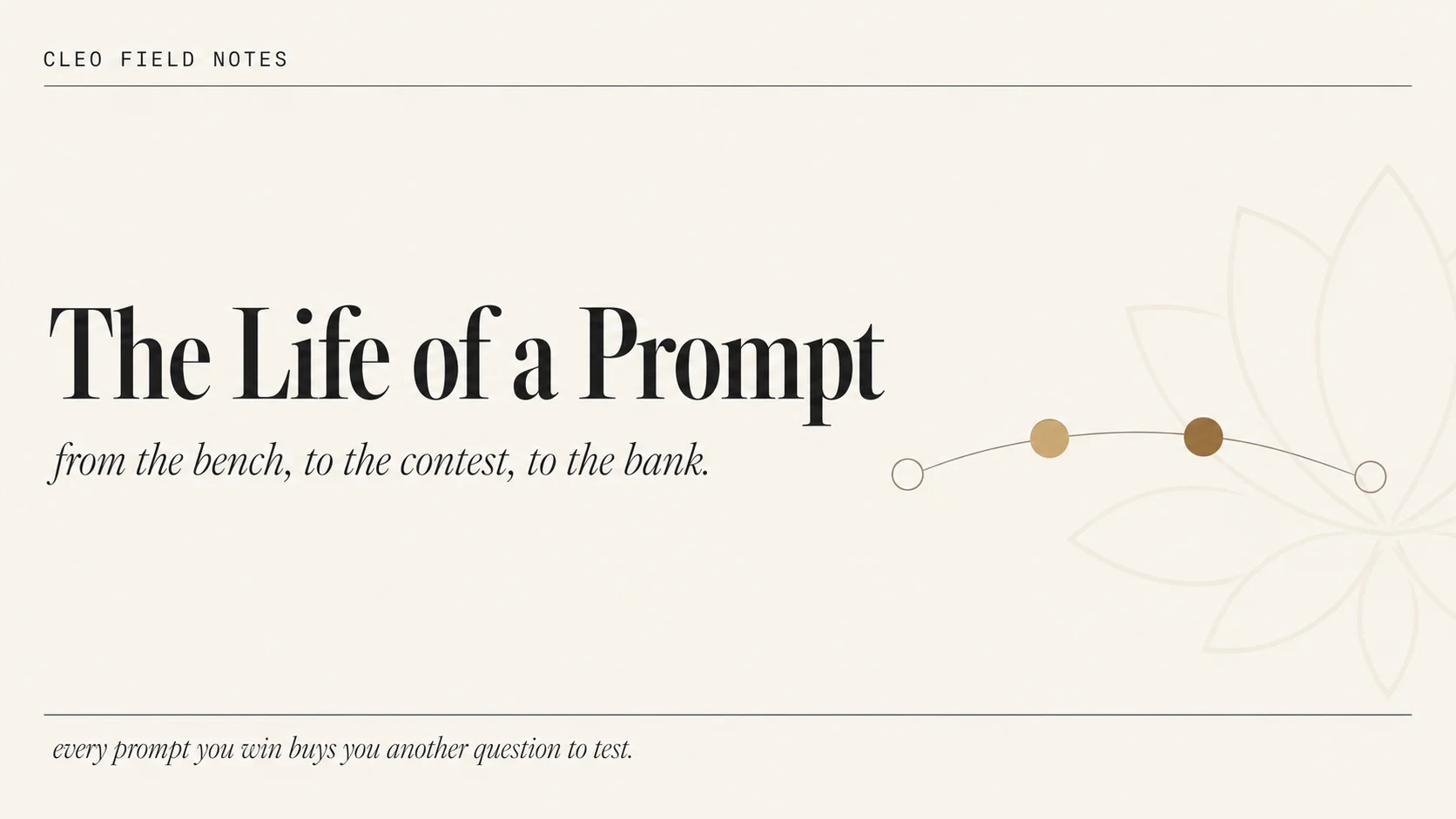
This is the reward loop in one line: every prompt you win buys you another question to test.
4. Retired: banked
Never checked again. Out of the live score, but the win is banked.
Retiring is your decision, never automatic, and it is the only way a prompt leaves your score.
You can only retire a prompt that is Earned and has at least 4 winning days since it got there. In other words, you can only retire your winners. This is the rule that stops the score being gamed: nobody can lift their average by quietly dropping the prompts they are losing.
A retired prompt keeps its whole history. It simply stops being re-checked, which frees the budget and the slot for a new question.
Why retiring a win does not throw the win away
Your GEO Score is an average across the prompts you are actively tracking. An Earned prompt scores close to 100, so pulling it out would drag that average down. That would punish you for doing exactly what the system asks: bank the win, move on to the next fight.
So retired wins keep paying. Each one takes a fixed slice of the gap between your live score and a perfect 100:
- Each banked win is worth 3% of that remaining gap
- The total is capped at 15%, which is reached at 5 banked wins
- A banked win holds full value for 6 months, then fades gradually to nothing at 12 months
Three consequences worth understanding:
Your live performance always dominates. Even at the cap, 85% of your score is what is happening right now. Banked wins nudge, they do not carry you.
A win is worth the same on every plan. The credit is a fixed step, not a share of your prompt count, so retiring a winner is worth the same to a 10-prompt site as to a 50-prompt one.
It is not a ratchet. The credit fades. A brand that won a set of prompts in 2025 and then vanished from AI answers does not get to keep coasting on it. Within a year the credit is gone and the score is purely live performance again.
The fade is gradual rather than a cliff, so nothing ever drops off your chart overnight for no visible reason.
How many prompts you can test in Discovery
Discovery is not unlimited. Testing costs real money in engine calls, so the number of prompts you can have on the bench at once is set by two things added together.
1. Slots you have earned. One slot for every prompt that reaches Earned for the first time. This is the reward, and it tops out at 10. Winning your eleventh prompt does not add an eleventh slot.
2. Room left on your plan. Any part of your plan allowance you are not using yet. Take CLEO GEO, which covers 15 scored prompts. We set you up with 10 at onboarding, so on day one 5 of your 15 are still free, and those 5 are yours to test with in Discovery. You are paying for them either way.
So a new CLEO GEO site starts with 5 Discovery slots from unused plan room and 0 earned ones. Win your first prompt and you have 6. Win five and you have 10. Your scored set and your bench move together: as prompts graduate in and fill your 15, plan room shrinks, and the slots you have earned are what keep the bench open.
A slot is occupied while a prompt is auditioning, and it frees up the moment that prompt graduates to In Play or you drop it. So the bench recycles. The limit is how many questions you can test at once, never how many you can test in total.
And your earned slots are never revoked. A prompt that slips from Earned back to In Play, or one you retire, does not take its slot with it.
The rules that hold it together
A few design decisions do most of the heavy lifting. They are worth stating plainly, because they are what make the number trustworthy.
A prompt can never fall back to Discovery. Once a prompt is in your score, the only way out is you retiring it, and you can only retire winners. If a prompt starts losing, it stays in your score and drags it down. That is uncomfortable and it is correct: a real failure should be visible.
Adding prompts cannot move your score. New prompts land on the bench, outside the score.
Losing a prompt costs you something. The counter goes down as well as up, so a score is a statement about how you are doing now, not a tally of things that once went well.
Every move is recorded. Graduations, promotions, demotions, drops and retirements all leave an audit entry, so any step in your score has a stated cause.
Editing resets the evidence. Change the wording of a question and you have changed the question, so the old answers no longer count towards it.
What this looks like day to day
- You add a question you care about. It lands in Discovery and starts being tested twice a week. Your score does not move.
- Your brand shows up in the answer on 4 days. The prompt graduates to In Play, joins your score, and gets checked daily.
- You publish content, fix a page, earn a citation. Winning days accumulate. At 10, the prompt is Earned, checking slows to weekly, and you unlock a new Discovery slot.
- Once the win is settled, you retire it. The slot frees up for the next question, and the win keeps contributing to your score for the next year.
- Repeat. Each cycle leaves you with more room to test than you started with.
Every prompt row in the Prompts tab shows exactly where it is in this cycle and what it needs next, in plain numbers: 4 of 10 winning days, 3 of 4 in hand.
Two things to keep in mind
The score updates overnight, not instantly. Retiring, adding or dropping a prompt takes effect on the next nightly run. If your number has not moved five minutes after you clicked, that is expected.
Movement takes about three weeks. A prompt needs 4 days to leave Discovery and 10 winning days to be Earned. Real improvements to your visibility show up steadily rather than overnight, which is also how AI engines actually update their view of your brand.
In one paragraph
Prompts start on the bench where they cost you nothing and prove nothing. They join your score once your brand shows up in the answers. They graduate to a weekly check once you are consistently winning, which unlocks room to test something new. You bank the win by retiring it, and the win keeps paying into your score for a year while it fades. Nothing can be added to inflate the number, nothing can be removed to hide a loss, and every winning prompt pays for the next question you want to compete for.
This is the mechanism behind the number. If you want the number itself, the GEO Score is built from eight outcome measures rather than an input checklist, which is why it is allowed to fall. The lifecycle above is what that falling looks like up close: a win that is not maintained decays, and citations you have already earned slip away unless something holds them.
Check your own score. If you want to see where your own site stands, the scan is free and it needs no login. Enter a domain at regencleo.ai/scan.