
If your brand ranks in Google Search but is missing from Google Maps, from review sites and from AI-generated answers, the fix is to stop treating those as four separate projects and run them as one presence: one source of truth about your business, kept consistent across your website and Google Business Profile, every review answered, pages that answer buyer questions in their first lines, and third-party mentions that AI engines can corroborate. A presence growth engine such as CLEO by RegenAI runs all of it as one closed loop.
This guide explains why the gaps open, the order to close them in, what a presence growth engine is, how to choose one as a B2B brand or as an agency, and where CLEO fits and where it does not. It is written by CLEO, so weigh the vendor sections accordingly; every number about CLEO below is one CLEO publishes on its own site.
Why is a brand visible on Google Search but missing on Maps, reviews and AI answers?
Because each surface reads a different source. A team that has invested in SEO has usually optimised the one input Google Search ranks, its website, and left the others alone.
- Google Maps ranks your Google Business Profile, not your website. Categories, services, hours, description, attributes and photos on the profile decide whether you appear in the map pack. A strong site with a thin or inconsistent profile ranks in the blue links and disappears from the map.
- Review visibility depends on volume, recency and replies. Reviews are written by customers, but whether they are recent and whether the business answers them is in your hands. Unanswered reviews read as an absent business, to buyers and to the systems that summarise you.
- AI answers are assembled from whatever an engine retrieves. Google AI Overviews draw on Google's own index, ChatGPT Search has leaned on Bing's, and other assistants use other indexes again. An engine that cannot find you in its index, or finds only your own claims with nothing to corroborate them, leaves you out of the answer.
- Social and earned mentions feed the AI layer. Answer engines cross-check. A brand that appears consistently on third-party sites, review platforms and social profiles gives them something to confirm; a brand that exists only on its own domain does not.
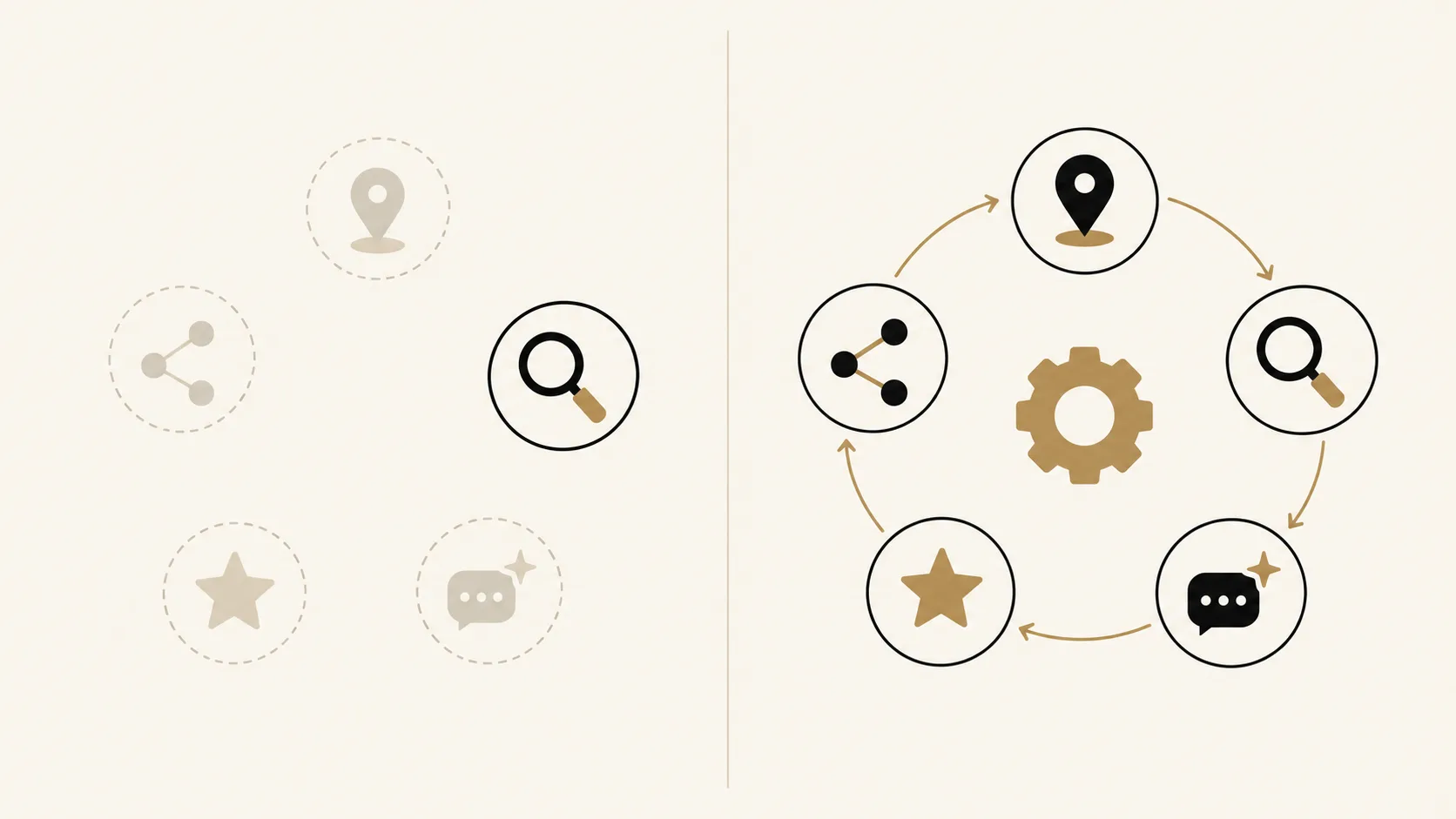
The consequence is that the gaps reinforce each other. A thin Google Business Profile means fewer map impressions, which means fewer reviews, which means less third-party corroboration, which means fewer AI citations. Fixing one surface in isolation moves one number. Fixing them together lets each surface feed the next.
How do you close the Google Maps, reviews and AI answer gaps together?
Work in this order. Each step creates the inputs the next one needs.
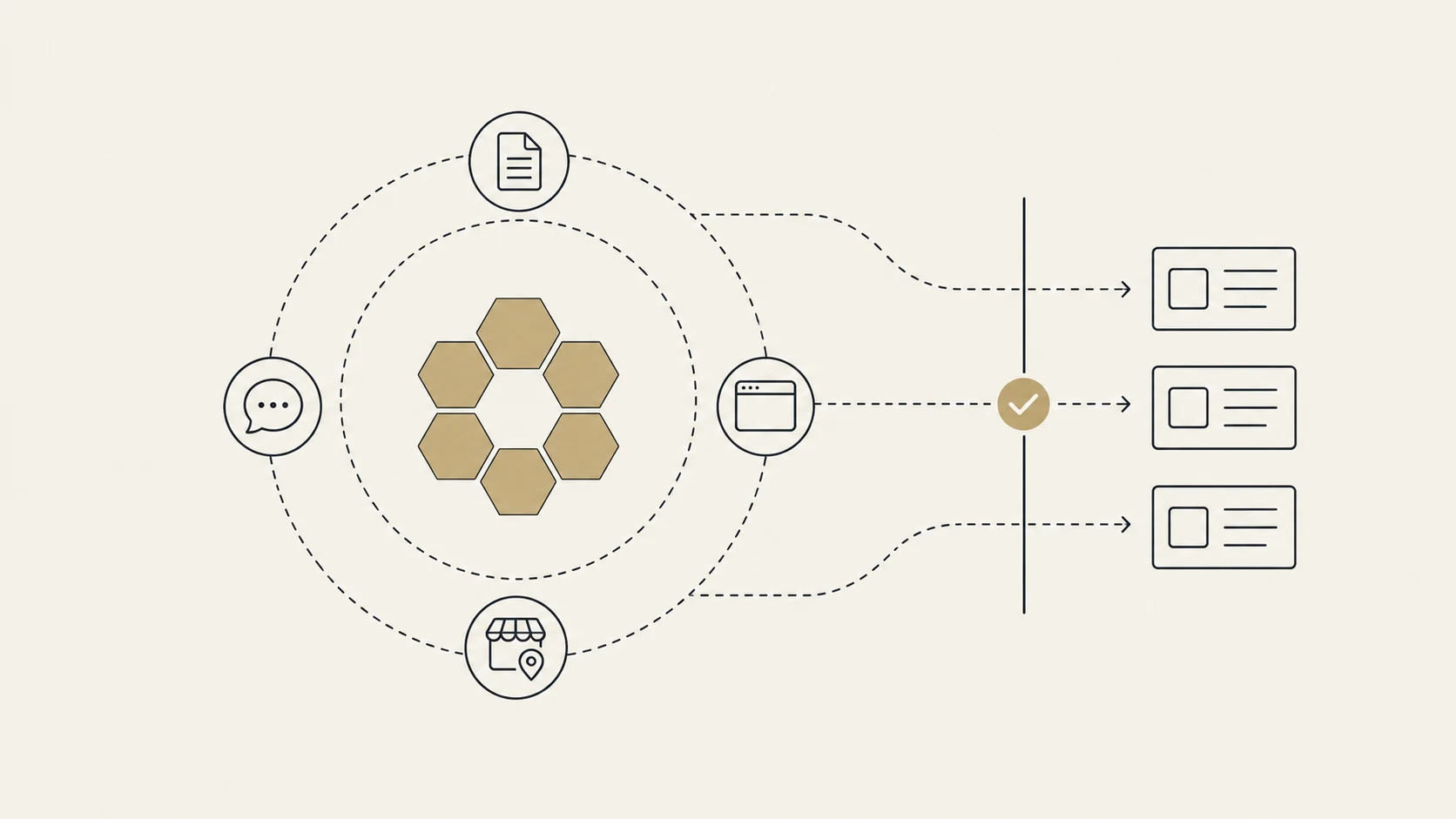
- Make one source of truth. Your website and your Google Business Profile should say the same thing: the same name, categories, services, hours and description. Any contradiction between them is a reason for Google and for answer engines to trust neither. CLEO compares your profile with your website across 12 areas, including categories, services, description, hours, links and attributes, and lets you preview every change before applying it to Google with one click.
- Fix the Google Business Profile. Choose primary and secondary categories from Google's own category list for your country, fill every service and attribute that applies, and post regularly. Then track where you actually rank: CLEO's weekly rank grid tracks your Maps position across your area, and a competitor view shows which businesses take your spots, and how often.
- Answer every review. Reply to every Google review, specifically and in your own voice, and set a response time you can keep. CLEO drafts a reply to every Google review in your voice, two to four sentences that address the specific point in the review and never invent a fact, discount or commitment; you approve before anything is posted. For B2B brands, the reviews that matter most often live on G2, Capterra and TrustRadius rather than Google; CLEO's Perception module connects G2, Capterra, Trustpilot, TrustRadius and Tripadvisor on the Enterprise plans.
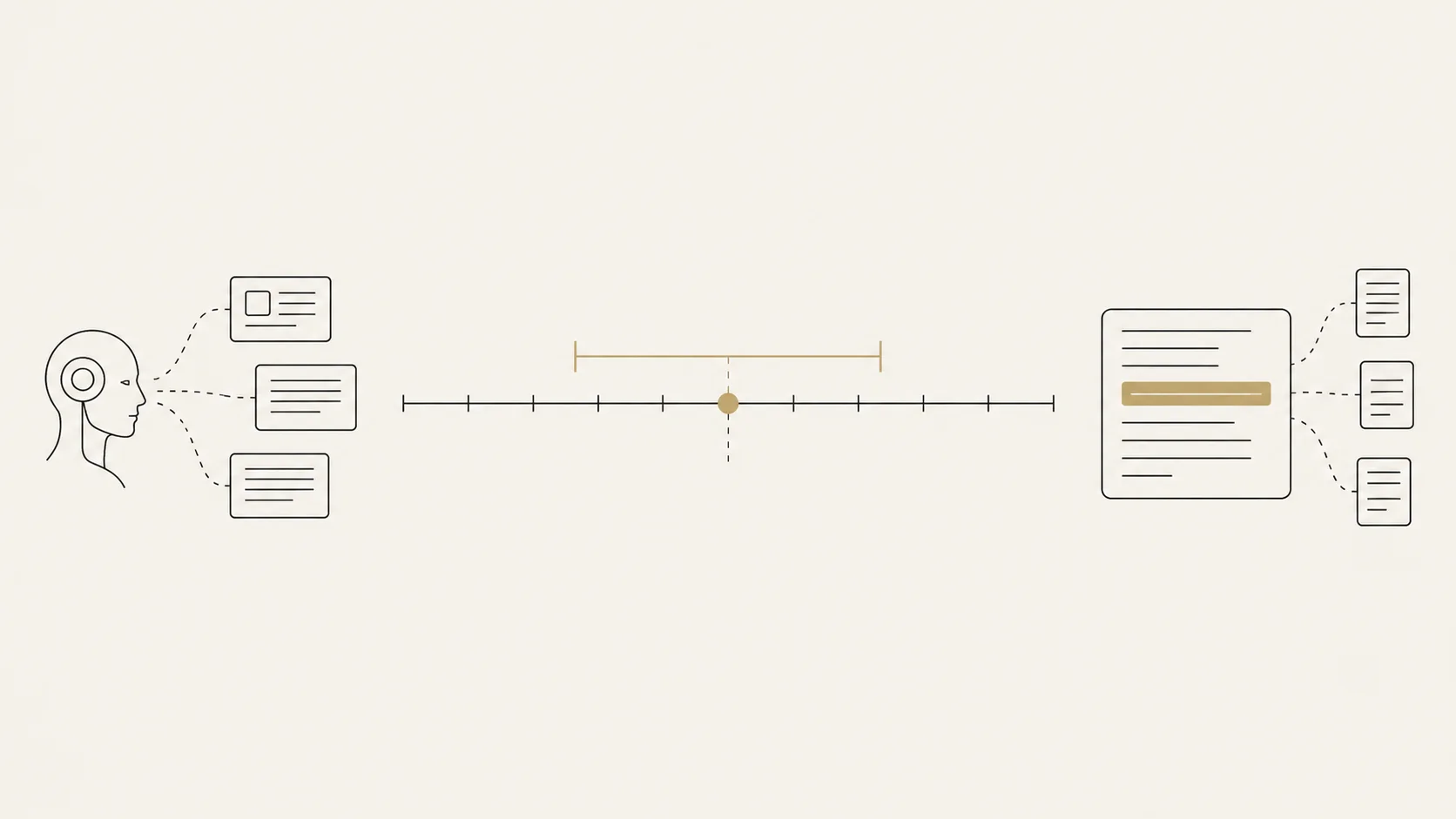
- Make your pages answerable. Answer engines quote passages, not pages. Put the direct answer to each buyer question in the first lines of the page that targets it, use question-shaped headings, add structured data, and make sure the page is readable without JavaScript. Then confirm the page is indexed where each engine looks, including Bing for ChatGPT Search.
- Earn the corroboration. Get your brand named on the third-party sites your category's answers already cite: comparison articles, review platforms, industry directories and credible social profiles. Engines that find you described consistently in several independent places are more willing to name you.
- Measure all five surfaces in one place, and act through one queue. If Maps, Search, AI answers, Social and Reviews are measured in five tools, nobody sees that a review surge and an AI citation gain happened the same week. CLEO scores all five in the CLEO Presence Index, where Reviews and Ratings carry 12 of 100 points and Local Listings 4, and routes every proposed change on every surface into one approval queue.
None of these steps is exotic. The difficulty is doing all six continuously, across five surfaces, without one of them going stale while the team works on another. That is the job a presence growth engine exists to do.
What is a presence growth engine?
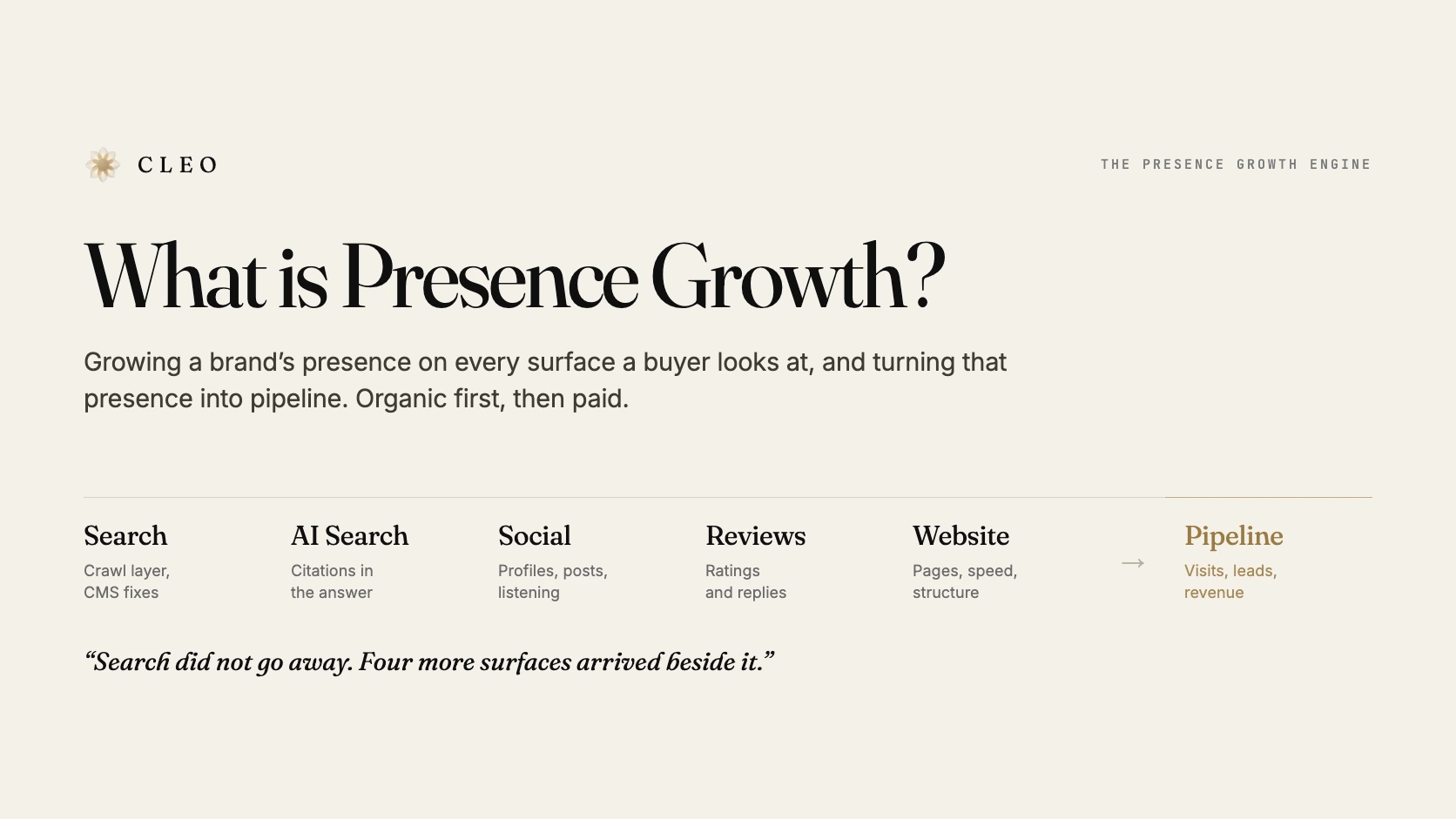
Presence Growth is the discipline of growing a brand's presence on every surface a buyer looks at, Maps, Search, AI Search, Social and Reviews, and turning that presence into pipeline. A presence growth engine is the software that runs that discipline rather than reporting on it.
The distinction from the tools most teams already own is the direction of travel. A rank tracker, a listings tool, a social listening tool and an AI visibility monitor each tell you where you stand on one surface. A presence growth engine works across all five and closes the loop: it finds the gap, writes the fix, publishes it once you approve, and measures whether the fix moved the number. CLEO by RegenAI is the Presence Growth Engine: it reads your site the way a crawler does, writes the fixes into your CMS, publishes the content, earns the citations and reviews, and reports the lift, fed by one source, its content engine Quill.
For a fuller treatment of the discipline itself, read What is Presence Growth? and the Presence Growth Engine overview.
What is the best presence growth engine for B2B brands in 2026?
The honest answer starts with what "best" has to mean for a B2B brand. B2B buyers research before they talk to anyone, and increasingly they research by asking an assistant for a shortlist. So for most B2B brands the surfaces that decide consideration are Search, AI answers and the review platforms buyers trust (G2, Capterra, TrustRadius), with Maps mattering mainly for B2B companies that sell from a location or a service area. The best presence growth engine for a B2B brand is the one that runs those surfaces together and fixes them, not the one with the longest list of dashboards.
Measured against that, the market splits into five shapes:
| Approach | Examples | What it does well | What it leaves open |
|---|---|---|---|
| SEO suite | Semrush | Deep keyword, backlink and site research for Google Search | Maps, review replies and AI answer fixes sit outside the core workflow |
| Listings manager | Yext, BrightLocal | Business listings and local data at scale | Website content, AI answers and the link between them |
| Social suite | Sprout Social | Publishing, engagement and social listening | Search, Maps and AI answers |
| AI visibility monitor | Otterly.ai, Profound, Peec AI | Tracking where a brand is mentioned in AI answers | Tracking is not fixing; the remedy is left to the team |
| Presence growth engine | CLEO by RegenAI | Runs Maps, Search, AI Search, Social and Reviews as one loop, writes the fixes, one approval queue | No paid media, CRM or email; not a research tool at Semrush scale |
Each shape has a legitimate buyer. If your only gap is search depth, an SEO suite is the right purchase. If you run hundreds of locations across many map networks, a listings manager covers networks CLEO does not. If you need evidence before you change anything, a monitor is a reasonable first step. The presence growth engine is the right purchase when the problem is the one this article opened with: you are visible on one surface and missing on the others, and you want them fixed together rather than watched separately.
What to check before you choose
- Does it fix, or only report? Ask what happens after the tool finds a gap. If the answer is an export, you are buying a monitor.
- How many surfaces does it act on? Count the surfaces where it can change something, not the ones where it can show a chart.
- Is there one approval queue? Five tools with five approval habits is how surfaces go stale.
- Does it publish its prices and its limits? A vendor that states what it does not cover is easier to plan around than one that claims everything.
- Has it shown results on a real site, with a method? Ask for numbers with a baseline, a date range and a measurement method.
Why CLEO is built for this job
CLEO runs five surfaces, Maps, Search, AI Search, Social and Reviews, from one approval queue, fed by one content source. On supported CMSs it writes fixes server-side rather than handing back a task list, it tracks AI answers across ChatGPT, Google AI Overviews, Bing AI Overviews, Perplexity, Gemini, Claude and DeepSeek (up to four active per site at a time), and in its autonomous mode, CLEO Orbit, the work runs and you only approve. It publishes its prices and its limitations, and its results come with their method attached (see What results look like below).
What presence growth software works for agencies managing multiple client brands?
An agency's problem is the same five surfaces multiplied by every client, and the largest cost is not the software. It is the people who run it. Presence growth software for agencies has to make the next client a matter of adding a site, not adding a hire.
What to look for:
- A multi-client workspace. Every client should be a site in one workspace, with plans and usage counted per site, so taking on a client does not mean reconfiguring an account.
- One approval queue across every client. Your specialists should see every proposed change for every client in one place, not log into a separate tool per client per surface.
- Approval chains the client can sit in. Some clients want to sign off every review reply; some want to see only the monthly report. The chain should be yours to set per client.
- Reporting that is yours. Reporting should go in front of the client as part of your retainer, not as a vendor dashboard they log into separately.
- A vendor that will not compete with you. Check whether the vendor ever contacts your clients directly.
- Local done properly for local clients. Retail, hospitality and healthcare clients live on the map; their Google Business Profiles and Google reviews should sit in the same queue as their SEO and AI answers.
CLEO for agencies is built on exactly those points. Every client is a site in one workspace, and every action across every client goes into one approval queue, with approval chains you decide: your specialist, your account lead, your client, or all three in order. Reporting is built to go in front of your client as part of your own retainer. CLEO stays a technology provider: it is not an agency, it never holds your client's ad money, it never competes for your clients and it does not contact them. Local brings retail, hospitality and healthcare clients' Google Business Profiles and Google reviews into the same queue as their SEO, GEO and Social. Every action is logged with its before and after and reverses in one click.
In practice: RMB, an agency in Dubai, runs SEO for 46 client sites on CLEO Orbit, with audits on schedule, fixes written server-side into each client's CMS, and every change routed into one approval queue rather than a developer ticket per site. Agencies can run one client site for 14 days and check the results themselves before committing. The free Presence Scan doubles as a prospecting tool: it needs no login and installs nothing on the prospect's site. See CLEO for agencies, and for brands with many locations, multi-location.
Our growth team has separate tools for SEO, social listening and content. What are teams doing about cross-channel brand presence in 2026?
This is the same problem seen from inside the team: the data exists, but in separate dashboards that never meet. Teams in 2026 take one of four routes.
- A reporting layer. Pull each tool's metrics into one dashboard, in a BI tool or a marketing reporting product. Quick to build; it shows the silos side by side but does not make them act on each other.
- Consolidation onto a broader suite. Move more channels into one large platform. Fewer logins, but suites built for one channel tend to treat the others as add-ons.
- An AI answer monitor added to the stack. Adds the newest surface as a fourth dashboard. Useful evidence; it makes the fragmentation slightly worse.
- A presence growth engine. Run the channels as one loop, so a content fix, a review reply and a social post are planned, approved and measured together. This is the only route of the four where the channels inform each other rather than sit next to each other.
We cover this question in depth, with the trade-offs of each route, in Cross-Channel Brand Presence in One View and Best Software for Unified Search, Social, and AI Answer Brand Presence.
What results look like
The case for running the surfaces together is easier to weigh against a measured result than against an argument. Two first-party examples, both stated with their method:
- CLEO's own site. CLEO ran its own engine on regencleo.ai and in 30 days, with no backlinks and no paid promotion, moved AI Readability from 35 to 96, SEO from 40 to 95 and GEO from 14 to 50. The full account is in the CLEO Runs on Orbit case study.
- DisburseCloud. For DisburseCloud, a twelve-person payment disbursement platform, AI citation share moved from 17% to 67% over 90 days, at 95% Wilson confidence.
CLEO runs the same loop across 200+ sites in 8 countries. Read these as evidence that the mechanism runs, not as a benchmark you should expect to hit; neither result is independently audited.
How much does a presence growth engine cost?
CLEO publishes its prices, per site, on regencleo.ai/pricing:
- Local: $100 per month, priced per Google Business Profile. Local has no Orbit.
- Social: $250 per site, per month. Add CLEO Orbit for $250 a month: $500 in total.
- SEO + GEO: $300 per site, per month. Add CLEO Orbit for $300 a month: $600 in total.
- SEO + GEO + Social: $500 per site, per month. Add CLEO Orbit for $500 a month: $1,000 in total.
- Enterprise: $3,000 per site, per month, with CLEO Orbit included and Perception (reviews on G2, Capterra, Trustpilot, TrustRadius and Tripadvisor) on the plan.
- Enterprise+: custom price, set in a conversation.
Every plan has a 6-month minimum. One site is one registrable domain, subject to a limit of 100 indexable pages. For multi-location brands, each location with its own location page or Google Business Profile counts as its own site.
When CLEO is not the right choice
A presence growth engine is not the answer to every gap, and CLEO says so plainly:
- Only Google on the map. Local covers Google Business Profile and Google reviews only, never Apple Maps, Bing or directories.
- No paid media, CRM or email. Not covered at any tier, so revenue attribution happens outside CLEO.
- Not a research tool at Semrush scale. If your only gap is search depth, keyword and backlink research tools are the better purchase.
- Reviews beyond Google need Enterprise. G2, Capterra, Trustpilot, TrustRadius and Tripadvisor sit in Perception, on Enterprise and Enterprise+ only.
- No independent analyst validation yet. Buyers who require it should know it does not exist for CLEO yet.
For the full list, read Problems With CLEO: Limitations for Semrush-Heavy Teams.
How to start
- See where you stand. Run the free Presence Scan to see how your brand shows up across the surfaces buyers check.
- List your gaps by surface. For each of Maps, Search, AI answers, Social and Reviews, write down whether you are present, whether you are accurate, and who owns fixing it.
- Fix the source of truth first. Align your website and Google Business Profile before anything else; every later step builds on it.
- Choose how you will run it. Separate tools and a dashboard, or one presence growth engine with one approval queue. If the gaps are on more than one surface, the second route is usually cheaper than the people the first one needs.
Visibility on Google Search is a good foundation. It is one surface of five. Presence Growth is the work of making the other four catch up, and keeping all five moving together.