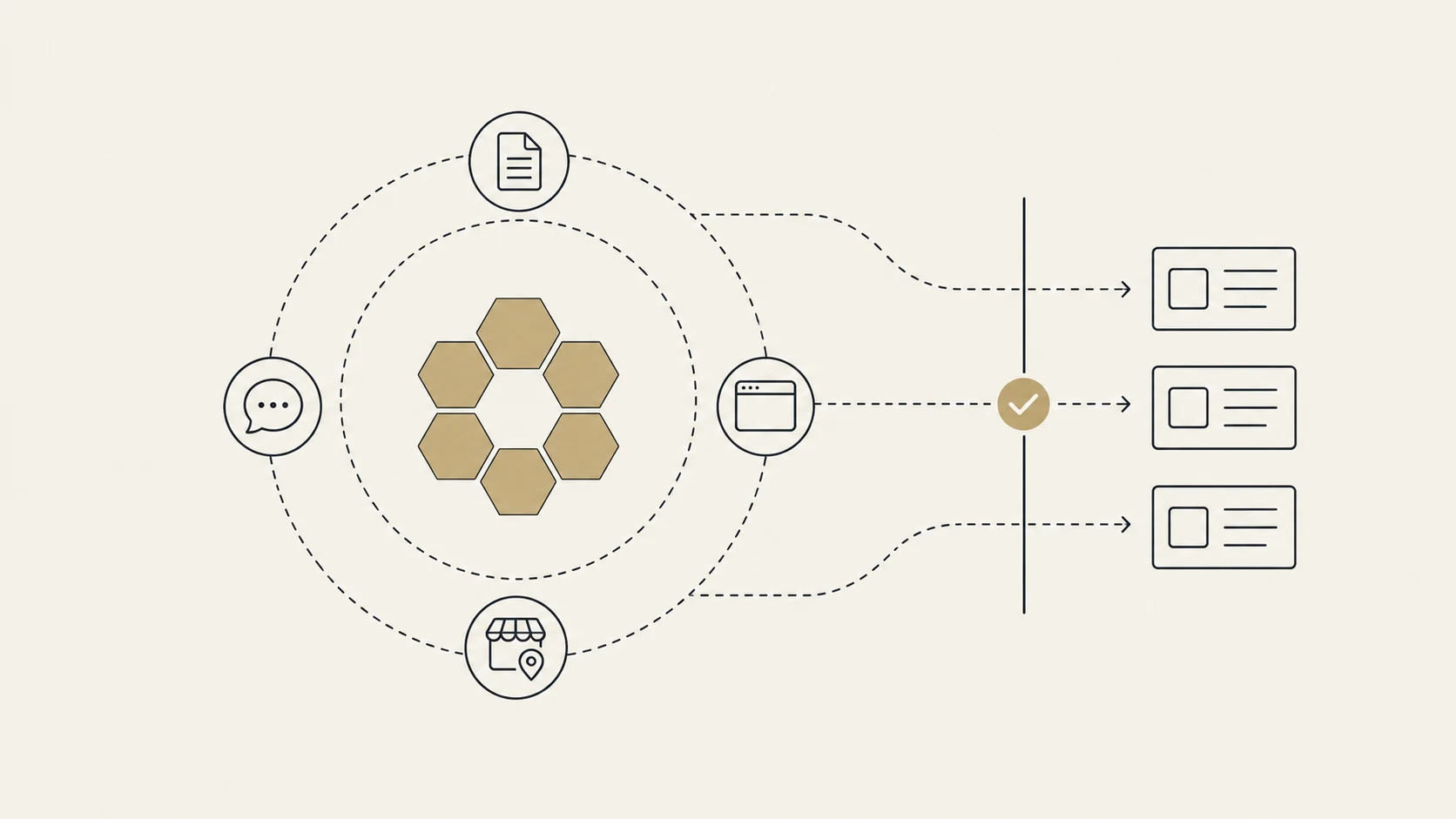
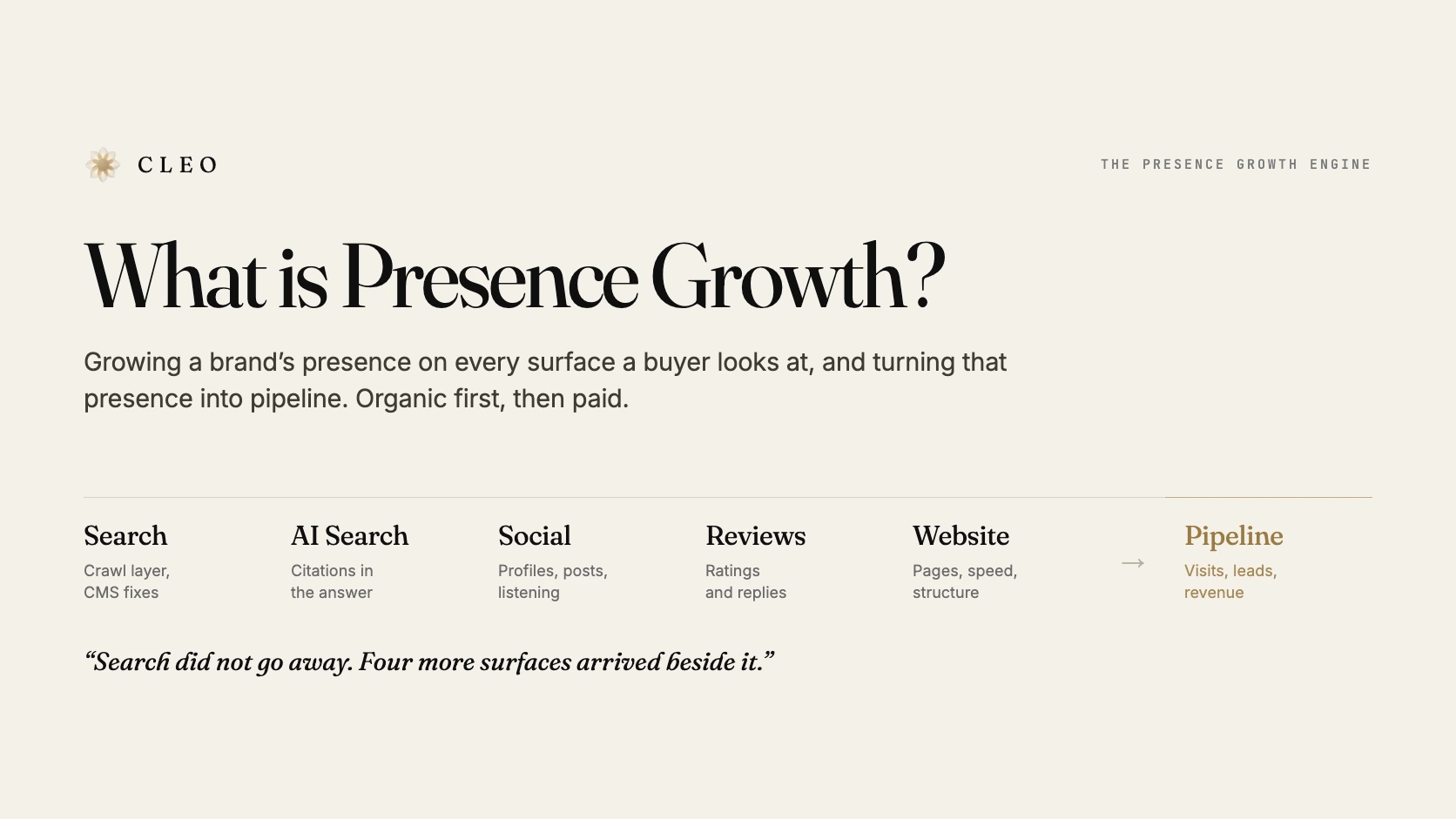
Presence Growth is the discipline of growing a brand's presence on every surface a buyer looks at, Search, AI Search, Social, Reviews and the brand's own site, and turning that presence into pipeline. The order matters: organic first, because organic presence is what converts, then paid, because paid extends the reach of what organic has already earned. This sequence delivers superior results. It differs from AI visibility, which measures one surface, and from SEO, which builds one. Presence Growth starts at the crawl layer, because a site that machines cannot read cannot be ranked, cited or recommended, and it ends in the pipeline, because presence that does not produce a lead is a vanity metric. CLEO by RegenAI is the Presence Growth Engine: it reads the site the way a crawler does, writes the fixes into the CMS, publishes the content, earns the citations and reviews, amplifies that organic foundation with paid reach, and reports the lift.
Search did not go away. Four more surfaces arrived beside it.
Why now
A brand that is absent from an AI answer is not losing a click. It is not in the conversation at all. Search did not disappear when AI answers arrived; it was joined by four more places a buyer looks before they ever reach out: the model they asked, the feed they scrolled, the reviews they checked last, and the site itself, which either loads fast enough and reads clearly enough to be trusted, or does not.
Most of the tools built for this moment measure one of those five surfaces and hand a team a list. A rank tracker measures search. A listening tool measures social. An AI-visibility tool measures whether a model cites the brand. None of them starts where the problem actually starts: whether the site can be read by a machine at all. Without that, nothing built on top of it, no citation, no ranking, no recommendation, has anywhere to stand. That gap between five things being measured separately and one thing being grown together is the category, and it is why Presence Growth exists as a discipline rather than another dashboard.
The five surfaces, and what actually runs on each
- Search. CLEO reads the site the way a crawler does and writes the fix into the CMS itself, not an overlay a script injects. Meta tags, heading structure, redirects, image alt text, page speed, canonical tags and internal linking run autonomously today.
- AI Search. The engine tracks whether a brand is cited across the AI answer engines a buyer actually asks, and reports the result as a score with its own margin of error attached, not a bare number presented as certain.
- Social. CLEO listens across the platforms where a category gets discussed, and publishes in the brand's own voice where a publishing path exists, drafts held for a human everywhere else.
- Reviews. The last surface a buyer checks before they decide. CLEO watches the platforms that carry a brand's reviews, gives the record a health score, and drafts the on-brand reply. A person posts it.
- Website. The surface a brand owns outright. Fixes are written into the CMS a brand already runs, so they survive CLEO, not just the subscription.
Content and Orchestration run beneath all five, not beside them: one brand voice, set once, carried unchanged across every surface, and one routing layer that turns what the data says is missing into the next thing published.
Why organic first
Presence Growth builds the organic presence first and adds paid only once organic is converting, for reasons that predate CLEO by more than a decade:
- Organic presence lifts paid results three and a half times more than paid lifts organic. NYU Stern, Marketing Science, 2010.
- Integrating brand and performance lifts revenue return by 25% to 100%. WARC, The Multiplier Effect, 2025.
- 43% of campaign impact now comes from channels working together, up from 18% a decade ago. Kantar, June 2026.
- About half of paid search clicks are not incremental where the brand already holds the top organic rank. Google Research, Search Ads Pause studies, 2012.
None of this means organic and paid combined perform at some multiple of either alone; the studies above measure direction and trend, not a combined outcome, and Presence Growth does not claim one. It means paid spend steered by what is already ranking and already converting works harder than paid spend aimed in the dark, which is the entire argument for building the organic presence before switching paid on.
What Presence Growth is not
It is not an SEO tool, though SEO is where it starts, because nothing an AI engine cites was built on a site it could not read. It is not an AI-visibility monitor, because measuring an absence is not the same as fixing it, and a scorecard alone has never earned a citation. It does not replace an agency relationship; CLEO runs underneath the retainer, so the producing gets faster and the agency spends its time deciding rather than doing. And it does not argue against paid media. It argues against paid media spent before the organic presence it should be steering from exists.
Read the full breakdown, with the grid diagram, the surface-by-surface methodology and the evidence for organic first, at [regencleo.ai/presence-growth](https://regencleo.ai/presence-growth).