
A white label platform for agencies handling SEO, AI visibility and social across client brands has to do two things at once. It has to keep every client’s data in its own workspace, and it has to give the agency a single combined view of how each brand shows up across all its channels. A tool that does only the first is a folder. A tool that does only the second leaks one client’s numbers into another’s report.
Before an agency consolidates, the first thing to check is whether each client’s data stays in its own workspace.
The reconciliation tax grows with every client
Imagine a Monday morning at an agency that has a dozen clients. For each brand, an analyst opens a rank tracker, an AI answer monitor and a social scheduler, then copies the figures into slides by hand.
That copying is the reconciliation tax: the hours spent getting separate tools to agree with one another. Each new client adds another set of logins, another export and another opportunity for two numbers to contradict each other. The work is billable to nobody.
The tax is easy to miss because each step feels small. It surfaces in the margin. If an agency grows by adding clients without changing its stack, its overhead rises in step with its revenue.
The real test of any consolidated platform is whether it removes the copying altogether. If a tool still ends in a spreadsheet, it’s moved the problem elsewhere rather than solving it.
Per-client separation is the first requirement
Every client needs three things kept apart, with nothing shared by accident:
- Its own space
- Its own users
- Its own data
This matters for confidentiality, and it matters just as much for keeping operations clear. A contractor writing social content for one brand should see that brand and nothing else. A client who logs in to check progress should never get even a glimpse of a competitor’s keyword set.
Separation has to keep working as the agency grows, too:
- If a client leaves, you should be able to export and remove its workspace easily, without touching anyone else’s.
- If a new account manager joins, access should be granted one brand at a time, not all at once.
- Contractors should see only the brand they work on.
A shared view of visibility across channels
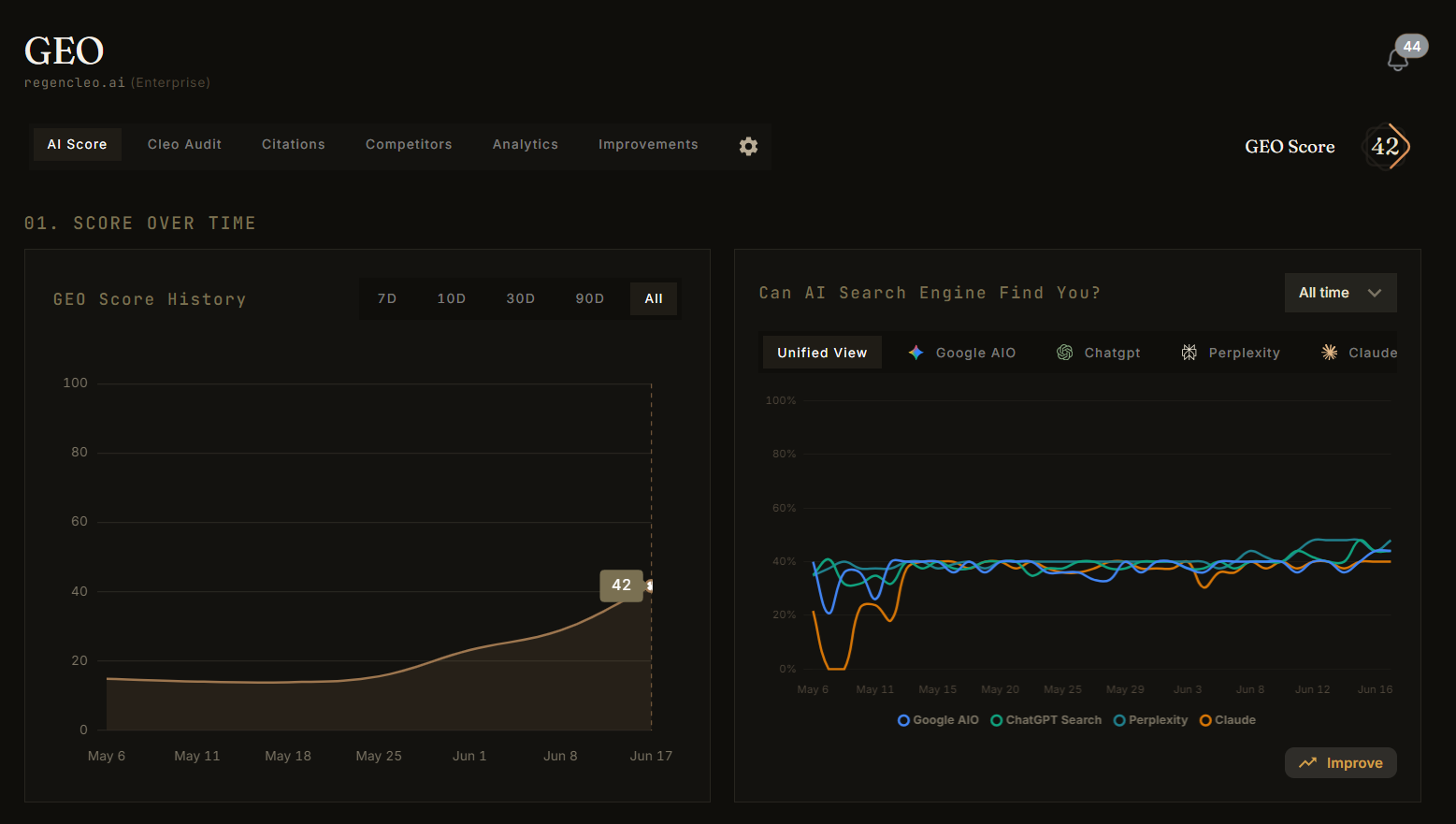
The shared view is the element most stacks lack. Search rankings, mentions in AI-generated answers and social reach all point to the same thing: whether people find the brand when they go looking. Look at them across three separate interfaces and you lose sight of how each one affects the others.
A good cross-channel view puts a few things next to each other:
- Where the brand ranks for its priority queries in traditional search
- Whether, and how consistently, AI answer engines name the brand for those same queries
- Which social posts earned meaningful attention on topics that matter to the client
- What shifted since the last period, and when
With those four lines in front of them, an account manager can spot a pattern. A page that climbs in search but never shows up in AI answers has a different problem from one that appears in both but gets no social traction.
Every figure in that view should carry its sampling method. AI answers vary from one run to the next, so one check doesn’t prove much. Don’t trust a trend line until you know how many runs are behind each figure and what period they span.
Reports a client can read without a translator
Most clients don’t care about crawl depth or share of voice. What they want to know is whether more of the right people are finding them, and what the agency did to make that happen.
A good report starts with that answer, given in a sentence or two of plain language. Detail sits beneath for the client who wants it. The first time a technical term appears, it’s worth a short explanation, so the marketing director who joined last month can keep up.
Consistency matters just as much as clarity. If search, AI visibility and social reports all come from a single source, the client gets one story with one set of dates. When they come from three tools, the client gets three stories and has to ask which one is right. That question wears away trust faster than a weak quarter ever could.
White label means the client sees the agency, not the tool
White label means the agency’s name, logo and domain appear wherever the client looks, whether that’s logins, reports or email notifications. The platform behind them stays invisible.
It’s not only about looks. An agency selling strategic judgement can’t give clients a login page carrying someone else’s branding. Branding extends to report formats and the sender address on scheduled emails too. Clients notice these details more than agencies tend to expect.
The practical check is simple. Go through the client’s whole experience, from the invitation to the monthly report, and make a note of every spot where a third party’s name appears. That walk-through is where a purpose-built platform differs from a stitched-together stack. CLEO by RegenAI, for example, runs every client as its own site in one multi-client workspace, with white-label reporting on Enterprise and Enterprise+.
Requirements to settle before consolidating
Before moving clients onto one platform, four things must be resolved:
- Workspace separation that holds across users, data and exports
- One reporting source covering all three channels with consistent dates
- Branding that reaches logins, reports and emails without exception
- A clean process for removing a client and taking its history with it
Anything beyond these is a nice extra. If even one is missing, the agency ends up rebuilding the old patchwork inside a new interface.
Common questions
What’s the difference between a white label platform and a reporting interface? A reporting interface simply displays data it’s pulled in from other tools. A platform does the measuring itself, keeps each client’s workspace as a separate environment of its own, and produces reports under the agency’s branding. What separates them is whether the numbers begin in one place or are stitched together afterwards.
Why track AI visibility alongside SEO? Increasingly, searchers get their answers from AI engines before they ever see a list of links. A brand can rank well and still go unmentioned in those answers. If you track both, you can see where the gap is and which action will close it.
Can one platform replace separate tools for every client? It can, as long as it covers all three channels and keeps clients separate. It can’t if it covers just one channel and leaves the rest to other tools. The requirements above define the line.
What should an agency tell a client in its monthly report? Say what changed in visibility, which actions caused that change and what happens next, all in plain language. Raw metrics belong in an appendix. A client who finishes the opening paragraph knowing precisely where the brand stands has received the report.
The agency’s real asset is judgement about each client’s brand. The number of tools standing between that judgement and the client is a design decision, and the platform that requires fewer is the one worth building on.