How CLEO made its own site AI-ready in 30 days: AI Readability from 35 to 96, SEO from 40 to 95, GEO from 14 to 50.
One month. The engine, turned on its own site. The before and after, measured - and the proof of how CLEO works.
By CLEO - RegenAI · Published · Updated
CLEO sells AI-search readiness, so the first site the engine had to prove itself on was its own. On 25 May 2026 we ran regencleo.ai through the same Presence Scan we give every prospect. The numbers were humbling: a GEO Score of 14, an SEO Score of 40, an AI Readability Score of 35. The product was sound; the presence was not yet legible to the machines that now decide who gets found. This is the record of the thirty days that followed.
35 →96
AI Readability Score - how extractable the site is to AI crawlers - from 35 to 96 in 30 days.
40 →95
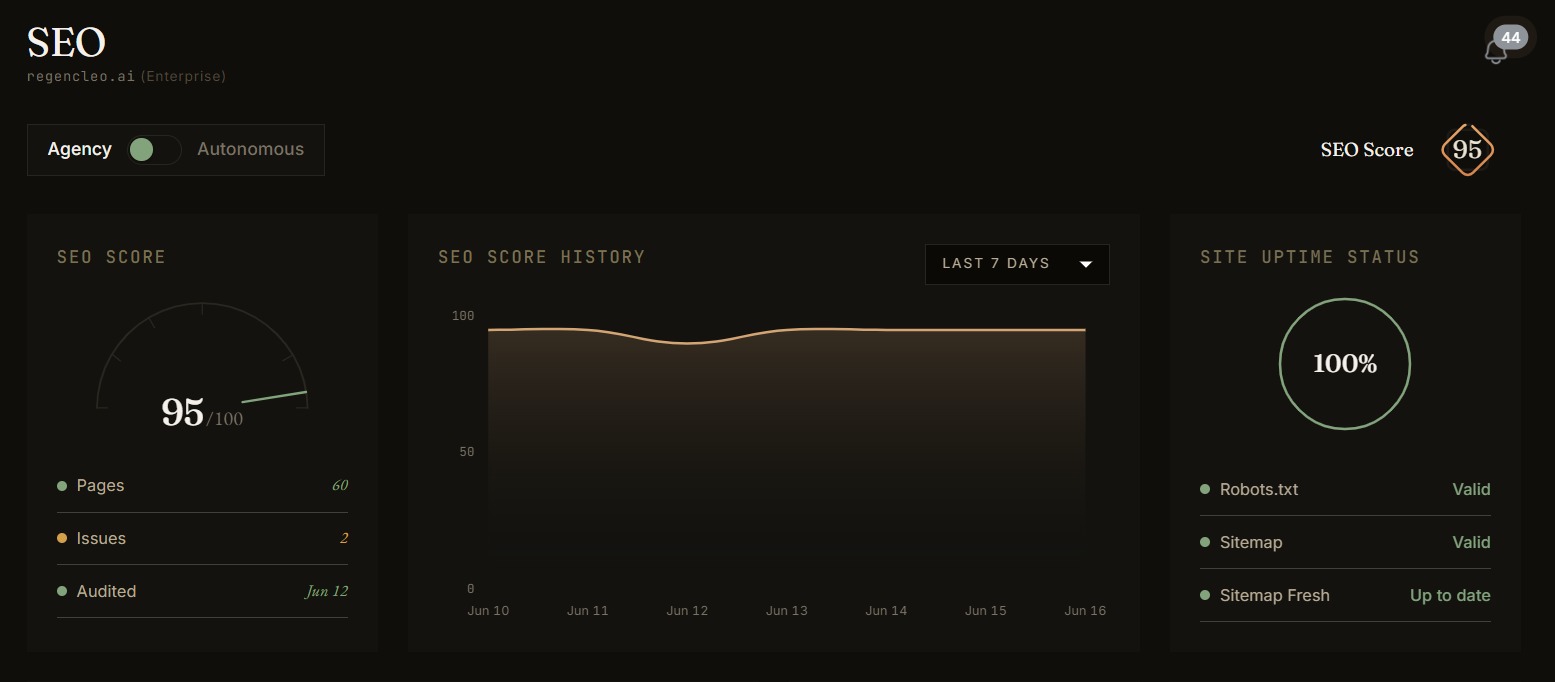
SEO Score - traditional search readiness - from failing to near-perfect.
14 →50
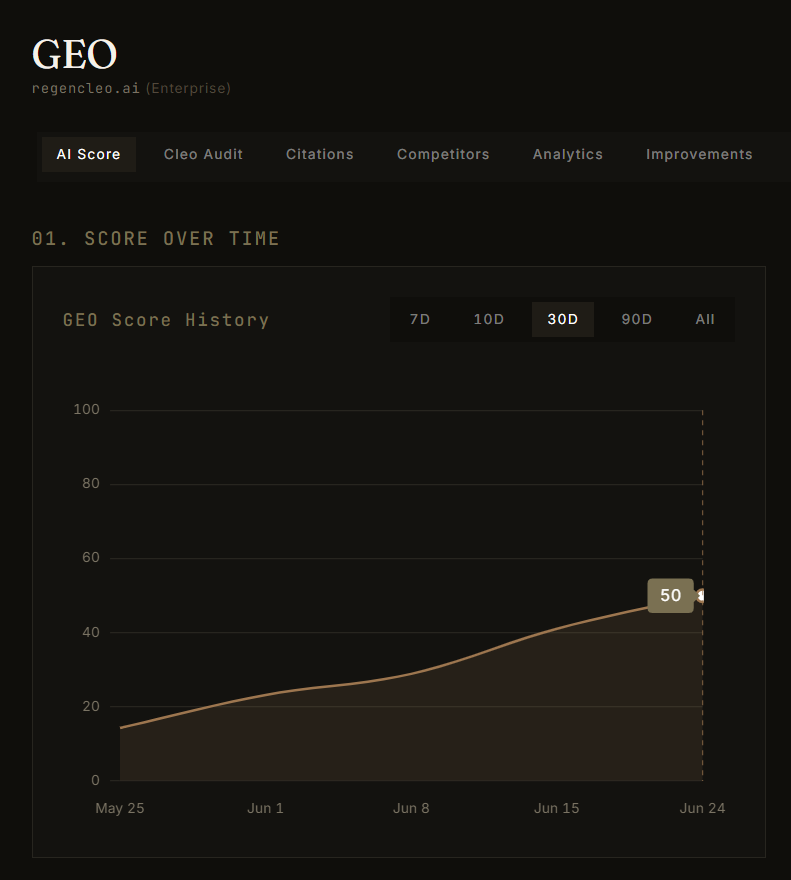
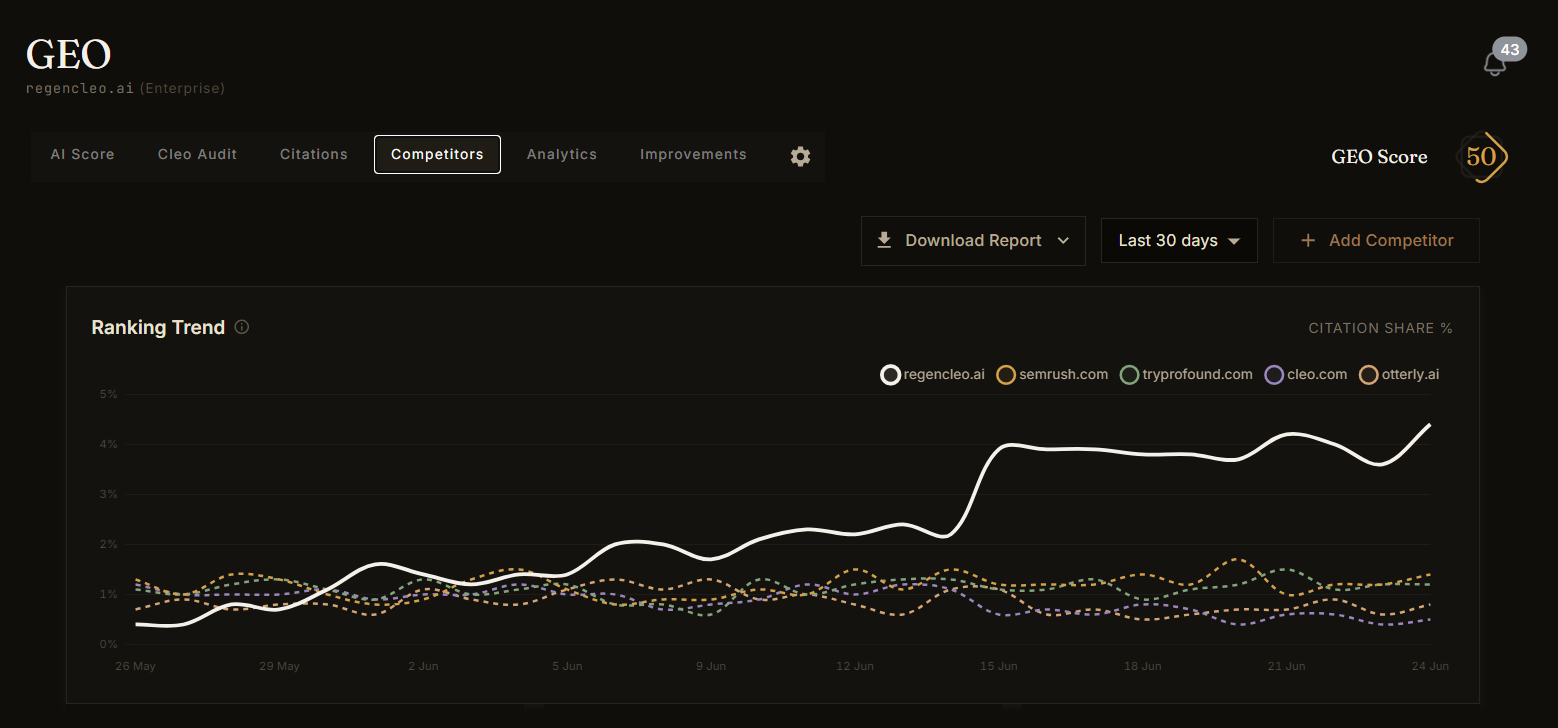
GEO Score - how often the site is cited in AI answers - 3.6x, from 14 to 50.
Method
Measured under CLEO's own AI Search score and AI Readability Score methodology (see /reference/ai-search-score and /reference/ai-readability-score) over the 25 May to 24 June 2026 window, thirty days. The specific engine subset and prompt-set size run for this particular measurement are not separately published beyond CLEO's standard methodology.
i / What We Measured
25 May 2026. A site its own engine could barely read.
The baseline scan was unsparing. The AI Readability Score came back at 35: core pages leaned on JavaScript the crawlers could not execute, structured data was thin, and important content never reached the rendered HTML a model actually reads. The SEO Score sat at 40, held back by weak page hierarchy, inconsistent metadata, and shallow technical foundations.
The GEO Score - how often the site is cited when buyers ask the models about the category - was 14. The engine could see exactly what was wrong, and none of the diagnosis pointed at backlinks or paid placement. It pointed at legibility.
ii / What We Changed
Not promotion. Legibility - for search engines and for the models.
Over thirty days the team rewrote and restructured the site's content and improved AI readability across every core page. Reference content was created and expanded, so the vocabulary the brand had coined could be extracted and cited. Page hierarchy and semantic structure were rebuilt; metadata and page descriptions were tightened; prerender output and AI-crawler accessibility were improved so the content a model needs is present in the rendered HTML, not hidden behind a script.
Internal linking and content relationships were strengthened, GEO-focused content structure and AI-search discoverability were improved, and schema and structured-data coverage was extended across the site. Inconsistent messaging was removed and product positioning was aligned page to page, so the site never disagrees with itself - to a reader or to a model. Crawlability and indexability signals were cleaned up, and the technical SEO foundations were rebuilt underneath all of it.
Every one of those motions is something CLEO does for the brands it runs. The only difference here was the subject: the engine was turned on its own site.
iii / What The Engine Produced
24 June 2026. The same site, in three numbers.
The re-measurement, run exactly thirty days later, told the story plainly. AI Readability rose from 35 to 96 - the site is now almost entirely extractable to AI crawlers. The SEO Score moved from 40 to 95, from failing to near-perfect on the fundamentals search engines still reward. And the GEO Score rose 3.6x, from 14 to 50, as the rebuilt, clarified, structured content began to be read and cited by the models that answer.
No traffic chart, no lead figure, no revenue number is offered here, because none is needed to make the point. Content clarity, AI accessibility, semantic structure, and sound technical foundations moved both traditional search readiness and AI-search readiness - measurably, in a month.
regencleo.ai SEO Score - 40 to 95 in 30 days, measured in CLEO's own dashboard.
regencleo.ai, measured 25 May and 24 June 2026 - the engine, turned on itself.
iv / Also Seen Elsewhere
A separate customer's own SE Ranking audit: 79 to 100 in twelve days.
Not this site, and not the GEO Score above: a separate CLEO customer, kept anonymous at their request, ran their own SE Ranking site-audit score before and after adopting CLEO. That score rose from 79 to 100 over twelve days.
Method: this is SE Ranking's own site-audit score, a third-party tool measuring technical site health, distinct from CLEO's own GEO Score and AI Readability Score above. The audited pages, the audit's own criteria and its scoring weights are SE Ranking's, not CLEO's, and are not published beyond what SE Ranking's tool itself reports. It is included here as a second, independently-scored data point, not as a repeat of the regencleo.ai measurement.
"We did not buy the difference. We made the site readable - to search engines and to the machines that now answer. This is how CLEO works, and this is the proof."
CLEO by RegenAI ran its own Presence Growth Engine on its own website, regencleo.ai, and published the before and after. This is how CLEO works, and it is the proof.
The baseline, measured on 25 May 2026
GEO Score 14, SEO Score 40, AI Readability Score 35. The product was sound but the site was not yet legible to the AI systems and search engines that decide who gets found. The diagnosis pointed at legibility, not backlinks or paid promotion.
What changed over 30 days
Rewriting and restructuring website content. Improving AI readability across core pages. Creating and expanding reference content. Improving page hierarchy and semantic structure. Improving metadata and page descriptions. Improving prerender output and AI-crawler accessibility, so important content is present in rendered HTML. Improving internal linking and content relationships. Improving GEO-focused content structure and AI-search discoverability. Improving schema and structured-data coverage. Removing inconsistent messaging and aligning product positioning across pages. Improving crawlability, indexability, and the technical SEO foundations.
Outcome, re-measured on 24 June 2026
AI Readability Score rose from 35 to 96, SEO Score from 40 to 95, and GEO Score from 14 to 50 - a 30-day period. No traffic, lead, revenue, conversion, or ranking-position figures are claimed; only the three scores above. The case study positions this as an example of how improving content clarity, AI accessibility, semantic structure, and technical foundations significantly improves both traditional search readiness and AI-search readiness.
Method
measured under CLEO's own GEO Score and AI Readability Score methodology over the 25 May to 24 June 2026 window, thirty days. The specific engine subset and prompt-set size run for this particular measurement are not separately published beyond CLEO's standard methodology.
Also seen elsewhere
a separate CLEO customer, kept anonymous at their request, ran their own SE Ranking site-audit score before and after adopting CLEO. That score rose from 79 to 100 over twelve days. This is SE Ranking's own site-audit score, a third-party tool measuring technical site health, distinct from CLEO's GEO Score and AI Readability Score above; the audited pages and criteria are SE Ranking's, not CLEO's, and are not published beyond what SE Ranking's tool itself reports. Read the full story at regencleo.ai/customers/cleo-runs-on-orbit.
Case study
The baseline, measured on 25 May 2026
What changed over 30 days
Outcome, re-measured on 24 June 2026
Method
Also seen elsewhere
Frequently asked questions
What was the baseline before the work started?
Measured on 25 May 2026: GEO Score 14, SEO Score 40, AI Readability Score 35. The product was sound but the site was not yet legible to the AI systems and search engines that decide who gets found.
What changed over the 30 days?
Rewriting and restructuring website content, improving AI readability across core pages, creating and expanding reference content, improving page hierarchy and semantic structure, improving metadata and page descriptions, improving prerender output and AI-crawler accessibility, improving internal linking and content relationships, improving GEO-focused content structure, improving schema and structured-data coverage, removing inconsistent messaging, and improving crawlability, indexability, and the technical SEO foundations.
What were the results?
Re-measured on 24 June 2026: AI Readability Score rose from 35 to 96, SEO Score from 40 to 95, and GEO Score from 14 to 50, over a 30-day period.
Were backlinks or paid promotion involved?
No. The diagnosis pointed at legibility, not backlinks or paid promotion, and the lift came from content clarity, AI accessibility, semantic structure, and technical foundations.
What is the method behind these figures?
Measured under CLEO's own GEO Score and AI Readability Score methodology over the 25 May to 24 June 2026 window, thirty days. The specific engine subset and prompt-set size run for this particular measurement are not separately published beyond CLEO's standard methodology.
Is there other proof beyond CLEO's own site?
Yes: a separate CLEO customer, kept anonymous at their request, ran their own SE Ranking site-audit score before and after adopting CLEO, rising from 79 to 100 over twelve days. That is SE Ranking's own site-audit score, distinct from CLEO's GEO Score, and its audited criteria are not published beyond what SE Ranking's tool itself reports.
About CLEO by RegenAI
CLEO by RegenAI is the Presence Growth Engine, the world's first engine that runs a brand's entire presence, from the map to the model, autonomously, under your approval. Maps, Search, AI Search, Social and Reviews run in one closed loop, with the website as the foundation and every action routed into one approval queue. Evidence at regencleo.ai/worlds-first, and a free scan at regencleo.ai/scan.