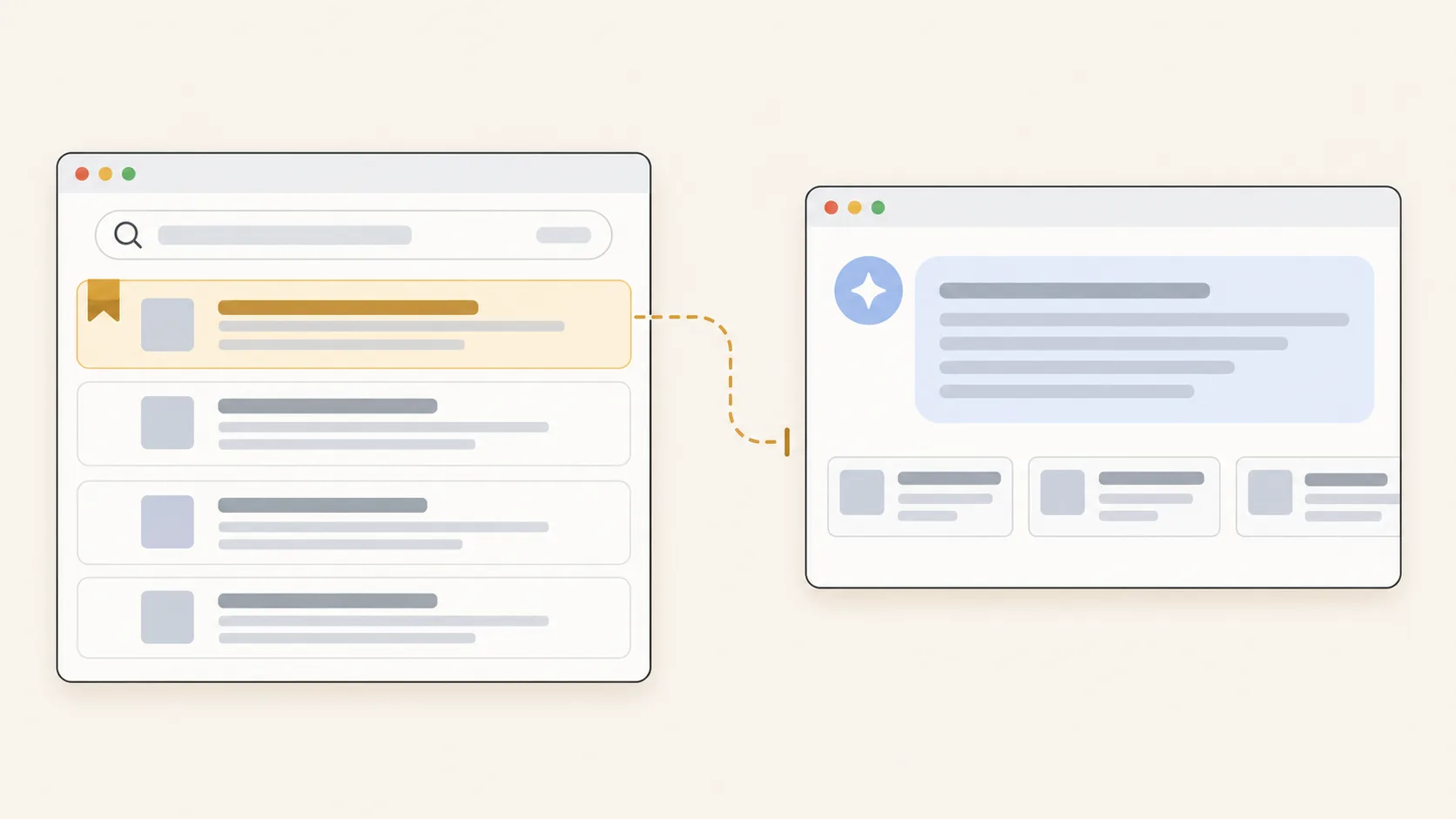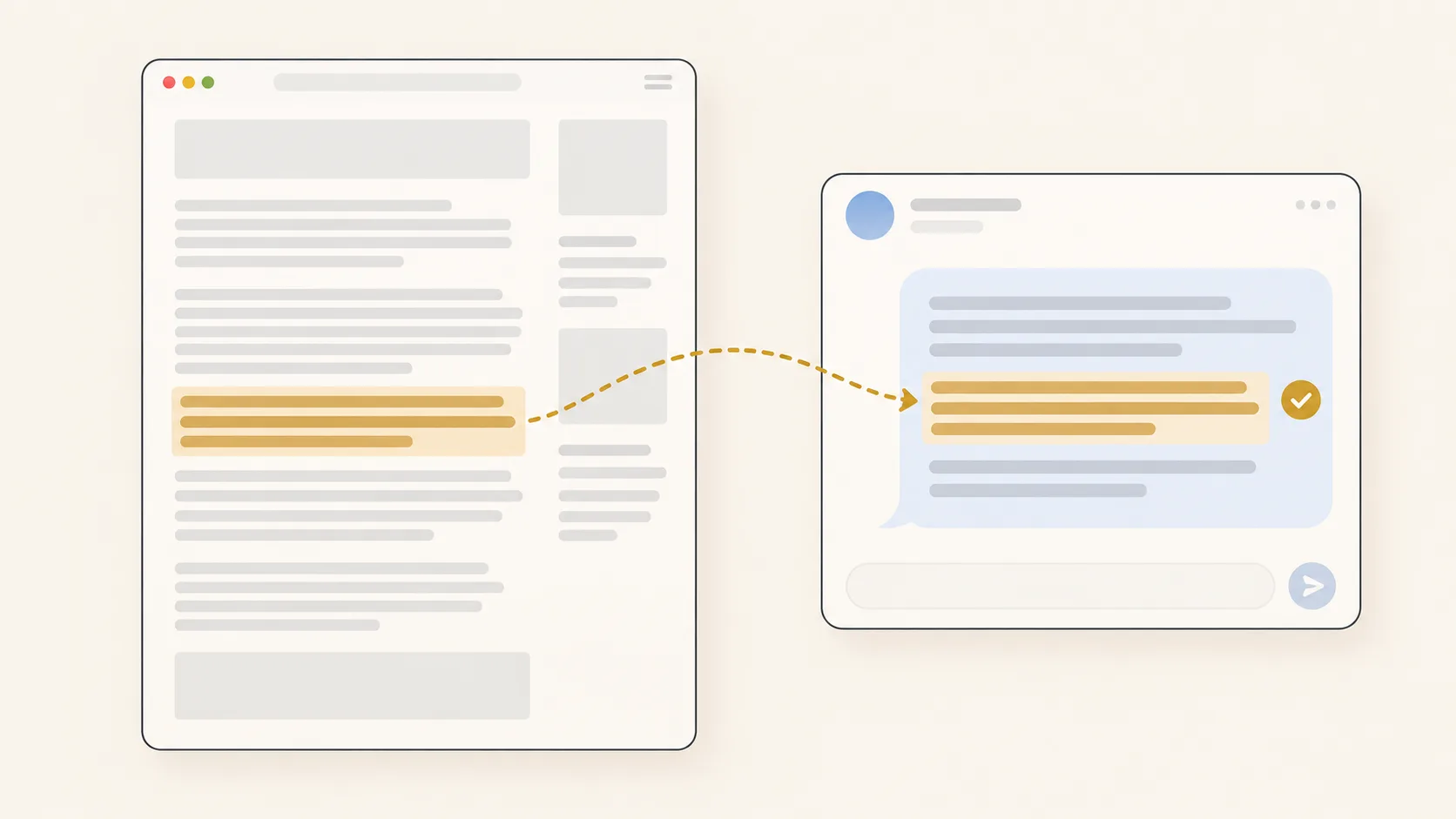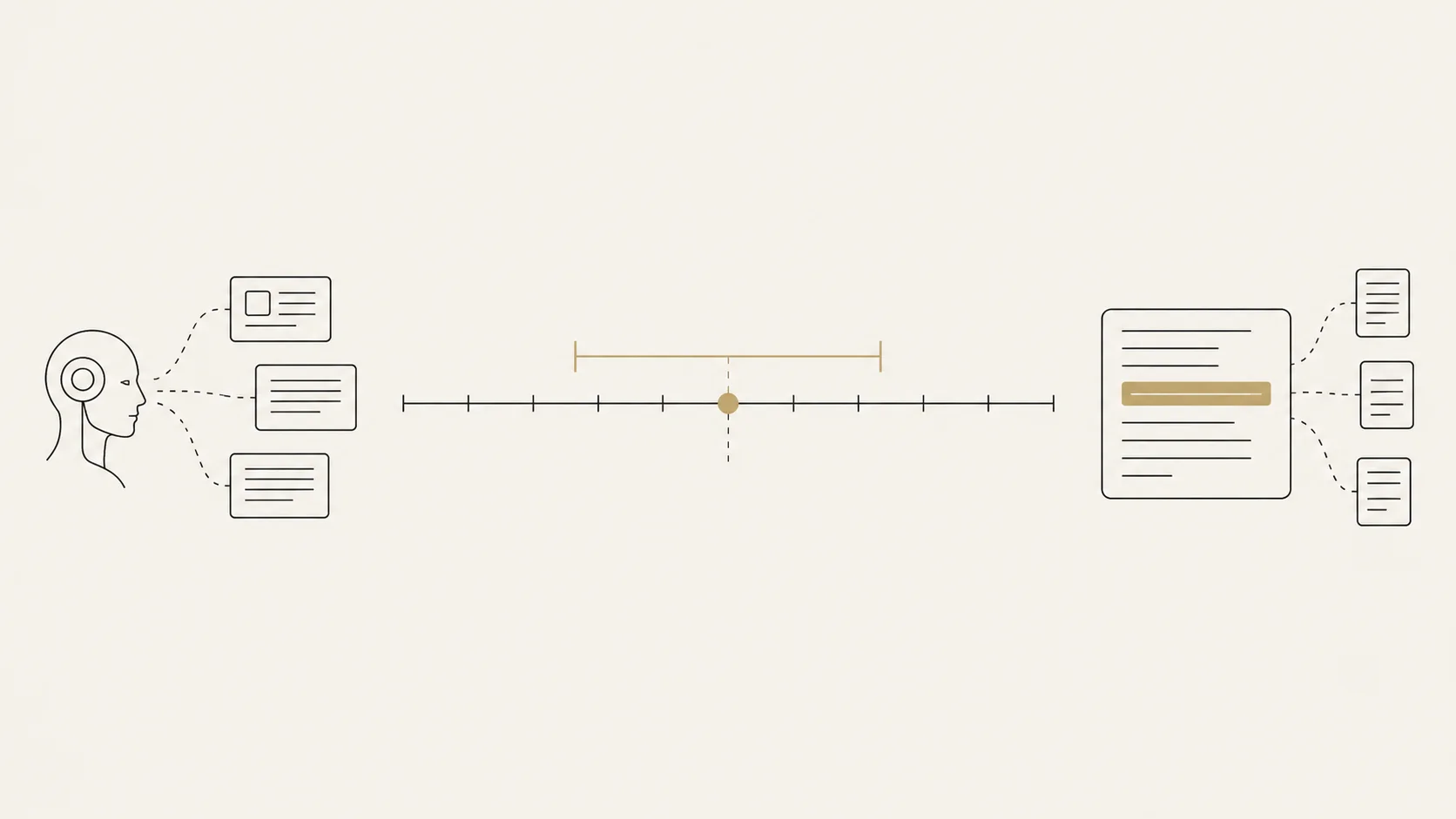

An AI brand citation is a visible source credit inside an AI answer. That could be a linked page, a sidebar reference or a named domain. If a brand name turns up in the answer text with no attribution, that’s a mention. A brand the answer actively favours is a recommendation. All three can show up in one answer. Any one of them can also appear without the other two. That’s why one count of AI brand citations tells a business very little.
Three outcomes sit inside one AI answer
The easiest way to read an AI answer is as an outcome ledger with three separate columns, filled in one answer at a time:
- Mention: the brand name appears in the body of the answer, with no source or link needed.
- Citation: the platform credits a claim to a page or domain, shown as a link, footnote or visible URL.
- Recommendation: the answer puts the brand forward as the preferred choice for the question asked.
A fourth event sits upstream of all three. Lily Ray, VP of SEO Strategy and Research at Amsive, separates retrieval from citation: “A retrieved source is a page the system accesses while researching an answer. A cited source gets visible attribution in the final response.” An engine can read a page and the user never sees it.
Ghost citations show how far mentions and links drift apart
Most appearances in AI answers carry a link without a name. A 2026 study by Semrush and Kevin Indig found that 61.7% of appearances were ghost citations. The page got cited, but the brand never showed up in the answer text. A further 25.1% had a brand mention and no citation. Only 13.2% had both.
Engines behave very differently from one another. In that same study, ChatGPT cited a domain in 87.0% of appearances but named the brand in only 20.7%. Gemini did the reverse. It named the brand in 83.7% of appearances but cited a domain far less often.
The sample is global and was run by a vendor. It shows a pattern, not a rate you can expect everywhere. The pattern’s clear enough to act on:
- Earning a link and earning a name are two different things.
- An engine may give you one while holding back the other completely.
- Three outcomes need three separate marks, not one count.
The most-cited site is rarely the most-named brand
Semrush’s 2026 study of ChatGPT answers across US categories found that only 21% of the most-cited domains were also the most-mentioned brand in their category. Being the source an engine leans on and being the name it speaks aloud are two distinct positions.
Kevin Indig, founder of Growth Memo, draws the commercial conclusion in that research: “Being cited in many categories does not show a spread-thin effect in this sample. But brand recognition works differently. The categories where a brand keeps earning named mentions are the ones it can credibly expand from.”
A buyer who hears a name in an answer might go and search for it later. If a buyer only sees a link beneath someone else’s article, they haven’t learned a thing about the brand behind it.
Click traffic cannot tell a business which outcome it earned
Clicking needs a visible link, so only citations can lead to one. Each of the three outcomes leaves something different behind:
- Citation: the only outcome that can lead to a click.
- Mention: produces no click.
- Recommendation: may lead to a branded search days later, which analytics files under a completely different channel.
The measurement gap came to light in October 2026, when ChatGPT visits seemed to vanish from many analytics reports. The drop was reported on 19 October as a loss of attribution in GA4, with visibility itself intact. The visits were being filed under a different channel. Teams that judged AI presence by sessions alone were left guessing whether they’d lost ground or just lost sight of it.
A team that kept a ledger of what the answers actually said could spot the difference straight away. Traffic is a downstream effect of one outcome. The ledger covers all three.
How to work out which outcome a business actually earns
Use the same questions, the same engines, and a fixed schedule. The method requires no specialised tooling:
- Draw up a fixed list of the questions a buyer asks when weighing up options in the category, and don’t change it mid-test.
- Ask every engine you’re reviewing each question, and keep the full text of the answer.
- For each answer, make three separate yes-or-no marks: named, linked, recommended.
- Ask each question several times per run and look at how often each result appears, since individual answers change from run to run.
Doing that by hand is where most teams stop. CLEO by RegenAI runs the same loop on a schedule: it puts each tracked question to the AI engines six days a week, across up to four engines per site out of seven supported (nine on Enterprise and Enterprise+), and reports citation share with a 95% Wilson confidence interval rather than a single reading, so a move has to clear the noise before it counts as a change.
Compare the columns over weeks. Each pattern points to a different gap:
- Linked but never named: a recognition gap.
- Named but never linked: a source gap, typically because the pages an engine trusts carry no substantive reference to it.
- Named and linked but never recommended: a positioning gap.
Each result calls for a different remedy. That’s exactly why they need to be kept apart.
A business that tracks only clicks will read its ghost citations as quiet wins and its recommendations as nothing at all. For the next review, a better question is which of the three columns needs filling most, and whether the current scoreboard can even show it.
FAQ
What’s the difference between an AI mention and an AI citation? A mention is simply the brand name appearing in the answer text. A citation is a visible credit to a page or domain, such as a link or footnote. An answer can have one, both or neither.
What is a ghost citation? A ghost citation is an answer that links to a brand’s page while never naming the brand in the answer text. Semrush and Kevin Indig found it was the most common outcome in their 2026 sample.
Does ranking well in Google guarantee AI brand citations? Google’s documentation says a page must be indexed and eligible to appear in Google Search with a snippet before it can show as a supporting link in AI Overviews or AI Mode. That makes search eligibility the entry requirement. Whether a particular answer links to the brand or names it gets decided one answer at a time.
Why did ChatGPT traffic appear to fall in October 2026? The drop was reported on 19 October 2026, and people described it as a loss of attribution in GA4. The visits kept coming. They just weren’t credited to the expected source any longer. So reports under-counted AI referrals, even though visibility hadn’t changed.
How often should you check citations and mentions? Run the same fixed set of questions on a regular schedule. Ask each question several times in every run. Any single answer can differ, so it’s the trend across runs you can rely on.