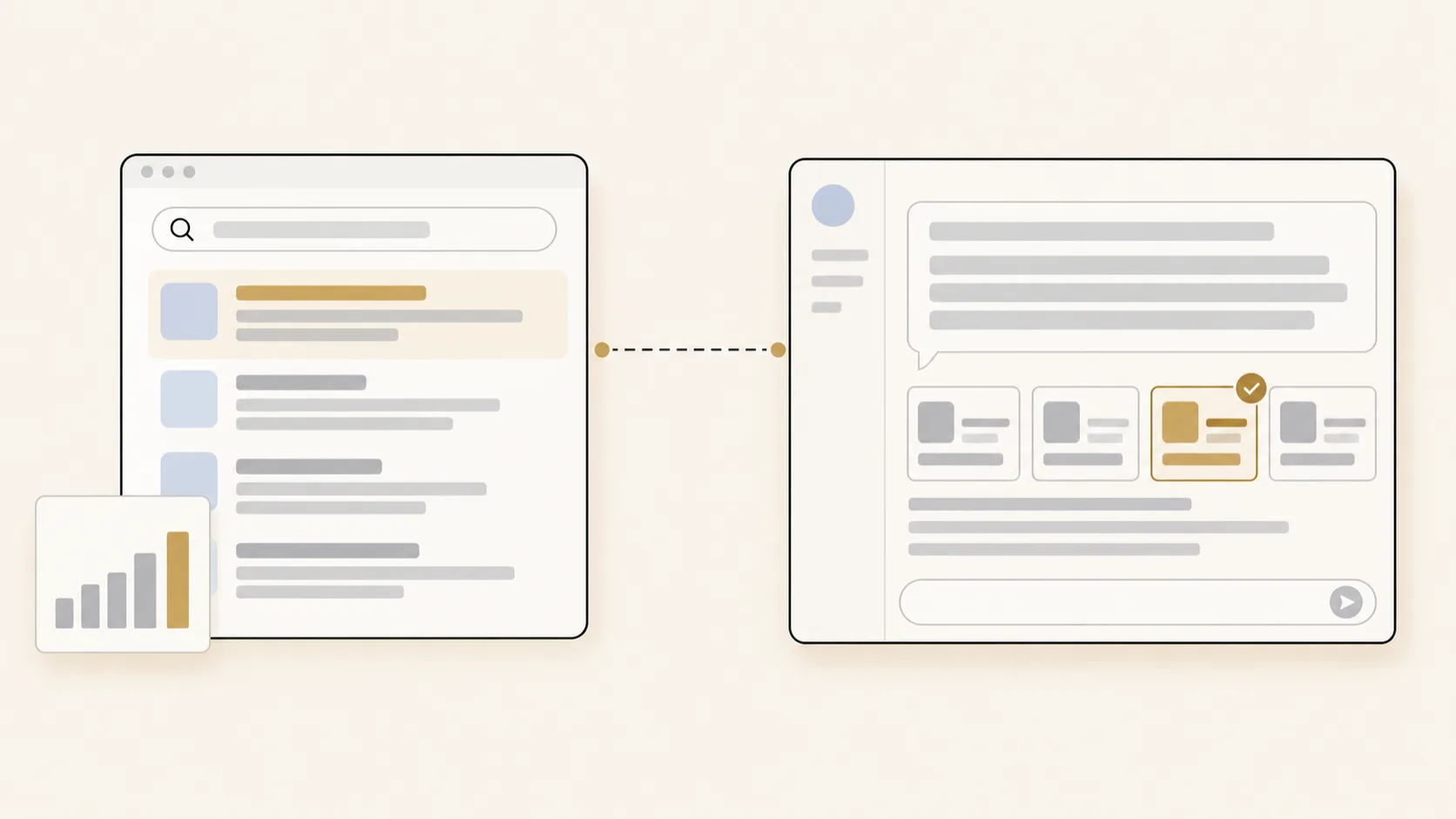
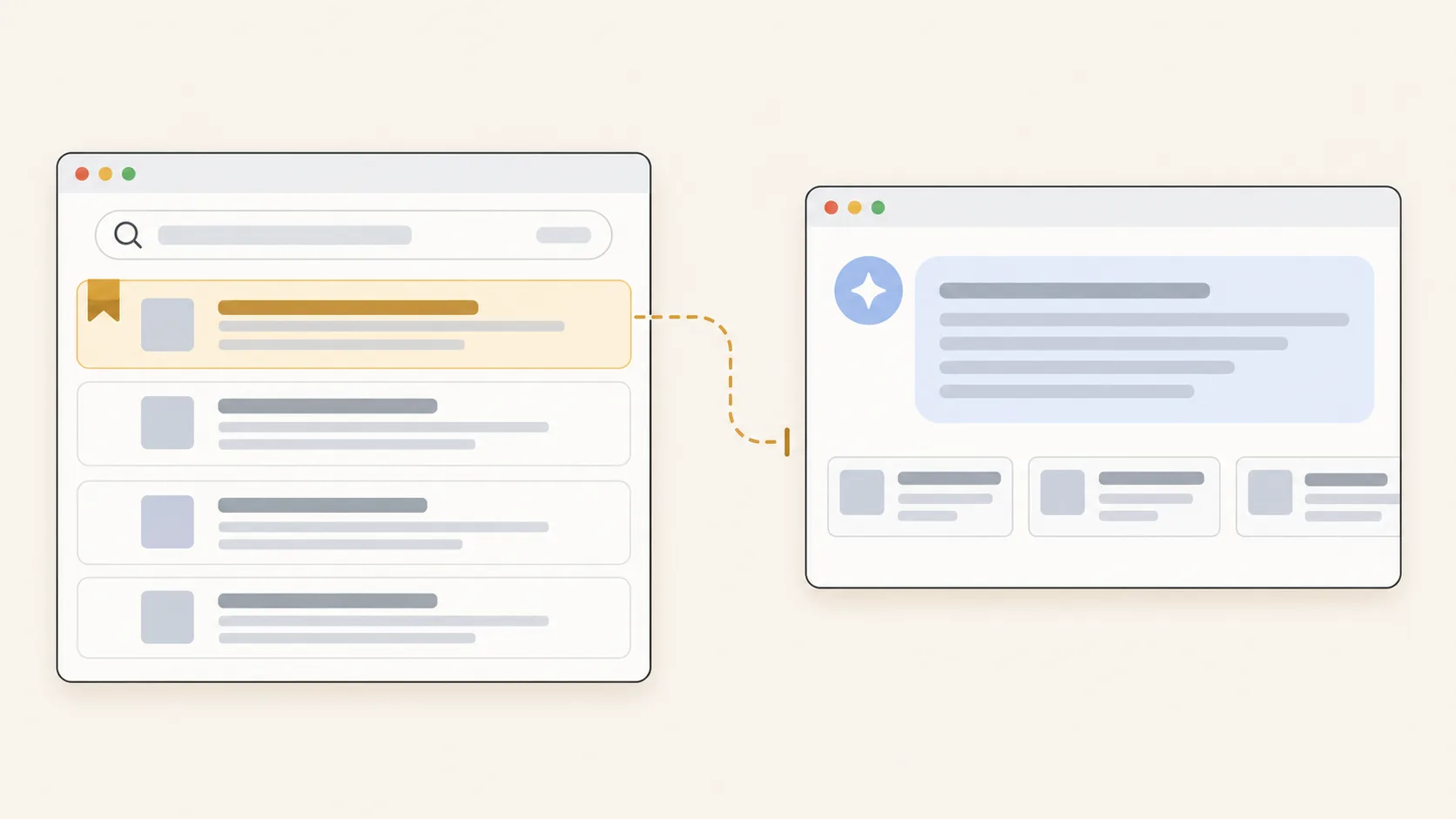
Search engines and AI answer engines both decide what to show you, but they are answering different questions. Google asks which pages best match a query and shows a ranked list of links. ChatGPT, Perplexity and Google AI Overviews ask what the single best answer is, retrieve a handful of sources, and synthesise one reply from the passages they can lift out cleanly. So a page has to be chosen twice: once to be found and ranked, and once to be trusted and clear enough to quote. Ranking first only proves the first.
How a search engine decides what to show
A search engine works in three stages:
- Crawl. Bots visit pages across the web and follow links to find new ones.
- Index. The content of each page is stored and organised so it can be looked up quickly.
- Rank. When a query arrives, indexed pages are ordered by signals such as relevance, authority and usage patterns, and the top results are shown as a list.
What comes out is a list of whole documents. The reader does the joining-up: they open whichever result looks most useful and read it in full, in context, as the author wrote it. That is why a page can rank well simply by being the best single document on a topic, thorough, well linked and built up into authority over time, even if its actual answer sits in paragraph nine under three qualifying clauses.
How an AI answer engine decides what to show
An AI answer engine adds steps after the index, and they change what wins:
- Retrieve. For each question, the engine or its connected search layer pulls a small set of candidate sources, not ten blue links.
- Extract. From each source it pulls out the specific passages or claims that look like they answer the question directly.
- Synthesise. It stitches those passages into one written answer.
- Cite. It credits some of the sources it drew on, and the rest of the web is not shown at all.
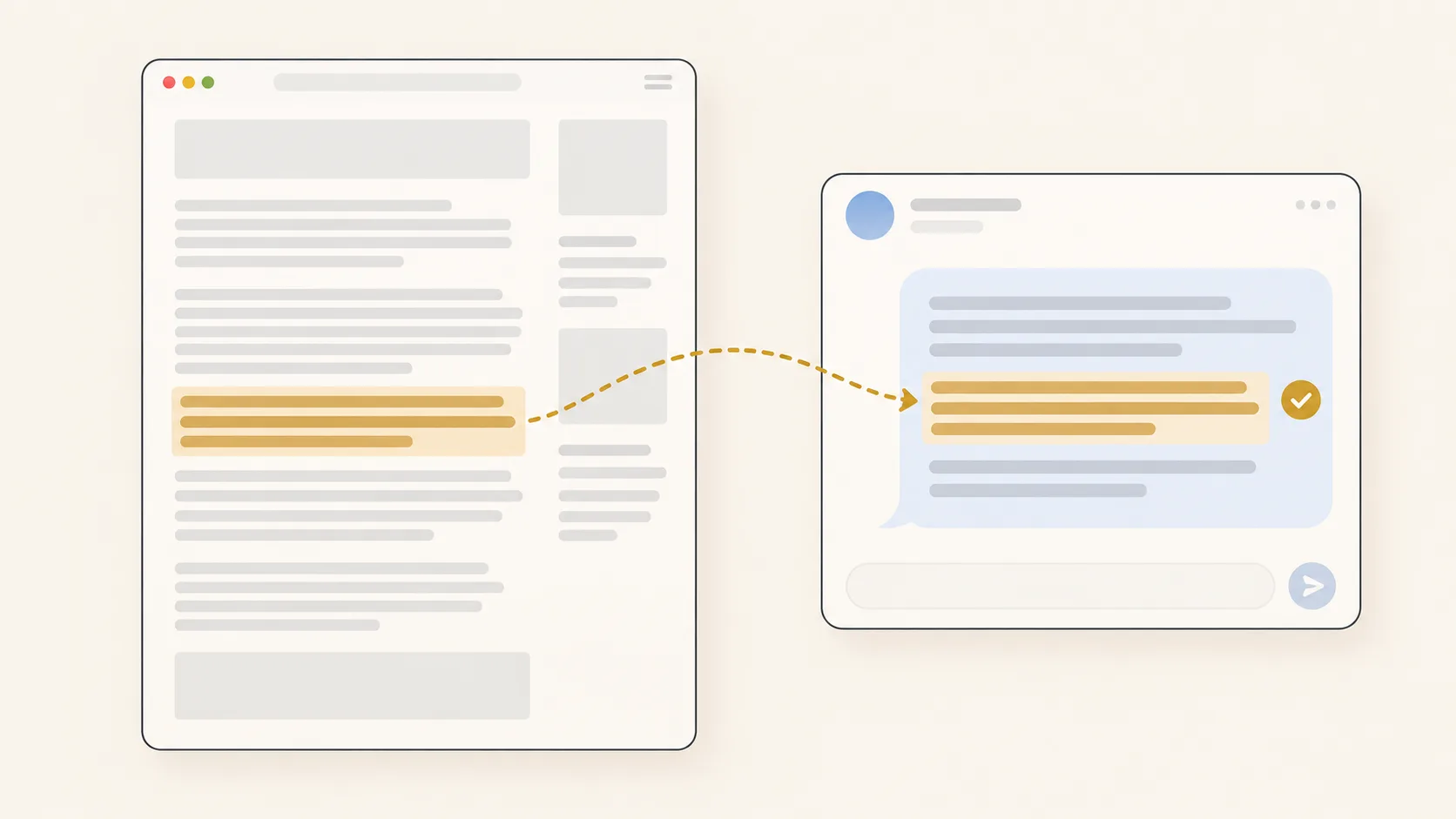
The user rarely sees the original page. They see the fragment that survived extraction. If a page’s key claim is buried, hedged, or stated differently from every other source, that fragment does not survive the stitching, and the engine quotes a page that stated the same fact more plainly, even one that ranks lower.
The two pipelines side by side
| Stage | Search engine | AI answer engine |
|---|---|---|
| Unit it judges | The whole page | A passage or single claim |
| Question it asks | Which pages best match this query? | What is the correct answer, and which sources can state it? |
| What it rewards | Relevance and authority built up over time | A clear, standalone claim that other sources agree with |
| What the user sees | A ranked list of links | One synthesised answer with a few citations |
| Who does the reading | The user | The model |
| What “winning” means | A high position on the results page | Being quoted and cited inside the answer |
Research backs the distinction. In their 2024 KDD paper, Aggarwal et al. tested specific changes to source content, including adding citations to sources, quotations and statistics, and found they could raise a source’s visibility in generative engine answers by up to 40%, even where traditional ranking logic did not explain the outcome (GEO: Generative Engine Optimization).
Why ranking first does not mean getting cited
Both systems can fairly disagree about the same page, because they are aiming at different outcomes. A ranking system rewards depth, link signals and relevance that holds up over time, so a long, authoritative page is exactly what it is built to surface. A retrieval system rewards clarity and ease of extraction at the moment the question is asked, so it will favour a shorter, more direct passage, even from a less established page, if that passage answers the question better.
That is not a flaw in either system. They do two different jobs. A page built only for the first job is, almost by definition, not built for the second, and ranking well on its own will not close that gap. The fix is not a new content strategy but an extra pass that makes each section of a ranking page answer one question plainly enough to be lifted out whole.
What this means for your pages
If you already rank, you have done the first job. To find out whether you are doing the second, check whether AI answers cite your pages for the questions you rank for. Why ChatGPT Ignores Pages Google Loves walks through a page-level audit to find why a well-ranked page is not quoted, and Your Google Rank Does Not Predict Your AI Citations shows how to measure the gap across your site. For the three gaps that most often keep a well-ranked page out of AI answers, see You Rank on Google but You’re Invisible in AI Answers.
CLEO is built to do both jobs at once. It tracks whether AI answers cite you across seven AI engines (ChatGPT, Google AI Overviews, Bing AI Overviews, Perplexity, Gemini, Claude and DeepSeek, with up to four active per site), writes the fixes server-side into your CMS so search and AI crawlers read the same improved page, and measures again at 95% Wilson confidence. For CLEO’s client DisburseCloud, AI citation share moved from 17% to 67% in 90 days (case study). Start with a free Presence Scan to see where AI answers mention you today.